China’s power strategy and America’s digital-currency response: A global order shifting toward the “techno-dollar”

Stefan Schneider brings a dynamic energy to The Economy’s tech desk. With a background in data science, he covers AI, blockchain, and emerging technologies with a skeptical yet open mind. His investigative pieces expose the reality behind tech hype, making him a must-read for business leaders navigating the digital landscape.
Authored On
Modified
Shift from petro-currency to electro-currency
Rise of digital-currency hegemonic competition
Scaling infrastructure and expanding CBDC use

As global electricity consumption shifts toward artificial intelligence (AI), data centers, and electric vehicles, the oil-based “petrodollar” system is showing signs of strain. China has rapidly secured strategic dominance across the entire electricity value chain—from renewable production to ultra-high-voltage transmission, electric vehicles, and batteries—while building the foundations for large-scale digital-currency expansion. The United States, in turn, has begun defending dollar primacy through stablecoins. As electricity becomes the central input to economic activity, the two nations’ monetary strategies now collide across technological, energy, and financial infrastructure, pushing the axis of global currency competition toward electricity itself.
Shift in consumption patterns moves the basis of monetary trust
Electrek, a global EV publication, declared on the 23rd that the age of oil-driven global dominance is ending and identified electricity as the new reserve asset of the 21st century. It argued that future economies centered on AI, automation, and electric transportation rely on one unchanging input—electricity. The outlet noted that “China detected this shift early and mobilized a national strategy,” adding that “the era of the oil-based ‘petrodollar’ is ending, and the era of the electricity-based ‘techno-dollar’ has arrived.”
China’s power strategy is reflected in concrete figures. According to the column, China already met its 2030 renewable-energy capacity target of 1,200 gigawatts (GW) earlier this year and integrated nationwide power allocation under state control through the State Grid Corporation. Amid this, China maintained an average electricity price of just 0.084 dollars per kilowatt-hour (KWh), using differentiated tariffs and heavy subsidies to favor strategic industries. In data centers, electricity discounts of up to 50 percent were offered, with incentives tied to using domestic AI chips—an explicit attempt to use electricity as a policy instrument.
China’s total ban on Bitcoin mining is also viewed as part of a strategy to eliminate competing stores of value in a system where electricity becomes the foundational asset. Electrek editor-in-chief Fred Lambert noted that “Bitcoin consumes massive electricity under its proof-of-work design, creating a decentralized stored value,” arguing that in a system where electricity becomes the reserve asset, Bitcoin represents an uncontrollable “parallel currency.” This aligns closely with China’s push to build a central-bank digital currency (CBDC) and a national blockchain-based payments network (BSN).
Expert assessments point in the same direction. In the August book The Age of Bitcoin: The Wave of Wealth Created by the Winning Currency of the Future, author Changik Kim argues the petrodollar regime is already deteriorating. He stated in an interview: “Global reserve currencies have always been determined by exclusive access to essential resources. In today’s structure, where electricity-purchasing power directly converts to political and economic power, the techno-dollar is no longer an abstract idea.” These remarks frame the discussion not merely as an economic shift, but as a full-scale power competition linking technology, industry, and geopolitics.
Power grids meet financial networks as rivalry intensifies
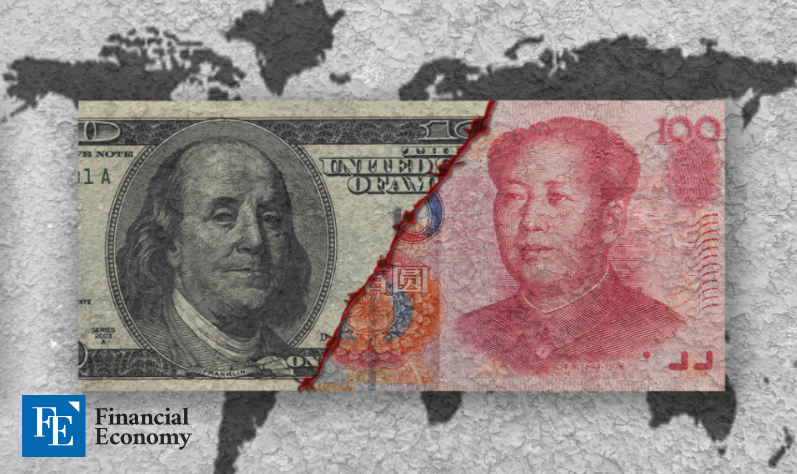
Against this backdrop, markets now view U.S.–China currency competition as shifting from “dollar vs. yuan” to “stablecoins vs. CBDCs.” While China has advanced digital-yuan development and pulled Asian and BRICS members into shared settlement experiments, the United States is moving in the opposite direction—using stablecoins to reinforce dollar dominance. With both strategies tied to electricity-driven economic structures, markets are watching closely to see where the center of international finance will settle as these systems collide.
China began CBDC research in the early 2010s and unveiled the e-CNY in 2019. It functions even without the internet, and cumulative transaction volume surpassed 7 trillion yuan last June. After Russia was cut off from the Western payments system following its invasion of Ukraine, China’s international settlement experiments accelerated. China and Russia jointly proposed a BRICS CBDC settlement system called “BRICS Bridge,” and more than ten countries agreed to test CBDC-based transactions among member states. Markets interpreted this as a move to establish the e-CNY as a shared settlement currency.
The United States responded when President Donald Trump declared that “any country adopting a currency designed to replace the dollar will face a 100 percent tariff,” signaling direct opposition to China’s CBDC expansion. At the same time, the U.S. formalized its strategy of maintaining dollar dominance through stablecoins. Through the “Genius Act,” Washington brought stablecoins into the regulatory perimeter, prompting major banks including JPMorgan and Citibank to enter the market. With even historically crypto-skeptical institutions joining, the U.S. stablecoin strategy is now viewed as the most effective tool for preserving dollar hegemony.
The two nations’ currency strategies differ sharply in technological design. China’s e-CNY is a centrally controlled system in which the central bank directly manages real-time policy transmission. Stablecoins, by contrast, operate through private issuance under public oversight, with the goal of expanding dollar-denominated reserve markets and establishing a private-sector dollar ecosystem for global payments. These differing architectures align with each country’s digital-economic foundations: China integrates currency with state-controlled power and industrial policy, while the U.S. uses private networks and financial infrastructure to expand the dollar ecosystem outward.
The emergence of an “electro-currency system”
The sector that most clearly reflects China’s model of integrating currency with national power and industrial strategy is electric vehicles. China has rapidly strengthened technological and manufacturing capabilities across the EV supply chain, demonstrating the growing influence of automobiles as major electricity consumers. BloombergNEF projected global EV sales to reach 21.9 million units this year, with roughly 67 percent concentrated in China. This expansion signals a structural shift in electricity demand across transportation and industry and reflects the arrival of an electricity-based economic regime.
In batteries—the core anchor of rising electricity consumption—China holds overwhelming advantages in both scale and technology. State-owned automaker GAC Group recently launched a high-capacity solid-state battery production line using dry-processing and a proprietary solid electrolyte, reportedly achieving nearly double the energy density of conventional lithium-ion batteries. Using this foundation, GAC plans pilot installations in 2026 and phased mass production between 2027 and 2030. As electricity becomes the common denominator for value creation across industry and transportation, this trajectory aligns with the techno-dollar concept.
Global market dynamics likewise show the center of gravity in electricity consumption shifting rapidly. China is accelerating EV penetration and global market share, while the United States faces slowing EV momentum due to looser fuel-economy standards, reduced tax credits, and rising policy risk. BloombergNEF cut its U.S. cumulative EV sales forecast for 2030 by 14 million units, noting cases where public fast-charging costs in some regions now exceed gasoline prices. Short-term policy swings could reshape the long-term transition toward an electricity-based value system, highlighting the need for coherent industrial strategy.
Stefan Schneider brings a dynamic energy to The Economy’s tech desk. With a background in data science, he covers AI, blockchain, and emerging technologies with a skeptical yet open mind. His investigative pieces expose the reality behind tech hype, making him a must-read for business leaders navigating the digital landscape.
Similar Post
















