Taiwan Expands Defense Budget Amid Intensifying “Chinese Invasion Threat,” but Personnel, Equipment, and Training Constraints Loom

Siobhán Delaney is a Dublin-based writer for The Economy, focusing on culture, education, and international affairs. With a background in media and communication from University College Dublin, she contributes to cross-regional coverage and translation-based commentary. Her work emphasizes clarity and balance, especially in contexts shaped by cultural difference and policy translation.
Authored On
Modified
GDP 3.3% Allocation to Be Raised to 5%
Defense Against China’s “2027 Armed Unification” Goal
Additional Budget Planned, Massive Procurement of U.S. Weapons
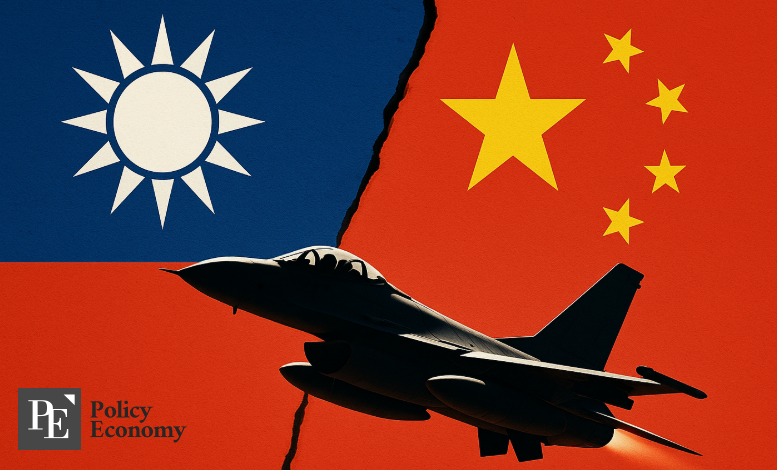
President Lai Ching-te has declared his intent to build a formidable defense posture by expanding Taiwan’s defense budget substantially through 2033. As China’s military pressure on Taiwan intensifies amid escalating Sino-Japanese tensions, the declaration underscores Taipei’s willingness to actively accommodate Washington’s demand for higher defense spending. Yet the surge in expenditures also highlights unresolved structural challenges—fiscal strain, shortages of officers and enlisted personnel, and weak electronic warfare capabilities.
China Threat Spurs Acceleration of “T-Dome” Air-Defense Network
In an op-ed published in The Washington Post on the 25th (local time), President Lai wrote that “China’s unprecedented military buildup, combined with mounting provocations across the Taiwan Strait, the East China Sea, the South China Sea, and the Indo-Pacific, has underscored the fragility of regional peace,” stressing that “China’s intent to alter the status quo through force is becoming increasingly evident.”
Lai stated that by 2026, Taiwan’s joint combat forces will achieve a heightened state of readiness capable of deterring Chinese threats, and by 2033 will establish a comprehensive deterrent-defense posture. He further noted that Taiwan will raise next year’s defense budget above 3% of GDP—aligned with NATO benchmarks—and lift it to 5% of GDP by 2030. Taiwan had previously allocated $294.3 billion (equivalent to 9,495 billion TWD) for next year’s defense budget at 3.3% of GDP, but Lai indicated he intends to expand it further.
He also emphasized that Taiwan will accelerate development of the multilayered integrated defense system known as the “T-Dome,” designed to counter China’s missile, drone, and fighter-jet threats. The plan is to integrate the system with AI-enabled unmanned platforms to create a protective security grid around Taiwan. “We will invest in advanced technologies and broaden Taiwan’s defense-industrial base,” he said, adding, “We will work with like-minded countries to leverage Taiwan’s manufacturing strengths to fortify defense supply chains, expedite deployment of advanced systems, and respond swiftly to emerging threats.”
He further announced, “As part of these efforts, our government will submit a historic $400 billion special defense budget, an investment that underscores our commitment to safeguard Taiwan’s democracy,” noting that “this landmark package will not only support major new weapons acquisitions from the United States but also significantly enhance Taiwan’s asymmetric capabilities.”
Defense Expansion Under Dual U.S.–China Pressure
The announcement came just two days after Chinese President Xi Jinping told U.S. President Donald Trump in a phone call that “Taiwan’s return to China is an important component of the post-World War II international order.” Taiwan has repeatedly signaled its intention to raise defense spending to around 5% of GDP, with Lai reaffirming in August that “China’s threats have grown in recent years” and that Taiwan “hopes to increase defense spending to 5% of GDP in line with NATO standards.”
Taipei’s stance reflects dual pressure: Washington’s insistence on higher defense expenditures and Beijing’s escalating military coercion. China has intensified political and military pressure on Taiwan over the past five years, viewing the democratically governed island as part of its territory. To deter cross-strait conflict, Washington has long urged Taiwan to spend at least 3% of its GDP on defense. During the campaign, President Trump went further, demanding that Taiwan pay “protection fees” to the United States and raise defense spending to 10% of GDP—the U.S. peak defense-spending ratio during the Cold War—arguing that Taiwan should reciprocate by dramatically increasing purchases of American weapons, tantamount to wartime levels.
As Taiwan continued announcing expanded defense outlays, China responded in September by accusing Taipei of allowing “external forces to dictate its defense spending, paying ever-increasing protection fees, and serving as an ATM.” Beijing argued that “Taiwan is recklessly squandering the people’s tax revenue and racing down a dangerous path of military adventurism that cannot buy safety or peace, sacrificing welfare and livelihoods and inviting disaster.” “External forces” referred to Washington’s demands that allies boost their own defense budgets.
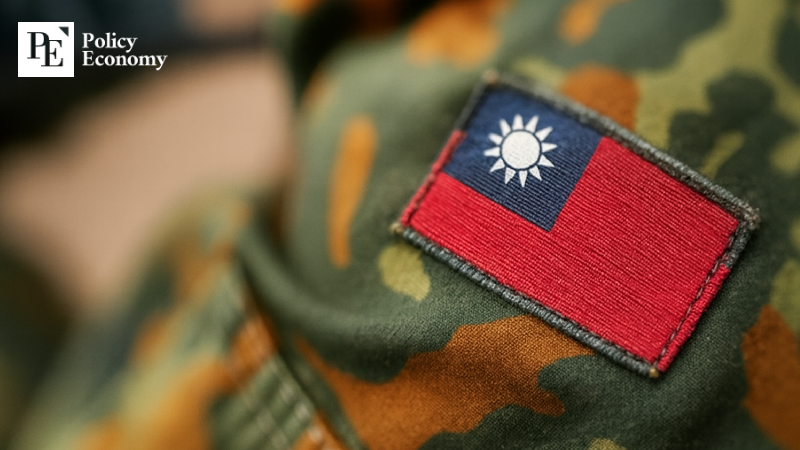
Mounting Challenges: Budget Constraints and Personnel Shortages
Within Taiwan, critics argue that a rapid escalation of defense outlays is unsustainable. Taiwan’s defense budget for this year stands at $200.6 billion (6,470 billion TWD), representing 2.5% of GDP, which totals $816 billion (26,449.3 billion TWD). The figure is up 7.7% year-on-year, marking an all-time high. The share of GDP is similar to that of South Korea (2.5%), a country technically still in a state of armistice, and significantly higher than the 2.1% level when former President Tsai Ing-wen took office in 2016. Defense accounts for 14.9% of Taiwan’s total budget of $93 billion (3 trillion TWD), ranking behind social welfare (26.5%), science and education (19.3%), and economic development (17.2%).
Even with expanded procurement of U.S. weapons, analysts warn that Taiwan lacks not only sufficient troops to operate them but also adequate funding to recruit additional personnel. Taiwan reinstated its one-year conscription system this year, producing its first cohort of discharged soldiers. While the government has lengthened service terms and strengthened training and education programs, challenges remain substantial. The one-year service requirement, abolished in 2018, was revived last year as part of the government’s response to heightened tensions with China and worsening demographic pressures. Authorities have also introduced more rigorous and advanced training, including exercises with Stinger and Javelin missiles, Kestrel rockets, and unmanned drones.
The critical test will come in 2027, when Taiwanese men born after 2004 graduate from university and begin entering the military. The Ministry of National Defense estimates that around 35,000 conscripts will be drafted that year, given that most Taiwanese men complete only a bachelor’s degree. Yet Taiwan lacks sufficient officers to train them. According to the Legislative Yuan’s Budget Center, voluntary enlistment has continued declining, with many combat units operating at less than 80% of authorized officer strength. To address the issue, President Lai raised monthly salaries for all volunteer soldiers to a maximum of $372 (12,000 TWD) in April, but the impact has been limited.
Equipment shortages are also acute. In the first year of the reinstated one-year conscription system, the only equipment used extensively in training was the domestically produced Kestrel anti-tank rocket. Taiwan reportedly lacked sufficient stockpiles of U.S.-made Stinger man-portable air-defense systems and Javelin anti-tank missiles to use them in broad-based training. As a result, soldiers focused more on acquiring theoretical knowledge than hands-on operation. Another longstanding challenge is Taiwan’s isolation from international military theory. Many Taiwanese officers study materials translated through China, inadvertently absorbing PLA doctrines, making it difficult to stay abreast of modern global military trends.
Electronic warfare represents Taiwan’s most critical vulnerability. Modern warfare hinges on control of the electromagnetic spectrum, yet Taiwan has underinvested in this domain. While major military powers have actively integrated space technologies into their defense apparatus since the 1991 Gulf War, Taiwan remains significantly behind in this field. The harsher reality is the sheer scale gap: even if Taiwan were to spend 10% of its GDP on defense, as demanded by President Trump, it would still amount to less than 40% of China’s publicly disclosed PLA defense budget.
Siobhán Delaney is a Dublin-based writer for The Economy, focusing on culture, education, and international affairs. With a background in media and communication from University College Dublin, she contributes to cross-regional coverage and translation-based commentary. Her work emphasizes clarity and balance, especially in contexts shaped by cultural difference and policy translation.
Similar Post