Europe’s Rearmament Drive and “Buy European” Shift Squeeze Korean and U.S. Defense Suppliers

As one of the youngest members of the team, Tyler Hansbrough is a rising star in financial journalism. His fresh perspective and analytical approach bring a modern edge to business reporting. Whether he’s covering stock market trends or dissecting corporate earnings, his sharp insights resonate with the new generation of investors.
Authored On
Modified
Europe Boosts Defense Spending, Driven by Germany
“European-Made First”: Region Moves to Cut Foreign Arms Imports
Korean and U.S. Defense Exporters Face a Shrinking Foothold in Europe
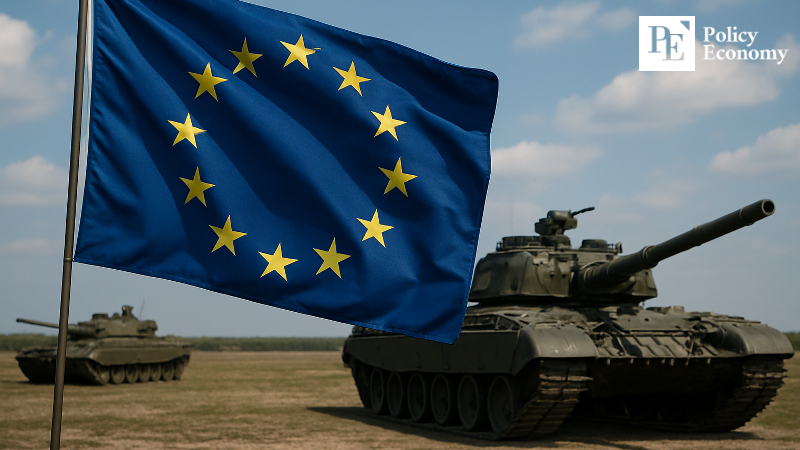
Europe is accelerating its rearmament drive. Since the outbreak of the Russia–Ukraine war in 2022, rapidly shifting geopolitical dynamics have pushed defense buildup to the forefront, with Germany leading a sharp rise in military spending. And as the European Union moves to reduce reliance on U.S. and other non-EU weapons, much of this new demand is expected to remain within Europe’s own defense industry.
Europe Begins Full-Scale Rearmament
On Nov. 26, Defense News reported—citing Israel’s Globes—that Germany is in talks with Israel Aerospace Industries (IAI) to procure additional Arrow-3 missile defense systems. Germany already signed a landmark $3.5 billion acquisition deal last August, the largest defense export contract in Israel’s history. The new round of negotiations reflects Berlin’s push to strengthen long-range defensive capabilities not only for Germany but for NATO forces as a whole. The Arrow-3 intercepts ballistic missiles outside the atmosphere—above 100 km—using a hit-to-kill mechanism, with a range of up to 2,400 km and the ability to neutralize ICBMs carrying nuclear or biochemical warheads.
Germany currently leads the EU’s defense-buildout. Chancellor Friedrich Merz maintains that Europe’s largest economy and population must assume greater security responsibility. Berlin plans to raise defense spending to 3.5% of GDP by 2030, expanding its budget from roughly $55.6 billion last year to about $66.8 billion this year, and to nearly $163.6 billion by 2029—Germany’s highest GDP ratio for defense since the Cold War in 1975.
This surge in defense spending is spreading across Europe. NATO member states are expected to spend $1.5 trillion on defense this year—about 55% of global military expenditures. The European Commission forecasts that EU defense budgets will rise from roughly $367 billion in 2024 to about $408 billion in 2025.
Europe Prioritizes Its Own Defense Supply Chain
Market expectations increasingly point to Europe absorbing most of the new weapons demand generated by its rearmament push. The EU has made clear that strengthening its internal defense supply chain is a strategic priority. Last month, all member states approved the European Defence Industrial Programme (EDIP), agreeing to expand weapons production and support defense-related businesses—including startups—with $1.8 billion in funding through 2027. The bloc also set a target to raise the share of Europe-made defense purchases to 65% by 2035, reducing imports from non-EU suppliers such as the United States and South Korea to 35% or less. Currently, more than 60% of EU military equipment comes from outside the bloc, predominantly from the U.S.
Defense manufacturers across Europe are rapidly expanding production capacity. According to the Financial Times, more than 7 million m² of new defense-industrial facilities are under construction across the continent as of August—triple the pace seen before Russia’s 2022 invasion of Ukraine. The largest expansion is a joint project between Rheinmetall, Europe’s biggest defense contractor, and Hungary’s state-owned N7. A plot in western Hungary’s Várpalota that was farmland in 2022 has already been transformed into a major ammunition and explosives plant, set to enter full operation in July 2024. Rheinmetall expects annual output of 155mm artillery shells to rise from 70,000 rounds in 2022 to 1.1 million by 2027.
Financial markets are also rallying around Europe’s defense sector. According to Deutsche Börse, Rheinmetall’s share price has surged about 200% over the past year. The company surpassed Volkswagen in market capitalization for the first time in March—reaching roughly $60.1 billion—and entered the Euro Stoxx 50 index in June, displacing France’s luxury group Kering. Other major European defense contractors have posted similar gains, with the U.K.’s BAE Systems up 40.4% and France’s Thales rising 58.2% over the same period.
Korea and the U.S. Lose Ground in Europe’s Defense Market
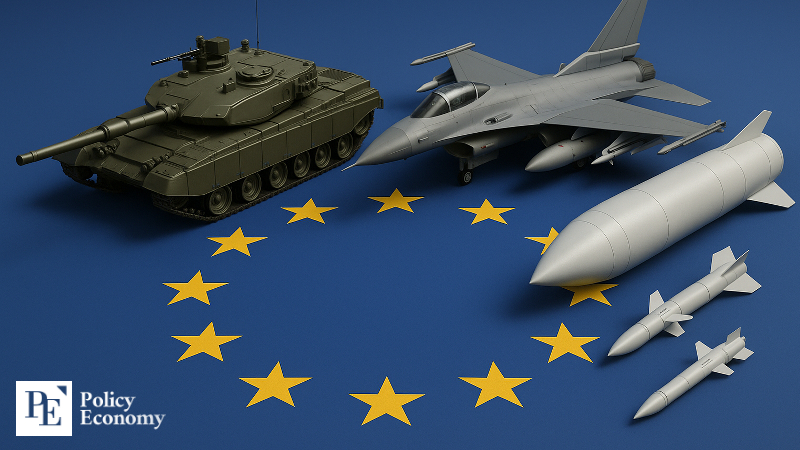
The shifting landscape is eroding the competitiveness of non-European suppliers, with the United States among the most affected. According to a German defense-procurement plan obtained by Politico Europe in September, Berlin intends to rely primarily on European systems for its rearmament. The plan, prepared for submission to the Bundestag’s budget committee, details 154 defense spending items through December 2026.
Germany has allocated only $7.4 billion for U.S.-made systems. This includes roughly $5.5 billion for Raytheon’s MIM-104 Patriot launchers and missiles, and torpedoes for Boeing’s P-8A maritime patrol aircraft priced at about $162 million each. The remainder of the rearmament budget will go to European suppliers: six F-127 air-defense frigates designed by German shipbuilder TKMS for $28.1 billion, and the Eurofighter Tranche 5 from Airbus and its partners for $4.3 billion.
Korea has also suffered setbacks. Seoul failed to win Poland’s “Orka” submarine program—an initiative tied to strengthening security in the Baltic Sea. Hanwha Ocean pitched the Jangbogo-III (Dosan Ahn Chang-ho class) alongside a comprehensive package including a permanent local MRO center, $100 million in local investment, technology transfer, and domestic production. Korea’s Defense Ministry and the Defense Acquisition Program Administration had already agreed to transfer a Jangbogo-class submarine for free as part of expanding defense ties following large-scale exports of K2 tanks, K9 howitzers, and FA-50 light combat aircraft.
However, after a cabinet meeting on the 26th, Polish Defense Minister Władysław Kosiniak-Kamysz announced that Sweden’s Saab had been selected as the preferred bidder. Poland aims to sign a final contract by the second quarter of next year and receive its first vessel around 2030. Saab’s A26 Blekinge-class—marketed as the world’s first “fifth-generation” diesel-electric submarine—features an air-independent propulsion system for extended submerged endurance, low-noise architecture, and a modular mission bay (MMP). Its design is optimized for shallow, acoustically complex waters like the Baltic Sea, aligning closely with Poland’s operational requirements.
As one of the youngest members of the team, Tyler Hansbrough is a rising star in financial journalism. His fresh perspective and analytical approach bring a modern edge to business reporting. Whether he’s covering stock market trends or dissecting corporate earnings, his sharp insights resonate with the new generation of investors.
Similar Post