“East Asia’s Three-Way Rivalry Heats Up” — China’s Southeast Asia Push Gathers Pace, Home Manufacturing Faces Growing Strain

As one of the youngest members of the team, Tyler Hansbrough is a rising star in financial journalism. His fresh perspective and analytical approach bring a modern edge to business reporting. Whether he’s covering stock market trends or dissecting corporate earnings, his sharp insights resonate with the new generation of investors.
Authored On
Modified
China Moves to Dodge U.S. Curbs by Deepening Reliance on Southeast Asia
East Asia’s Three Powers Clash in the Region, Racing for Talent and Contracts
Local Manufacturing Loses Momentum, Raising Red Flags for Jobs
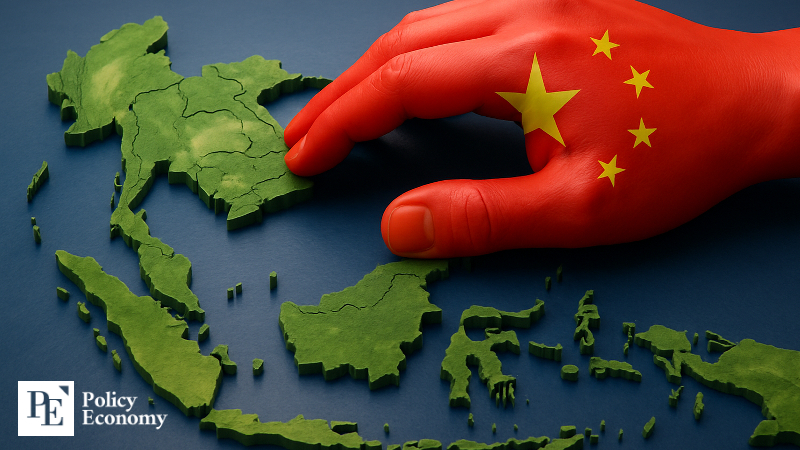
China is accelerating its push into Southeast Asia. To bypass steep U.S. tariffs and tighter tech restrictions, Chinese firms are ramping up exports and investment into the region—challenging Japan and South Korea, which were already deeply entrenched there. Some warn, however, that if this growing reliance on overseas markets persists, it could deepen the strain on China’s manufacturing sector, which is already showing signs of a slowdown.
China Leverages Southeast Asia to Circumvent U.S. Pressure
According to the Financial Times (FT) on the 7th (local time), China’s exports to six Southeast Asian countries—Indonesia, Singapore, Thailand, the Philippines, Vietnam, and Malaysia—totaled $407.0 billion from January to September this year, up 23.5% from $330.0 billion a year earlier. That is roughly double the average annual growth rate of 13% over the past four years. With the U.S. imposing an average tariff of 47% on Chinese goods, China is believed to be using Southeast Asian routes for indirect exports to offset the burden, lifting overall export figures.
Cases are also emerging of Chinese tech companies using Southeast Asia to navigate U.S. restrictions on AI technology. Last month, the FT cited people familiar with the matter as saying Chinese big tech firms such as Alibaba and ByteDance are training their latest large language models (LLMs) at data centers in Southeast Asia. The report added that such offshore training has become more common since the U.S. tightened restrictions in April on sales of Nvidia’s China-focused H20 chip.
Sources said Chinese companies typically lease capacity at overseas data centers owned and operated by non-Chinese firms. This structure is described as legal and not in violation of U.S. export-control rules, because the “diffusion rule” introduced under the Joe Biden administration to curb such workarounds was scrapped after the launch of Donald Trump’s second administration earlier this year. The FT reported that Chinese firms are using Southeast Asian data centers equipped with high-end Nvidia chips not only for AI training but also to provide cloud services to overseas customers, while expanding into data centers in other regions, including the Middle East.
A New Battleground for East Asia’s Three Powers
As China accelerates its push into Southeast Asia, competition among the region’s three major Northeast Asian economies is also intensifying on the ground. For example, China has been pouring large amounts of capital into Vietnam’s Bac Ninh, Thai Nguyen, and Hai Phong—areas densely populated by Korean manufacturers. Cases are increasingly common where local employees trained for years by Korean firms move to Chinese companies offering higher pay. This has fueled wage inflation in the labor market and raised red flags for Korean companies trying to recruit and retain talent.
Japan, meanwhile, is feeling the pressure as China’s vehicle exports to Southeast Asia expand. Drivers who once favored Japanese brands such as Toyota, Honda, and Nissan are increasingly turning to competitively priced Chinese EVs. According to PwC, Japanese automakers’ share of the auto market across six Southeast Asian countries fell to 62% in the first half of 2025, down sharply from an average of 77% in the 2010s.
The three countries are also locked in fierce bidding for major projects promoted by the Vietnamese government. One flagship example is the North–South High-Speed Rail project, Vietnam’s first high-speed rail initiative, designed to link Hanoi and Ho Chi Minh City—a 1,541 km route—in about five hours at speeds of up to 350 km/h. The core project cost alone is estimated at roughly $66 billion, and once surrounding station-area development is included, the total could easily rise into the hundreds of billions of dollars. Korea, Japan, China, and France have all joined the race, and Vietnamese conglomerates—including Vingroup, often dubbed “Vietnam’s Samsung”—have also entered the competition.
The three are also vying in Vietnam’s revived nuclear power program, the Ninh Thuan project, which aims to build two reactors in central Vietnam by 2030 with a total budget of about $18.3 billion. Vietnam initially moved forward in 2009, naming Russia’s Rosatom as the preferred bidder for Unit 1 and Japan Atomic Power Company for Unit 2, before abruptly postponing the project in 2016 due to funding constraints. Now the process has restarted: Rosatom was confirmed as the Unit 1 operator in October, and the current contest is effectively a battle for the Unit 2 contract.
Will the Slump in China’s Domestic Manufacturing Deepen?
The more China leans on Southeast Asia for exports and investment, the greater the risk that growth momentum in domestic manufacturing weakens. China’s factory sector has already struggled for months to escape contraction. According to China’s National Bureau of Statistics, the official manufacturing PMI for November rose 0.2 points from the prior month to 49.2. That matched the median economist forecasts compiled by Reuters (49.2) and Bloomberg (49.3). PMI is a diffusion index where readings above 50 indicate expansion and readings below 50 signal contraction. China’s official manufacturing PMI has stayed below 50 for eight straight months, from April (49.0) through November.
Private-sector gauges point to a similar trend. The November Caixin-style manufacturing PMI published by RatingDog came in at 49.9. The index is based on private surveys rather than government data—previously produced under the Caixin brand and now compiled by RatingDog. In a statement, RatingDog said new orders were essentially stagnant in November, halting growth in output. It added that manufacturers cut both headcount and purchasing volumes and became more cautious in managing inventories.
This trajectory could worsen one of China’s most pressing social challenges: youth unemployment. National Bureau of Statistics data show the unemployment rate for ages 16–24 (excluding students) was 17.7% in September and 17.3% in October. After roughly 12.2 million graduates entered the job market in August, youth unemployment jumped and has remained elevated. With next year’s graduating class expected to hit a record 12.7 million, a prolonged manufacturing downturn could further curb hiring and leave young job-seekers with even fewer openings.
As one of the youngest members of the team, Tyler Hansbrough is a rising star in financial journalism. His fresh perspective and analytical approach bring a modern edge to business reporting. Whether he’s covering stock market trends or dissecting corporate earnings, his sharp insights resonate with the new generation of investors.
Similar Post