U.S. Congress Moves to Curb Troop Cuts in Korea and Europe, Pushing Back on Trump’s Burden-Sharing Drive

Aoife Brennan is a contributing writer for The Economy, with a focus on education, youth, and societal change. Based in Limerick, she holds a degree in political communication from Queen’s University Belfast. Aoife’s work draws connections between cultural narratives and public discourse in Europe and Asia.
Authored On
Modified
U.S. Congress Adds NDAA Curbs on Troop Cuts in Korea and Europe
Trump Team Presses Allies to Shoulder More of the Security Burden
Cutting Overseas U.S. Forces Could Ultimately Backfire
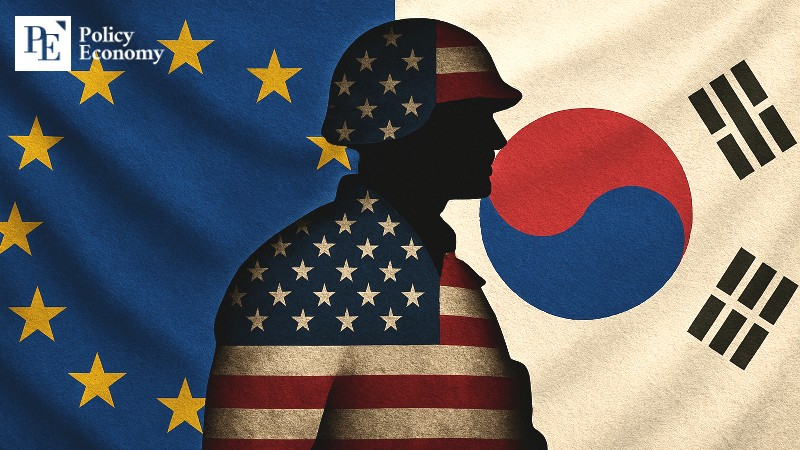
The U.S. Congress has finalized legislation that restricts cutting U.S. troop levels stationed in Europe and South Korea below certain thresholds. As the Trump administration underscores greater burden-sharing from allies and signals the possibility of scaling back overseas deployments, lawmakers have moved to put formal guardrails in place. The decision reflects Congress’s view that maintaining forces in Europe and Korea delivers strategic advantages that outweigh the costs.
U.S. Congress Unveils Final NDAA Package
On December 8 (local time), Fox News reported that Congress finalized the FY2026 National Defense Authorization Act (NDAA) conference agreement the day before. The bill requires the Pentagon to submit advance reports and assessments to Congress before reducing U.S. Forces Korea (USFK) below 28,500 troops. The Defense Department would need to demonstrate that it consulted with allies on any drawdown, that deterrence against North Korea would not be weakened afterward, and that the reduction would not harm U.S. national security.
It also includes a provision barring a cut of permanently stationed or deployed U.S. forces in Europe below 76,000 for more than 45 days. In that case as well, the Pentagon would have to show that the drawdown aligns with U.S. national security interests and that the decision was coordinated with NATO allies. The bill also maintains support for Ukraine and adds provisions aimed at curbing the long-standing practice of presidents conducting overseas military operations without additional congressional approval, citing past Middle East wars as precedent.
In addition, Congress would codify that the United States continues to hold NATO’s top military post, Supreme Allied Commander Europe (SACEUR). This appears to follow recent remarks by U.S. Ambassador to NATO Matthew Whitaker at the Berlin Security Conference, where he suggested he hoped the role could eventually be transferred to Europe—particularly Germany—over the long term. SACEUR is the key position overseeing all NATO military operations, and since the alliance’s founding, it has been held exclusively by U.S. generals for 75 years.
Trump’s “America First” Line
Congress’s move to restrict overseas troop reductions is widely seen as an effort to put a brake on the Trump administration’s direction. In the first National Security Strategy (NSS) of Trump’s second term—released on December 5—the document says the era of the U.S. “carrying the entire world order like Atlas” is over, and that Washington can neither tolerate nor afford “free-riding” through military alliances. The message is clear: scale back U.S. military burdens abroad and press allies and partners to take more responsibility for regional security.
Europe and Korea—explicitly referenced in the NDAA—would be among the first to feel the impact of that approach. Reuters reported on December 5, citing sources including a U.S. government official, that the Pentagon told a European delegation in Washington that Europe should assume responsibility for most of NATO’s conventional defense capabilities by 2027. The report added that U.S. officials warned that if Europe fails to meet that deadline, Washington could stop participating in parts of NATO’s defense-coordination system, such as military planning and force posture arrangements.
A potential USFK reduction has also been repeatedly hinted at by senior Trump officials. In May, after a round of U.S.–Korea defense consultations, Under Secretary of Defense for Policy Elbridge Colby said the way U.S. forces are stationed and deployed in Korea should be recalibrated around deterring China. More recently, Defense Secretary Pete Hegseth said at a press conference following the U.S.–Korea Security Consultative Meeting (SCM) in Seoul on November 4 that the U.S. would need to review options for more flexible force employment to prepare for regional contingencies—remarks widely interpreted as leaving the door open to greater operational flexibility in how USFK is postured and used in response to threats such as China.
Why Korea and Europe Still Matter to U.S. Strategy
If U.S. forces in Europe are cut, it could weaken Washington’s ability to project power—air/sea lift, sustainment, medical support, maintenance, and command-and-control—into the Middle East and Africa, while also shrinking “options” in other theaters. It also risks eroding intangible assets like access, intelligence cooperation, and political backing from allies.
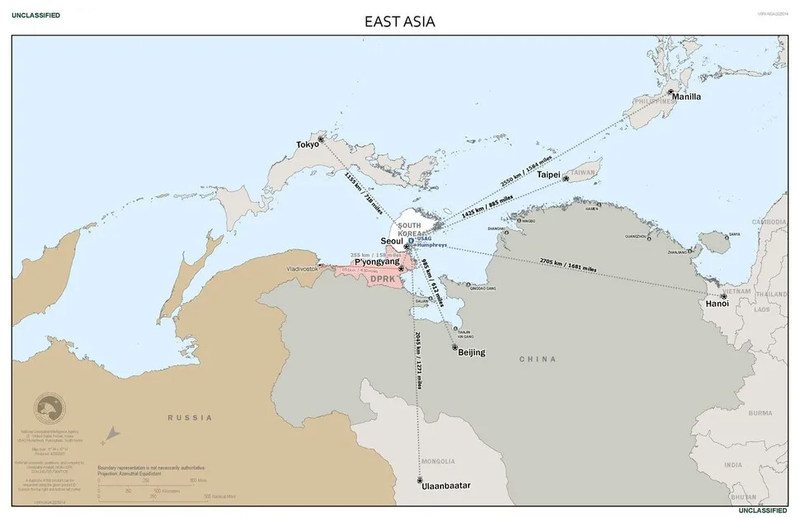
Korea’s strategic value is often illustrated by the “inverted East Asia map” used in U.S. Forces Korea training materials. Centered on the Korean Peninsula, it visually compresses Taiwan and the Philippines near China’s coastline and marks straight-line distances from Camp Humphreys (Pyeongtaek) to key nodes—Taipei (1,425 km), Manila (2,550 km), Beijing (985 km), Tokyo (1,155 km), and Pyongyang (255 km)—reflecting how USFK could be employed under “strategic flexibility” in contingencies such as a Taiwan crisis or a South China Sea clash.
USFK commander Gen. Xavier Brunson has also highlighted the peninsula’s location in this context, citing the “first island chain” (Kyushu–Okinawa–Taiwan–Philippines) and arguing that USFK is not a “distant forward outpost” requiring reinforcement, but forces already positioned inside the defensive line the U.S. would need to penetrate in a crisis. He has likewise said Korea’s geography can constrain Russia’s access to the East Sea and complicate Chinese ground and naval activity in the Yellow Sea, and that—viewed from Beijing—Osan Air Base is not a far-off threat but a nearby platform capable of producing immediate operational effects.
Aoife Brennan is a contributing writer for The Economy, with a focus on education, youth, and societal change. Based in Limerick, she holds a degree in political communication from Queen’s University Belfast. Aoife’s work draws connections between cultural narratives and public discourse in Europe and Asia.
Similar Post