AI-Driven Surge in Demand Sparks Wafer Shortages, Widening Intel-Led Supply Crunch

Niamh O’Sullivan is an Irish editor at The Economy, covering global policy and institutional reform. She studied sociology and European studies at Trinity College Dublin, and brings experience in translating academic and policy content for wider audiences. Her editorial work supports multilingual accessibility and contextual reporting.
Authored On
Modified
Intel grapples with worsening CPU and AI chip shortages
Shift toward server-first production pushes PC prices higher
Wafer constraints ripple across the broader semiconductor ecosystem

Intel has formally acknowledged shortages of central processing units (CPUs) and artificial intelligence (AI) chips, citing misjudged demand forecasts and difficulties securing sufficient wafers. With production capacity increasingly prioritized for server products, upward pressure on PC CPU prices has intensified. At the same time, soaring market-wide demand for AI servers is driving simultaneous spikes in both memory and logic production, spreading bottlenecks throughout the entire wafer-processing chain.
Supply Shortfalls Expose Limits in Intel’s Production Capacity
According to a report by Tom’s Hardware published on the 9th, Intel recently took the unusual step of acknowledging that it cannot fulfill orders for all of its customers, stating, “If we had secured more wafers for the Core Ultra 200 series, we could have shipped substantially more processors.” The company attributed the shortage to conservative capacity planning rooted in inaccurate early demand projections.
The Core Ultra 200 lineup—split into the “Lunar Lake” and “Arrow Lake” platforms depending on application—relies on TSMC’s 3-nanometer N3B process. Because Intel depends on external foundry production for these chips, internal adjustments alone cannot resolve the issue. TSMC’s leading-edge capacity has become effectively inflexible as high-performance computing (HPC) and AI-driven demand surges, leaving virtually no room for additional wafer allocation. As a result, Intel has little ability to revise its short-term production plans and has been forced to prioritize certain customer groups.
Wafer constraints are equally pronounced on Intel’s legacy nodes. Products based on Intel 7 and Intel 10 continue to see strong demand, yet key CPUs such as Raptor Lake and Xeon 6 “Granite Rapids” are simultaneously facing volume pressures. In practice, I/O components for server chips manufactured on the Intel 7 node have been limited by die shortages, restricting datacenter chip output and ultimately reducing client CPU supply while driving prices higher. Intel has indicated it is evaluating pricing adjustments and SKU reallocations, yet industry consensus holds that disruptions on older nodes will remain unavoidable through 2026.
Server Chips Take Priority
Intel previously posted better-than-expected third-quarter earnings, emphasizing a strategic pivot toward datacenter chip production. The company reported USD-equivalent revenue of $13.7 billion, modestly exceeding the market expectation of $13.15 billion USD-equivalent. CEO Pat Gelsinger framed the performance as evidence of strengthened operational discipline, noting that AI is rapidly accelerating compute demand and generating “compelling opportunities across the x86 platform, custom ASICs, accelerators, and foundry services.”
The message underscores Intel’s intention to reinforce its datacenter- and AI-centric revenue model despite mounting supply constraints. With wafer availability limited, Intel has already begun allocating capacity to server chips ahead of client CPUs. CFO David Zinsner added that the current supply limitations are likely to persist for some time. Consequently, client CPU supply is expected to tighten further, and prices for existing products such as Raptor Lake have already shown clear upward movement.
Intel last experienced a significant wafer shortage in 2018, when supply issues extended beyond client processors to Xeon CPUs for servers and workstations. The situation became severe enough that major OEM and ODM partners acknowledged the shortfall publicly. Intel responded by shifting portions of chipset production from 14 nm back to 22 nm while managing internal transitions, yet the fundamental wafer shortage was not resolved quickly.
The parallels to today are difficult to ignore. Whereas the 2018 shortage was exacerbated by a sudden boom in the PC market, the current cycle is driven by AI server demand reshaping wafer allocation priorities, pushing client products to the back of the line. This has led some industry observers to warn that the present shortage may prove even more prolonged. With Intel committed to prioritizing server-chip shipments, relief from rising PC prices appears unlikely in the near term.
Production Disruptions Now Echo Across the Real Economy
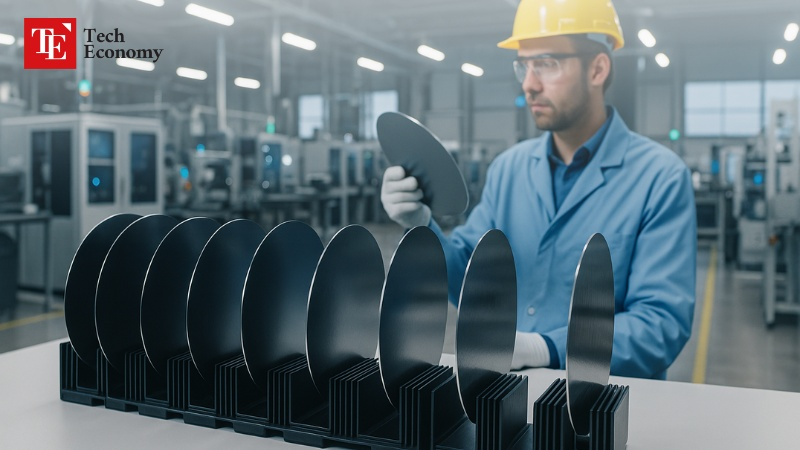
The larger concern is that wafer shortages are no longer confined to Intel alone. Explosive AI server demand is simultaneously straining wafer supply, extreme ultraviolet (EUV) lithography tools, foundry capacity, and packaging operations across the entire semiconductor chain. In particular, high-bandwidth memory (HBM), DDR5, and AI GPUs have become so sensitive to delays at any single step that even minor disruptions can prevent timely market release. Industry analysts increasingly view this as evidence of deep-rooted vulnerabilities in a supply chain being reshaped around AI-driven demand rather than a company-specific setback.
The 300 mm (12-inch) wafer market—shared starting material for DRAM and logic chips—is dominated by a handful of suppliers, including Shin-Etsu Chemical, SUMCO, GlobalWafers, Siltronic, and SK Siltron, which collectively hold more than 80 percent market share. Although these firms announced capacity expansions following the 2021–2022 semiconductor shortage, most new facilities will not reach mass production until 2024–2026. Building fabs, installing equipment, and completing quality certification require years, and additional time is needed before major chipmakers can qualify the output.
Bottlenecks worsen at the leading edge, where EUV lithography systems remain available only from ASML in the Netherlands, with annual supply limited to a few dozen units. Considering that installation can take a year or more from the point of order, chipmakers’ next-generation roadmaps remain constrained by EUV availability. As a result, some memory manufacturers appear more focused on reallocating existing EUV tools within current lines than on expanding both fabs and EUV fleets simultaneously.
Some projections warn that these supply cliffs could persist through 2028. HBM is a particularly heavy consumer of wafers, requiring two to three times more wafer input than conventional memory, thereby amplifying the “cannibalization effect”—fewer chips produced per wafer. One industry source noted that the recent shortages stem from “bottlenecks unfolding across every step of manufacturing—from wafers to substrates, outsourced assembly, and testing.” If resource allocation continues to favor AI servers above all else, the source warned, “prices, launch schedules, and even corporate investment plans across PCs, smartphones, and broad electronics markets could be disrupted simultaneously.”
Niamh O’Sullivan is an Irish editor at The Economy, covering global policy and institutional reform. She studied sociology and European studies at Trinity College Dublin, and brings experience in translating academic and policy content for wider audiences. Her editorial work supports multilingual accessibility and contextual reporting.
Similar Post
















