U.S. home prices fall for the first time in two years, fueling fears of a faster “deflation clock”

Authored On
Modified
Eroding purchasing power and falling sales volumes
Deflation warnings from two years ago begin to materialize
Concerns grow over a consumption-investment slowdown

U.S. home prices have entered a downturn for the first time in two years, prompting assessments that “the delayed correction has finally begun.” After soaring throughout the early 2020s, home prices held firm even through the pandemic-era rate shock and weakening demand. But recent nationwide declines suggest the market is now entering a phase of asset-price adjustment. Analysts say this downturn is an early sign of the deflation warnings raised in 2023, adding that the economy may face a chain reaction of weakening consumption, reduced investment, and diminishing policy effectiveness.
Declines of around 1 percent despite regional divergence
On the 11th (local time), CNBC reported, citing real estate analytics firm Parcl Labs, that U.S. home prices had fallen 1.4 percent over the past three months. This marks the first nationwide decline since mid-2023, when mortgage rates surged into the 7 percent range following the Federal Reserve’s rate hikes. That today’s downturn is occurring during a rate-cutting cycle suggests the decline stems from accumulated erosion in purchasing power rather than short-term supply-demand forces.
The fact that the downturn spans many regions, rather than being localized, reinforces this interpretation. Parcl Labs noted that the surge in home prices during the pandemic had settled into a gradual softening as the market absorbed the shock of high rates. It added that the “purchasing-power shock” caused by soaring interest rates pushed buyers out of the market, reducing transaction volumes and forcing sellers to lower their price expectations, even as rate cuts began. The correction pressure, in other words, has not dissipated.
Inventory dynamics are reinforcing this adjustment. According to Realtor.com, active listings in November rose 13 percent year-on-year, while new listings grew only 1.7 percent. Meanwhile, existing listings were withdrawn at a faster pace, highlighting an imbalance in supply. While the national average decline is around 1 percent, regional differences are stark: Austin fell 10 percent, Denver 5 percent, Tampa and Houston 4 percent, and Atlanta and Phoenix 3 percent. In contrast, Cleveland rose 6 percent, and Chicago, New York, and Philadelphia climbed 3–5 percent.
Some analysts, however, view the adjustment as a normalization process. In a recent report, real estate platform Redfin projected that existing-home sales will rise about 3 percent next year to 4.2 million units. It said rate cuts will gradually filter through, noting that in early 2024 mortgage rates were still in the high-6 percent range. Redfin added that rising wages are beginning to outpace home-price growth, easing the burden on buyers.
Still, interpreting the market remains difficult because several key supply indicators have not been released for months. With data on housing starts, building permits, and new-home sales missing due to the federal government’s shutdown-related reporting gap, major builders have cited weakening demand and the need for expanded sales incentives in recent earnings calls. Despite repeated Fed rate cuts, market sentiment remains tepid, and analysts say a near-term rebound is unlikely. Most expect the market to flatten near zero, oscillating between slight gains and slight declines.
Tariff-driven inflation masked deflationary forces
Experts largely view the recent decline in home prices as the first visible sign that deflation warnings—raised since 2023—are materializing. At the time, falling durable-goods prices, slowing core personal consumption expenditures (PCE), and normalizing supply chains had all pointed toward deflationary risk. Durable-goods prices fell for five straight months in the second half of 2023, and core PCE slowed from 5.5 percent in 2022 to 3.5 percent by October 2023. Walmart CEO Doug McMillon even remarked that “deflation could emerge within months,” as weakening consumer demand put downward pressure on prices.
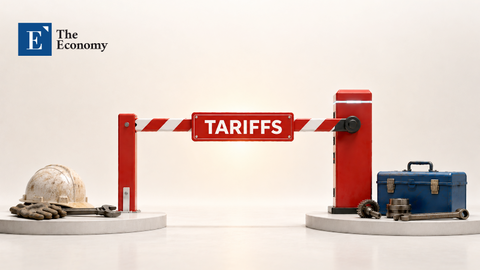
Tariff-driven inflation, however, delayed the shift. As the U.S. imposed successive rounds of tariffs on steel, aluminum, and other goods—and expanded duties on imports from China and Mexico—import prices spiked. JPMorgan estimated that if firms passed through about half of tariff costs, consumer inflation could rise up to 0.6 percentage points. The Peterson Institute for International Economics projected that heightened tariffs on China and Mexico could lift inflation by as much as 0.9 percentage points. These pressures pushed prices back up even as supply chains normalized, delaying the onset of asset-price correction.
Tariffs also eroded real household income, contributing to the delayed adjustment. ING projected that under full pass-through assumptions, tariffs would cost U.S. consumers 835 USD per person and 3,242 USD per household of four. With household budgets squeezed by higher prices, inflation metrics stayed elevated even as underlying demand weakened—slowing the transition into deflationary territory. As a result, analysts now see the recent home-price decline as the surfacing of a “delayed correction” created by tariff-driven inflation.

Broader pressure on economic sentiment and overall activity
Markets are increasingly concerned that the deflation chain reaction is beginning to take hold. If home-price weakness persists, declining household asset values will directly dampen consumption. U.S. consumers already face reduced real purchasing power under high interest rates; adding a housing-market downturn accelerates the decline in spending. Slower consumption then weakens corporate revenues, ultimately triggering cuts in capital investment—a feedback loop characteristic of deflationary environments.
A key concern among experts is diminishing monetary-policy effectiveness. As deflationary pressure rises, households and firms may not respond to Fed rate cuts. Households tend to hoard cash amid heightened uncertainty, while companies maintain cost-cutting postures. This dynamic suppresses real-economic activity. Analysts warn that home-price declines could become a turning point that not only reflects cyclical adjustments but also tightens credit, constrains sentiment, and depresses spending more broadly.
Prominent business leaders and investors have also raised alarms about deflation. Tesla CEO Elon Musk said in an interview earlier this month that “a deflationary era will arrive sooner than most expect,” predicting that advances in artificial intelligence and robotics will sharply lower production costs and intensify downward price pressure. AI-driven automation could push the marginal cost of goods “toward zero,” undermining the effectiveness of monetary policy and accelerating the supply of cheaper goods.
Investor Anthony Pompliano likewise argued that the U.S. economy faces multiple simultaneous deflationary forces, citing aging labor, limits on immigration, and tariffs as demand-suppressing factors while corporate cost structures shrink rapidly. Calling the trend a “deflationary boom,” he said the economy may enter a phase where prices fall while output grows because supply is expanding faster than demand. His analysis suggests that as technology, demographics, and policy shifts converge, a weakening housing market combined with softening real-economy indicators could broaden deflationary pressures across sectors.
Similar Post