EV demand slump rattles Korea–U.S. battery ties, red flags flash for LG Energy Solution and SK On

Authored On
Modified
SK On and Ford to run plants independently after dissolving BlueOvalSK
GM halts LG Energy Solution joint plant as U.S. EV subsidies end
Cooling demand saps growth momentum, putting Korea’s battery industry on alert
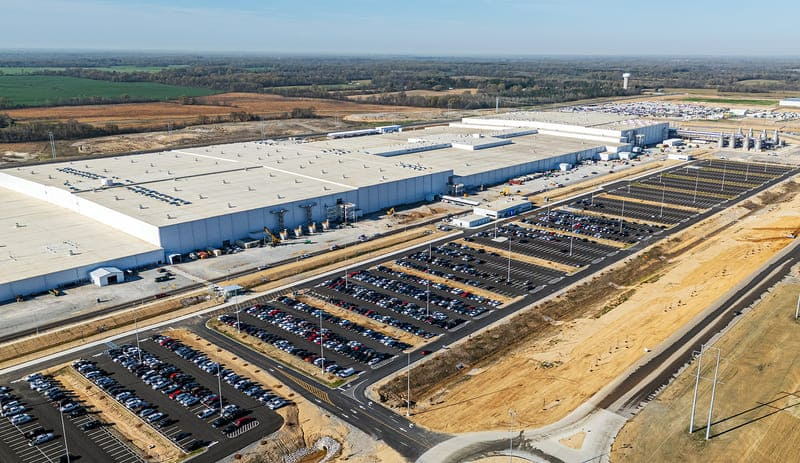
SK On has agreed with Ford Motor to dissolve their large U.S. joint venture and split ownership of the three battery plants they had been building in the country. With U.S. EV demand cooling under the Trump administration’s policy stance, the partnership model between local automakers and Korean battery makers is showing signs of fraying. As growth momentum fades, Korean battery companies are increasingly under pressure from the risk of worsening earnings.
SK On–Ford end battery JV
On the 11th, SK On said it had “mutually agreed with Ford to independently own and operate BlueOvalSK’s production facilities.” The two companies originally launched the U.S. battery joint venture BlueOvalSK in 2022, each committing $5.7 billion, and planned to begin phased mass production from August 2025 at three plants in Tennessee and Kentucky. Under the breakup, Ford will own Kentucky Plant 1 (37 GWh) and Kentucky Plant 2 (45 GWh), while SK On will own the Tennessee plant (45 GWh).
Specifically, Ford will recover its 50% stake in BlueOvalSK through a paid capital reduction. BlueOvalSK’s capital will be cut from about $6.7 billion to about $3.3 billion. Until now, SK On’s U.S. subsidiary SK Battery America and Ford each held 50%. In return for the capital reduction, Ford will take over certain assets, liabilities, and contracts tied to the Kentucky plants held by BlueOvalSK. The assets involved are valued at about $6.7 billion, with no additional cash changing hands. After the deal, BlueOvalSK will become a wholly owned subsidiary of SK Battery America. The agreement is subject to regulatory approvals, with ownership transfers and related steps expected to be completed by the first quarter of 2026.
The brokerage community expects the two companies’ partnership to loosen as a result. KB Securities researcher Wooje Jeon said it was “regrettable” that SK On would lose its near-exclusive status as a key supplier to Ford, noting that SK On’s major customers include Hyundai Motor, Ford, and Volkswagen Group, and that the JV had effectively raised expectations of exclusivity with Ford. He added that, with the JV ending, SK On’s capacity-build target for Ford EV batteries would shift from 127 GWh in 2022 to 82 GWh in 2025, and going forward would move to operating only part of a 45 GWh scale—around 30% to 60% utilization. He also projected that Ford would produce batteries for mass-market EV models at its Kentucky plants, while sourcing batteries for existing and premium EV models from SK On’s Georgia and Tennessee plants.
U.S. EV market cools sharply
Signs of a weakening partnership are also emerging between General Motors (GM) and LG Energy Solution, which jointly operate the Ultium Cells battery plants in Tennessee and Ohio. In October, GM said it would pause production at an Ultium Cells facility for about six months starting Jan. 5. GM also said it would temporarily lay off 850 workers in Tennessee and 700 in Ohio, and place 550 Ohio workers on indefinite layoff. LG Energy Solution has effectively been pulled into the fallout from GM’s ongoing pullback in EV investment.
The Trump administration’s rollback of EV support is widely cited as a key reason the partnership model between U.S. automakers and Korean battery makers is increasingly under strain. Under the One Big Beautiful Bill Act (OB3), which was finalized in July, the federal EV tax credit worth up to $7,500 was ended early from Sept. 30 this year. U.S. EV sales in October fell more than 24% from the previous month, laying bare the market’s adjustment as policy-driven momentum fades.
Many in the market expect demand to be slow to recover, given the administration’s broader policy stance. Consulting firm AlixPartners has said the share of fully electric vehicles in U.S. sales next year could come in at 7%, about half of its earlier 13% forecast. Even by 2030, the U.S. EV share is projected at just 18%—well below forecasts for Europe (40%) and China (51%). Against that backdrop, the scaling back—or breaking up—of battery partnerships by U.S. automakers is being seen as a preemptive move to brace for a prolonged slowdown.
LG Energy Solution in the red, SK On on a knife-edge
Korean battery makers are bracing for a rough stretch. According to FnGuide, LG Energy Solution is expected to post an operating loss of about $15 million in the fourth quarter this year. The hit comes as its biggest customer, GM—accounting for roughly 30% of revenue and an estimated 80% of operating profit—has shifted to a more conservative playbook. GM was the first among LG Energy Solution’s customers to cut orders as the EV downturn deepened (30 GWh in 2025 to 25 GWh in 2026), and utilization at Ultium Cells has already fallen below 30%. As other customers also move to trim inventories, LG Energy Solution’s U.S. shipments of mid-to-large batteries in the third quarter are estimated to have dropped about 50% year on year. The benefit from the AMPC tax credit has also narrowed, falling from about $335 million in the first quarter to about $269 million in the third—down roughly $66 million.
SK On is under similar strain. The company has offset battery losses by expanding beyond batteries, bringing in businesses such as lubricants, refining trading, and petroleum products to keep cash generation intact even as its battery operations remain in the red. In the third quarter, SK On’s battery revenue stood at about $1.32 billion, far below its petroleum business revenue of about $9.26 billion. Battery EBIT was about -$218 million, and after about $127 million in AMPC credits it was adjusted to about -$91 million. Adding petroleum EBIT of about $103 million, SK On narrowly avoided a loss, posting final EBIT of about $12 million.
Industry watchers say that model is not a path to long-term growth. Unless profitability in the core battery business recovers, SK On will struggle to meaningfully ease its underlying financial burden. The company is now eyeing energy storage systems (ESS) as a way to ride out the EV slowdown and revive earnings, but it has yet to secure a dedicated ESS battery production line. So far, the main step has been its first U.S. ESS battery contract in September, alongside a plan to convert part of a Georgia plant line. Production of ESS batteries at the Georgia facility is expected to begin around October next year.
Similar Post