China’s Actual Defense Spending Estimated at $500 Billion, Repeated Provocations Rattle Asia’s Security Landscape

Oliver Griffin is a policy and tech reporter at The Economy, focusing on the intersection of artificial intelligence, government regulation, and macroeconomic strategy. Based in Dublin, Oliver has reported extensively on European Union policy shifts and their ripple effects across global markets. Prior to joining The Economy, he covered technology policy for an international think tank, producing research cited by major institutions, including the OECD and IMF. Oliver studied political economy at Trinity College Dublin and later completed a master’s in data journalism at Columbia University. His reporting blends field interviews with rigorous statistical analysis, offering readers a nuanced understanding of how policy decisions shape industries and everyday lives. Beyond his newsroom work, Oliver contributes op-eds on ethics in AI and has been a guest commentator on BBC World and CNBC Europe.
Authored On
Modified
China’s defense budget contains numerous off-the-books items, making its true scale difficult to determine
Geopolitical tensions intensify as Asian countries accelerate military spending
A series of recent military provocations targeting Taiwan, the Philippines, and Japan

As China accelerates its military buildup, the security architecture across Asia is being rapidly destabilized. Amid growing assessments that Beijing’s actual defense spending far exceeds its official figures, China has continued a string of provocations in the South China Sea, around Taiwan, and in the East China Sea, sharply elevating the risk of clashes with neighboring states. At the same time, an accelerating arms buildup among China’s regional neighbors is further stoking military tensions across Asia.
China’s Defense Budget Approaches U.S. Levels
On the 11th (local time), defense and security outlet RealClearDefense reported that China’s defense spending is far larger than officially disclosed, and that calculating its precise scale is effectively impossible. In March, Premier Li Qiang stated in his government work report to the National People’s Congress that China’s 2025 defense budget would rise 7.2% year on year to $250 billion, equivalent to 1.26% of estimated GDP. According to official data, China’s defense budget expanded 6.8% in 2021, 7.1% in 2022, and has maintained a 7.2% growth rate from 2023 through this year.
Experts note, however, that official figures alone fail to capture the full scope of China’s military expenditure. Off-budget spending—including research and development, overseas weapons and equipment purchases, and military pensions—is excluded, as are the budgets of paramilitary organizations such as the People’s Armed Police and the Coast Guard. The Coast Guard, in particular, plays a central role in executing localized provocations to advance China’s territorial claims in the South China Sea, yet its expenditures are classified separately from defense outlays. In addition, lower labor costs mean China can field more personnel and services than the United States for the same nominal expenditure, further complicating estimates.
As a result, institutional estimates diverge sharply. While China’s official 2024 defense budget stood at $235 billion, the U.S. Senate estimated actual spending at $700 billion. The International Institute for Strategic Studies (IISS) put the figure at $330 billion, while the Stockholm International Peace Research Institute (SIPRI) estimated $317.6 billion. The American Enterprise Institute (AEI) assessed that China’s true defense spending is roughly three times its official figure, reaching parity with U.S. levels as early as 2022. The U.S. Department of Defense has likewise estimated that China’s military spending has grown at an average annual rate of 10.3% since 2001, surpassing $500 billion this year and potentially reaching $1 trillion by 2035.
Singapore, Australia Near 2% of GDP
The sustained expansion of China’s military power is exerting significant pressure on neighboring countries. According to the IISS Military Balance report, China doubled its defense spending between 2020 and 2024. President Xi Jinping has set out objectives to complete military modernization by 2035 and to become the world’s leading military power by 2049, the centenary of the People’s Republic of China. Against the backdrop of intensifying South China Sea disputes and Taiwan invasion scenarios, China’s defense budget is widely expected to grow even faster.
Russia is also rapidly increasing military spending. Ranking third globally in defense outlays in 2024, Russia lags the U.S. and China in absolute terms but is pouring massive resources into troop expansion, nuclear deterrence, and military infrastructure modernization. Since the outbreak of the Ukraine war in 2022, Russia’s defense spending surged 42% year on year last year. Compared with 2020, expenditures have expanded more than fourfold, now exceeding the combined defense spending of all European NATO members. This year, Russia is estimated to have raised defense spending to 7.5% of GDP.
Notably, defense spending among Asian countries is also accelerating. Last year, Asia’s military expenditures rose 7.4% year on year, with defense outlays averaging 1.8% of GDP. Many Asian countries are now approaching or surpassing NATO’s 2% of GDP benchmark. According to SIPRI data, Japan allocated a record-high defense budget last year, pushing spending above 1.8% of GDP, while South China Sea-adjacent states such as Singapore (2.8%) and Australia (1.9%) have also maintained elevated defense-to-GDP ratios.
China’s Provocation in the West Sea Joint Management Zone
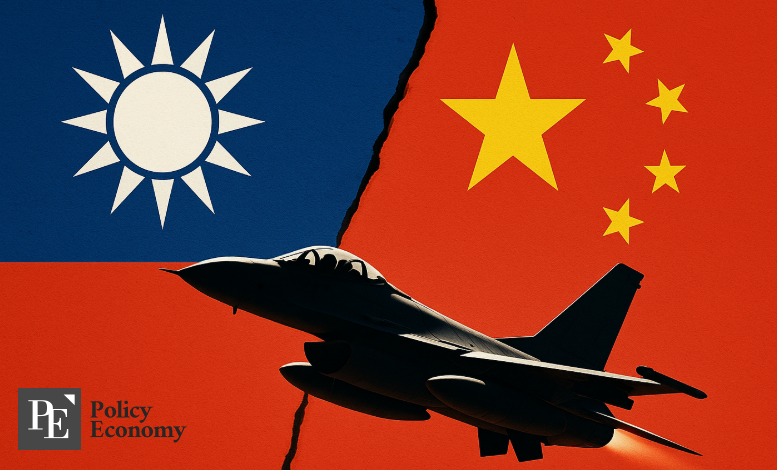
Geopolitical tensions in the South China Sea have intensified markedly in recent months. In August, the Chinese military deployed 111 aircraft—including fighter jets, early-warning planes, and drones—along with 12 warships and six government vessels in a 48-hour exercise around Taiwan. During the drills, 85 Chinese military aircraft entered Taiwan’s Air Defense Identification Zone, with some drones flying from northern Taiwan down to Hualien in the central region and Taitung in the south. Jie Zhong, a researcher at Taiwan’s Association of Strategic Foresight, noted that China has conducted more than 30 drills of similar scale this year alone, adding that “combat-oriented exercises premised on Taiwan attack missions are increasing sharply.”
China has exerted even more overt military pressure on the Philippines. In October, Chinese Coast Guard and maritime militia vessels blocked Philippine resupply ships near Second Thomas Shoal, using water cannons and other shows of force. Although the Philippines maintains effective control over the disputed area, China has persistently applied “gray-zone tactics” to intensify pressure. The incident was widely viewed as a military response to joint exercises involving the Philippines, the United States, and Japan, prompting U.S. Indo-Pacific Command to characterize the episode as “a series of Chinese maritime provocations” and to signal a firm response.
The risk of military confrontation between China and Japan is also rising. Bilateral tensions, initially sparked by Japanese Prime Minister Sanae Takaichi’s remarks describing Taiwan as a matter of Japan’s “existential crisis,” have increasingly spilled into the military domain. The most recent incident occurred on the 6th in international waters near Okinawa. According to Japan’s Ministry of Defense, a J-15 fighter launched from the Chinese aircraft carrier Liaoning twice attempted radar targeting of a Japanese Air Self-Defense Force F-15 over a 30-minute period. Defense Minister Shinjiro Koizumi convened an emergency press briefing, condemning the Chinese military’s actions as “extremely dangerous” and lodging a strong protest with Beijing.
South Korea has not been immune to China’s actions. On the 10th, the Center for Strategic and International Studies (CSIS) reported that although South Korea and China agreed under a 2001 fisheries accord to jointly manage a Provisional Measures Zone (PMZ) in the West Sea, China has since 2018 installed 13 buoys, two aquaculture facilities, and an integrated management platform within and around the PMZ without prior consultation. CSIS released photographs of 16 Chinese structures detected in and around the PMZ between February 2018 and April this year, urging the United States to respond forcefully, describing the moves as China’s “incremental expansion of sovereignty” targeting Indo-Pacific allies and a textbook example of gray-zone strategy.
Oliver Griffin is a policy and tech reporter at The Economy, focusing on the intersection of artificial intelligence, government regulation, and macroeconomic strategy. Based in Dublin, Oliver has reported extensively on European Union policy shifts and their ripple effects across global markets. Prior to joining The Economy, he covered technology policy for an international think tank, producing research cited by major institutions, including the OECD and IMF. Oliver studied political economy at Trinity College Dublin and later completed a master’s in data journalism at Columbia University. His reporting blends field interviews with rigorous statistical analysis, offering readers a nuanced understanding of how policy decisions shape industries and everyday lives. Beyond his newsroom work, Oliver contributes op-eds on ethics in AI and has been a guest commentator on BBC World and CNBC Europe.
Similar Post