U.S. secures mineral access in Congo through a combined model of peace, infrastructure, and sanctions

Authored On
Modified
Mining access secured in exchange for security support
Peace mediation, stability, and national reconstruction as justification
A recurring model linking capital injection to resource access
The United States has moved to secure access to critical minerals in the Democratic Republic of the Congo by forging a partnership that combines peace mediation, security stabilization, and infrastructure investment, marking the emergence of what can be described as an era of “resource security alliances.” Under the banner of sanctions enforcement and control over armed groups in conflict zones, mining operations are being folded into formal regulatory frameworks, allowing Washington to secure access to the extraction, transport, and investment rights tied to key minerals such as cobalt and coltan.
Mining rights exchanged for infrastructure support
On the 14th, resource-focused outlet Discovery Alert reported that global diplomacy has entered an era of “comprehensive resource security alliances,” in which national security, infrastructure development, and public order are negotiated as a single package. The publication described the partnership between the United States and the Democratic Republic of the Congo as a signal of this shift, calling it a clear example of the strategic cards Western countries are now playing to pull Global South nations away from China’s sphere of influence.
In exchange for guaranteed access to cobalt, coltan, and other critical minerals central to next-generation industries, the United States has pledged massive infrastructure investment and security support to the DRC. A key feature of this approach is the shift from spot-market purchases toward formal institutional integration. Rather than allowing volumes and prices to be set entirely through open markets, governments are tying long-term supply contracts to infrastructure investment, with access rights preferentially allocated to partners. The objective is to ensure a stable flow of minerals critical to battery and semiconductor supply chains, while creating a system in which Western firms and markets gain priority access within a regulated framework.
Infrastructure packages serve to lock in these access rights over the long term. The Grand Inga hydropower project, frequently cited as a symbol of the partnership, carries an initial investment cost exceeding $10 billion and is expected to generate 43,200 megawatts of electricity once completed. While framed as a solution to chronic power shortages and a catalyst for regional economic recovery, the project also lays the energy foundation required for mining, processing, and transport, effectively turning mineral production into a predictable industrial activity. The parallel focus on transport infrastructure such as the Lobito Corridor, which links ports to inland mining regions, reflects the same calculation.
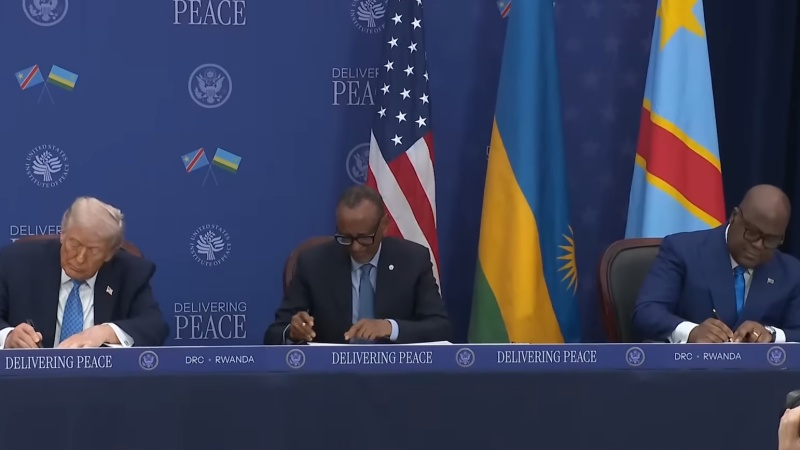
Former U.S. President Donald Trump’s direct mediation of a peace agreement between the DRC and Rwanda also fits into this broader pattern. At the signing ceremony earlier this month, Trump emphasized the symbolic significance of ending the conflict, calling it a “great day.” Major media outlets, however, interpreted the move as part of a broader effort to reduce instability in eastern Congo and improve the investment environment for resource development. The conflict in the region has persisted for more than three decades, allowing armed groups to seize control of areas rich in cobalt, coltan, and lithium, fueling illegal mining, smuggling, and chronic supply instability.
A phased structure of resource control
As a result, Washington’s peace mediation is widely viewed not as an end in itself, but as preparatory groundwork to ensure stable execution of infrastructure investment and mineral access rights. Under the banner of national reconstruction, security and infrastructure are being bundled to restructure the governance of resource management. The United States has framed armed groups and illegal mining networks as both security threats and international criminal enterprises, using the restoration of order as justification for intervention and signaling an intent to bring mining activities under institutional rules rather than pure market forces.
Sanctions have played a central role in this process. From 2022 to 2024, the U.S. Treasury designated the armed group PARECO, which controlled the Rubaya coltan deposits in eastern Congo, for illegal mining, forced labor, and civilian executions, imposing asset freezes and transaction bans. The sanctions were extended to local mining firm CDMC and Hong Kong trading companies Eastrise and Star Dragon for purchasing and distributing the minerals. These measures effectively shut down mining sites and supply routes controlled by armed groups, pushing mineral flows into channels governed by state authority and international agreements.
Behind the scenes, the United States also engaged in negotiations with the Congolese government to formalize a trade-off linking minerals and security. The DRC sought military support and security cooperation in exchange for allowing U.S. companies to invest in mining operations, a deal Washington framed as part of an effort to end civil conflict and build sustainable peace. In interviews with local media, DRC President Félix Tshisekedi openly suggested that granting U.S. firms access to mineral extraction and processing was tied to expectations of enhanced defense and security capacity, underscoring how peace mediation and military assistance functioned as institutionalized exchange conditions for mineral access.
In this light, U.S. engagement in Congo goes beyond a diplomatic event, serving as a calculated prelude that enabled the formal integration of mining into regulated systems. Sanctions targeting armed groups and illicit trade networks, combined with intergovernmental agreements linking infrastructure and security support, have shifted mining from a byproduct of conflict to a strategic asset governed by international rules and contracts. Peace mediation, public order, and national reconstruction have effectively functioned as the narrative framework surrounding this transition.

Expanding the “stockpiling strategy” to allies
Cooperation with the DRC signals that the United States is elevating resource diplomacy from ad hoc responses to a standing strategic framework. Rather than limiting efforts to bilateral arrangements, Washington aims to restructure supply chains for rare earths and critical minerals long dominated by China. The U.S. government has explicitly defined strategic minerals as foundational infrastructure for semiconductors, defense, and aerospace industries, placing global supply chains within the realm of national security assets. The Congo case illustrates how this shift in perception has moved into an execution phase that mobilizes diplomacy and fiscal tools in tandem.
The scale of financial commitments underscores this intent. Last month, U.S. Export-Import Bank President John Jovanovich said that the United States and its allies would invest $100 billion to strengthen supply chains for critical minerals, nuclear power, and liquefied natural gas, adding that without stable access to fundamental raw materials, none of Washington’s broader objectives could be achieved. The funding includes a $4 billion credit guarantee to support natural gas supplies to Egypt and a $1.25 billion loan for Pakistan’s Reko Diq mining project.
Financial markets have been closely watching these moves. As the Trump administration designated rare earths, lithium, and uranium as strategic resources while easing regulations and expanding investment, related commodities rallied sharply. Exchange-traded funds focused on rare earths and strategic resources recorded gains of up to 60 percent in the second half of the year alone, reflecting market expectations that U.S. policy direction had been priced in. The U.S. Department of Defense has also signaled its willingness to act directly as a market participant by acquiring a stake in rare earth producer MP Materials, becoming its largest shareholder.
This trend is now extending to companies in allied countries. A prominent example is the ongoing discussion surrounding a potential equity investment in Korea Zinc. The U.S. government has reportedly discussed plans for defense-related investors to acquire a stake via a third-party capital increase, partnering with the company to build a strategic mineral smelting facility in the United States with an investment scale equivalent to roughly $6.9 billion. Given the challenges of rebuilding domestic supply chains amid environmental regulations and profitability constraints, Washington appears intent on leveraging Korea Zinc’s world-leading hydrometallurgical expertise. The move underscores how U.S. resource diplomacy is hardening into a repeatable model rather than remaining an exceptional, region-specific choice.
Similar Post