“Neither Chinese nor European arms look reliable”: India–Pakistan clash deepens market turmoil, with South Korea tipped to benefit

Authored On
Modified
China’s J-10C falters in maneuvering against India’s Rafale fighters
In May, Rafales were reportedly downed by Chinese-made jets and missiles
Global arms demand looks for new suppliers, with some shifting toward South Korea
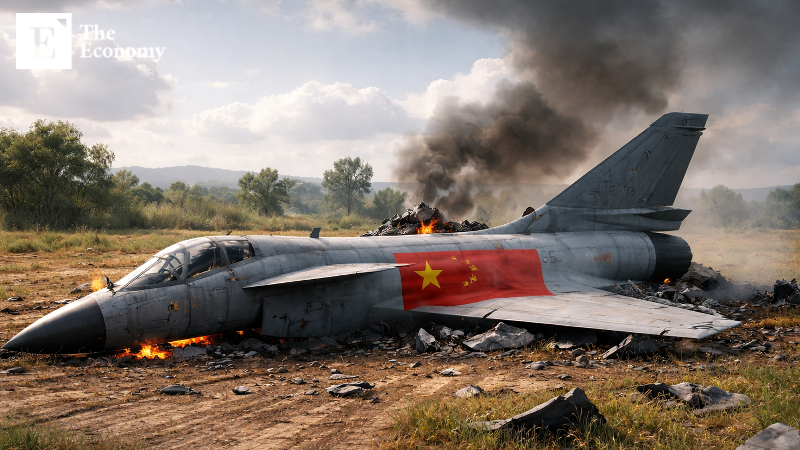
The competitive landscape in the global defense market is shifting. Chinese-made weapons, which had been capturing demand for military build-ups with aggressive pricing, are once again facing performance questions—while confidence in European systems often seen as alternatives is no longer as solid as it once was. Some experts say South Korea, a U.S. ally known for offering capable weapons at relatively competitive prices, could emerge as a new beneficiary.
Pakistan’s China-armed air force, air defenses breached
On the 14th (local time), India’s Zee News reported that “India’s Sindoor operation shattered the illusion of China’s defense industry,” claiming that countries are canceling procurement deals after Chinese-made weapons appeared ineffective in real combat, contrary to Pakistan’s messaging. Pakistan’s air force has actively brought in China’s J-10C fighter and promoted it as a “Rafale killer” that could overpower India’s frontline French-made Rafale. The J-10C is a platform developed with design elements drawn in part from the U.S. F-16 and technologies associated with Russia’s Su-30.
However, sources said Pakistani J-10C formations failed to carry out even basic counter-maneuvers as the Indian air force carried out precision strikes during the Sindoor operation. Local military analysts suggested pilots may have abandoned interception under pressure from India’s electronic-warfare capabilities and the Rafale’s long-range detection, or that a system fault caused them to miss the takeoff window. Satellite images released by India later showed terrorist camps inside Pakistan destroyed by precision strikes—evidence, the report argued, that Pakistan’s air defenses were penetrated and that China-made air-defense systems and fighters that formed the backbone of that network failed to perform as intended.
Questions about the performance of Chinese weapons have circulated for years. A frequently cited example is the DF-21D anti-ship ballistic missile, a ballistic missile with a range of about 2,500 kilometers that is designed to strike aircraft carriers using satellite-based targeting. In response, the U.S. has developed capabilities aimed at disrupting the satellites that serve as the “eyes” for such systems. In 2020, the U.S. announced that, for the first time since establishing the Space Force, it had achieved initial operational capability (IOC) for its first offensive weapon, CCS Block 10.2—meaning the system had reached a basic level of operational readiness.
The U.S. military has described CCS as a system that “disrupts adversary satellite communications in both directions.” It is designed not only to interfere with satellite phone and data links, but also to jam telemetry signals between missiles and ground control stations. In effect, it could block signals sent from Chinese reconnaissance satellites to command centers, as well as commands sent to adjust satellites’ orbits for tracking a U.S. carrier. If CCS is used, the report said, China would be unable to track carrier positions in real time—making it difficult to launch the DF-21D accurately, and potentially rendering the system far less effective.
European weapons’ footing also wobbles
Growing distrust of Chinese-made weapons is reshaping the global arms market, with China’s push into emerging markets on “value for money” now running into headwinds. As accusations resurface that many Chinese systems are built on illegal copying and modification of Western and Russian technology, doubts are also rising over after-sales support and the reliability of spare parts.
Some countries have reportedly paused talks to acquire Chinese fighters or begun looking to switch to Western alternatives. Bangladesh, which was said in October to be considering buying around 20 J-10Cs, is now reported to have signed a letter of intent for the Eurofighter Typhoon, developed jointly by Germany, the UK, Italy, and Spain. Several countries in Africa and the Middle East are also said to be re-examining plans to bring in Chinese fighters.
The problem is that confidence in Western—especially European—systems seen as alternatives is not exactly rock-solid either. During the India–Pakistan border clash in May, reports surfaced that India’s latest Rafale fighters were shot down by Chinese-made aircraft and missiles. India deployed 72 aircraft to Pakistan’s 42, yet still failed to respond effectively despite the numerical advantage.
Some analysts, however, argue the outcome had more to do with an intelligence failure than with the fighter’s performance. Reuters reported in August, citing two Indian officials and three Pakistani sources, that India misjudged the range of China’s PL-15 missile—an error seen as decisive in the Rafale losses. Indian pilots reportedly believed the missile’s range was around 150 km, when it was in fact more than 200 km. Reuters said the clash unfolded as beyond-visual-range (BVR) engagements without either side crossing into the other’s airspace, and that the Rafales might not have been downed had India accurately assessed the PL-15’s reach.
Korea’s defense industry taps demand in the Middle East
As the established competitive order in the arms market begins to wobble, experts are pointing to South Korea as a likely beneficiary of the turmoil. Timothy Heath, a senior researcher at the U.S. nonprofit policy think tank RAND Corporation, said Korea is “in a good position” because it is a U.S. ally yet offers high-quality equipment at lower prices than U.S. or European options. Bence Nemeth of King’s College London also said Korea is highly attractive to Middle Eastern buyers because it can offer performance comparable to Western systems at a lower cost and is flexible on technology transfer.
Korean weapons also drew meaningful attention at last month’s Dubai Airshow, the Middle East’s largest defense event. Korea Aerospace Industries (KAI) showcased models of its 4.5-generation KF-21 fighter and FA-50 light attack aircraft, and the United Arab Emirates (UAE) expressed interest in the KF-21. A senior UAE air force official later visited Korea, and the two sides reached a cooperation agreement worth $15 billion covering joint weapons development, local production, and exports to third countries.
Hanwha Aerospace and the UAE’s EDGE Group also signed a memorandum of understanding. Under the deal, the two companies will prioritize co-developing an AI platform to be applied to smart radar and autonomous unmanned ground vehicles (UGVs). In addition, Hanwha plans to support upgrades to the UAE’s layered air-defense network and help establish an integrated air-defense MRO center, while expanding shipbuilding cooperation with the UAE’s state-run shipyard ADSB—ranging from repairs of large commercial vessels to joint development and production of unmanned ships, and the design and construction of large warships.
Similar Post