“Sharper performance, broader use cases”: Google’s Gemini 3 closes in on ChatGPT, OpenAI fires back with new models and Disney deal

As one of the youngest members of the team, Tyler Hansbrough is a rising star in financial journalism. His fresh perspective and analytical approach bring a modern edge to business reporting. Whether he’s covering stock market trends or dissecting corporate earnings, his sharp insights resonate with the new generation of investors.
Authored On
Modified
Google’s “Gemini 3” rapidly gains ground, prompting OpenAI to move up the release of “GPT-5.2”
As the generative AI race heats up, Google holds an edge when model performance is broadly comparable
OpenAI steps up its counterplay, from a Disney licensing deal to an intensified talent push
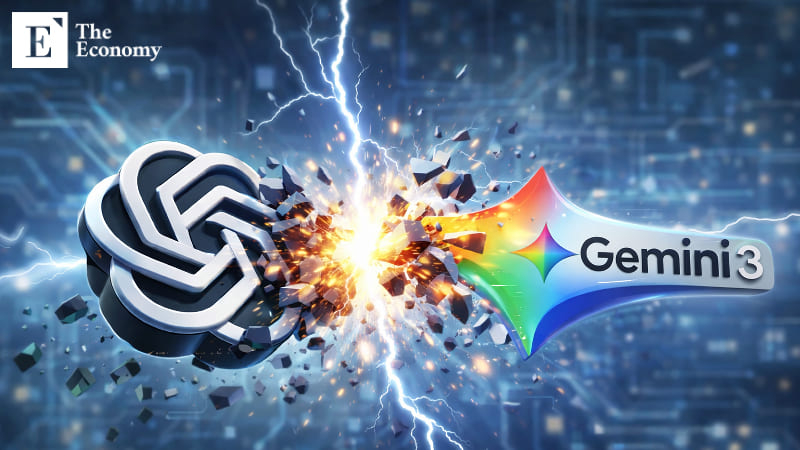
OpenAI, the developer of ChatGPT, is facing a growing challenge to its once-dominant lead in the generative AI market. Google’s latest model, “Gemini 3,” released last month, is closing in fast—pairing sharper performance with the reach of Google’s broader ecosystem and reshaping the competitive landscape. In response, OpenAI is moving to shore up its position, pursuing measures such as a partnership with Walt Disney and recruiting talent with Google backgrounds.
Google’s Gemini 3 shakes up the field
According to traffic analytics firm Similarweb on the 15th (local time), ChatGPT’s share of global generative AI traffic—once as high as 87% a year ago—had fallen to 71.3% as of early this month. Over the same period, Gemini’s share jumped nearly threefold, from 5.7% to 15.1%. With the release of Gemini 3 last month, Google has strengthened its competitiveness on both performance and accessibility, and the market’s competitive landscape is beginning to shift.
Sensing the pressure, OpenAI moved quickly to raise the intensity of its response. CEO Sam Altman declared an internal “code red” and accelerated the launch of its next model, “GPT-5.2,” ahead of schedule. It came just a month after the release of “GPT-5.1.” Unveiled on the 11th, GPT-5.2 is positioned as a model with stronger capabilities for specialized knowledge work, adding a “Pro” mode to the existing “Instant” and “Thinking” modes. The aim is to regain a technical edge by reducing hallucinations in expert domains and strengthening reasoning. OpenAI said GPT-5.2 scored 74.1% on “GDPval,” which evaluates performance on professional industry tasks, and reached 80% on software engineering—outperforming Gemini 3 Pro.
Still, major benchmarks and real-world indicators suggest GPT-5.2 and Gemini 3 are effectively on par. On the “LM Arena” leaderboard, where users rank models through direct comparisons, Gemini 3 currently holds first place in an overall evaluation spanning text, vision, image editing, search, and more. GPT-5.2 is still early in its rollout, with results available only for some metrics; on LM Arena’s WebDev category, it ranks second behind Anthropic’s “Claude Opus 4.5 Thinking,” while Gemini 3 sits fourth. However, across several subcategories—including text, vision, text-to-image, image editing, and search—Gemini 3 has taken the top spot.
Gemini races ahead on the back of Google’s ecosystem
With model performance now largely comparable, the market increasingly sees Google as holding the upper hand in the generative AI race. Analysts point to the accessibility inherent in Google’s ecosystem as a key springboard for Gemini. Gemini 3 has already been integrated across widely used Google services, including its deep-search “AI Mode,” the AI-powered summarization tool NotebookLM, Gmail, YouTube, and document tools. For individual users, that means Gemini can handle a broader range of tasks more seamlessly than ChatGPT.
Gemini is also seen as more versatile in content creation. While it supports both image and video generation within a single system, ChatGPT currently offers image generation only, with AI video handled through the separate Sora app—limiting convenience. Image quality is another point of differentiation. Images generated by ChatGPT often show distorted or broken text, especially when users ask for characters such as Korean to be embedded, sometimes rendering the text unreadable. By contrast, Gemini 3’s image-generation model, “Nano Banana Pro,” has significantly reduced these issues, accurately producing visuals that combine images and text, such as billboards and menus. It can also generate fact-based visuals, including real biological or scientific diagrams, geographic data, and maps. For example, users can upload a complex academic paper and ask the system to visualize its contents.
Google’s broader “full-stack” strengths—spanning cloud services, search, platforms, and AI chip design—are another advantage that rivals cannot easily match. Gemini can continue training on vast in-house datasets from YouTube, Google Search, and Maps, making it easier to improve performance without navigating the copyright disputes faced by startups like OpenAI and Anthropic. Backed by deep financial resources rather than external funding, Google can sustain large-scale infrastructure investment without the risk of sliding into prolonged losses or seeing its business foundations shaken.
OpenAI searches for a way forward
OpenAI is scrambling to respond to Google’s advance. A key move came on the 11th, when it signed a licensing deal with entertainment giant Walt Disney. Under the agreement, users of OpenAI’s video-generation platform Sora and its ChatGPT service will be able to create and share AI-generated content featuring characters from Disney, Marvel, Pixar, and the Star Wars franchise over the next three years. The lineup includes icons such as Mickey and Minnie Mouse, Ariel from The Little Mermaid, Cinderella, Simba and Mufasa from The Lion King, as well as characters from Frozen, Inside Out, Monsters, Inc., Toy Story, and Zootopia. Animated or illustrated versions of Marvel characters from franchises such as Captain America, Black Panther, and Deadpool are also included.
Alongside the licensing agreement, Disney said it would make a $1 billion equity investment in OpenAI and receive options to purchase additional shares. According to Bloomberg, the deal represents the largest equity investment ever made by a major Hollywood studio in an AI model developer. Disney is also expected to deepen its internal use of AI. As part of the agreement, it will become a major OpenAI customer, using OpenAI’s APIs to build new services, tools, and experiences—including for Disney+—while encouraging employees to use ChatGPT in their day-to-day work.
At the same time, OpenAI is moving to bolster its organizational strength by recruiting talent from Google. On the 15th, U.S. tech outlet The Information reported that OpenAI has appointed Albert Lee, a former senior executive who led corporate development at Google Cloud and DeepMind, as a vice president. Lee spent about 14 years at Google beginning in 2011, where he helped cement Google Cloud’s growth by leading multibillion-dollar acquisitions such as cybersecurity firm Mandiant and data analytics platform Looker. At DeepMind, he also spearheaded multiple “acqui-hire” deals aimed at securing top talent. At OpenAI, Lee is set to oversee the identification and acquisition of promising companies, with a particular focus on strengthening the competitiveness of the ChatGPT platform and shaping the company’s internal talent strategy.
As one of the youngest members of the team, Tyler Hansbrough is a rising star in financial journalism. His fresh perspective and analytical approach bring a modern edge to business reporting. Whether he’s covering stock market trends or dissecting corporate earnings, his sharp insights resonate with the new generation of investors.
Similar Post