Losing ‘Europeanness,’ Sliding Into Dependence: A Fractured ‘Weak Europe’ Under Trump’s Pressure

Matthew Reuter is a senior economic correspondent at The Economy, where he covers global financial markets, emerging technologies, and cross-border trade dynamics. With over a decade of experience reporting from major financial hubs—including London, New York, and Hong Kong—Matthew has developed a reputation for breaking complex economic stories into sharp, accessible narratives. Before joining The Economy, he worked at a leading European financial daily, where his investigative reporting on post-crisis banking reforms earned him recognition from the European Press Association. A graduate of the London School of Economics, Matthew holds dual degrees in economics and international relations. He is particularly interested in how data science and AI are reshaping market analysis and policymaking, often blending quantitative insights into his articles. Outside journalism, Matthew frequently moderates panels at global finance summits and guest lectures on financial journalism at top universities.
Authored On
Modified
The European Commission remains silent as Germany and others seek direct channels
European industrial competitiveness trapped by Green Deal regulations
Loss of decision-making power between great powers becomes reality, strategic autonomy recedes
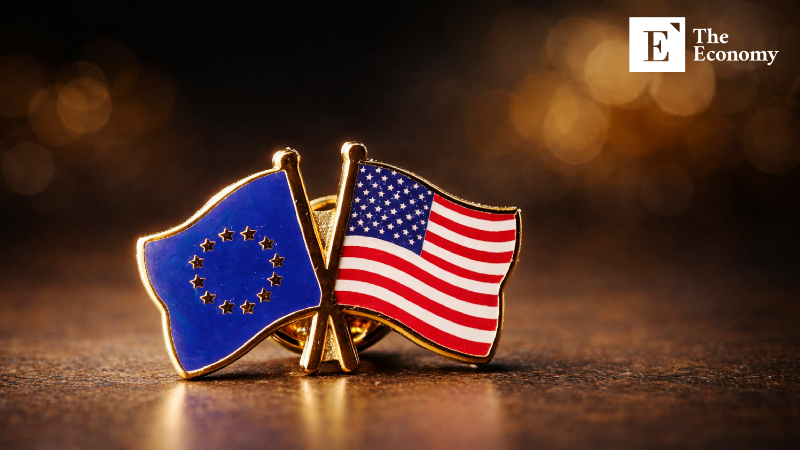
As the administration of U.S. President Donald Trump has characterized the European Union (EU) as a bloc facing “civilizational erasure” and as a rival that erodes U.S. national interests, divisions are deepening among EU member states over how to respond to Washington. Some advocate direct confrontation, while others prioritize keeping the United States engaged, undermining the prospect of a unified transatlantic strategy. Analysts say this exposes Europe’s power vacuum and strategic fragility. Europe is already reeling from the backlash of a hastily introduced common currency and unrealistic environmental policies, and now stands at an existential crossroads, losing even the capacity to determine its own future amid geopolitical crises and economic decline.
EU Leadership Splits as Trump Derides Europe as “Weak and Decaying”
According to the Financial Times (FT) on the 15th (local time), President Trump’s frontal attack on the EU has intensified internal discord not only within the European Commission but also among member states. In the new National Security Strategy (NSS) released on the 5th, Trump explicitly stated that Europe, a long-standing U.S. ally, is facing a “harsh outlook of civilizational erasure.” The document argues that Europe has lost its core values and gone astray, asserting that the United States must step in to help correct its trajectory.
In particular, the U.S. administration contends that open immigration policies and excessive regulation have eroded national identities across Europe, reducing the continent’s global presence to an “unrecognizable” level. The Trump administration said, “We want Europe to remain European,” urging the bloc to restore civilizational pride and dismantle what it called failed, suffocating regulations. It also warned that, if current trends persist, it is uncertain whether Europe will remain a reliable ally.
This offensive, intertwined with U.S. dissatisfaction over the EU’s digital regulations, sustainability legislation, and immigration policies, has sent shockwaves through the European Commission. Yet opinions diverge sharply on how to respond. European Commission President Ursula von der Leyen is reportedly advised to exercise restraint, out of concern that open conflict with Trump could undermine cooperation with Ukraine. NATO Secretary General Mark Rutte and Ukrainian President Volodymyr Zelensky are also said to have urged von der Leyen to avoid public criticism of Trump.
By contrast, some member states critical of the EU’s muted response are seeking to bypass Brussels and engage Washington directly. German Chancellor Friedrich Merz said that if President Trump finds it difficult to work with EU institutions, individual countries such as Germany could serve as channels of cooperation. A senior EU official noted that “several countries are looking for ways to discuss European issues directly with the United States.” While the EU initially believed it was negotiating three separate issues with Washington—trade agreements, expanded NATO burden-sharing, and military supplies to Ukraine—one head of government admitted, “We were deceiving ourselves,” adding, “In reality, it was a single negotiation: keeping the United States anchored in Europe.”
There are also voices willing to accept Trump’s criticism. EU High Representative for Foreign Affairs and Security Policy Kaja Kallas said at the Doha Forum in Qatar on the 6th that “some of the criticism is true,” emphasizing that “the United States remains Europe’s largest ally.” Jordan Bardella, president of France’s far-right National Rally (RN) and a leading presidential contender, echoed the Trump administration’s stance. In an interview with the BBC on the 10th, he said that mass immigration and decades of neglect in migration policy have destabilized European nations.
Deepening Deindustrialization Amid Lost Competitiveness
Europe’s structural weakening is increasingly difficult to deny. This reality is laid bare in The Future of European Competitiveness, a report released by former European Central Bank (ECB) President Mario Draghi. Draghi argued that Europe has yielded to U.S. demands despite being an ally, noting that even increased defense spending was not an autonomous choice but the result of external pressure. He went further, calling it “humiliating” that Europe was excluded entirely from the negotiating table at the U.S.–Russia summit held in Alaska in August, underscoring that Europe has become an object of decisions rather than a decision-maker. The UK-based think tank Official Monetary and Financial Institutions Forum (OMFIF) and Bloomberg similarly concluded that “the forces actually moving Europe are the United States and Russia.”
The EU’s Green Deal, promoted as a global model, has also come under fire. Under the policy, the Emissions Trading System (ETS) will be extended to households from 2030, imposing additional annual costs of roughly $230 to $380 per household, while reducing global temperatures by only an estimated 0.003 degrees Celsius, according to existing analyses.
Moreover, environmental regulations championed by EU leadership are placing European companies at a disadvantage relative to U.S. competitors. Many European firms have fallen off the Fortune Global 500 list, and Europe’s share of global aluminum production has plunged from about 30% in 2000 to roughly 5% today. Although Brussels promotes the Green Deal as a universal benchmark, major economies prioritizing growth, supply chains, and industrial competitiveness show little willingness to follow Europe’s lead. This, critics argue, is why both Europe’s military and diplomatic clout continue to erode.
Geopolitical tensions are accelerating Europe’s retreat. Two major wars are unfolding in Europe’s immediate vicinity: the Russia–Ukraine war and the Israel–Hamas conflict in the Middle East. The Ukraine war, in particular, has dealt a direct blow to Europe’s economy. Russia had been a key energy supplier, and the war triggered soaring energy prices and supply-chain disruptions. The refugee issue has also emerged as a critical factor. Following Russia’s invasion, millions of Ukrainians fled to Europe, adding to economic burdens and fueling social and political instability across the continent.
German Reunification and the Early Adoption of the Euro Deepen Economic Vulnerabilities
Major European media trace the origins of Europe’s decline to German reunification in the early 1990s. The rapid unification process left eastern Germany grappling with inflation, prompting the Bundesbank to raise interest rates sharply. The shock manifested in speculative attacks on the British pound in 1992, ultimately forcing the United Kingdom to exit the Exchange Rate Mechanism (ERM) and exposing early cracks in Europe’s integration experiment.
Nevertheless, France and Germany pressed ahead with the launch of the euro. Germany accepted monetary union as the price of reunification, while France viewed it as a strategic tool to constrain German power. However, the euro was introduced without fiscal union, embedding structural flaws that later triggered crises such as Greece’s debt meltdown. FT columnist John Authers observed that “the eurozone was incomplete from the start and has yet to escape its unfinished architecture.”
Although the EU maintains the appearance of unity, disparities and divisions among member states are widening. Misalignment between monetary and fiscal policies, the absence of credible military power, and an excessive fixation on environmental agendas are collectively producing what analysts call a “weak Europe.” This helps explain why, despite Europe’s self-image as a major power, real decision-making authority lies largely with Washington and Moscow.
Experts increasingly describe Europe’s decline as the result of “self-destructive integration.” The breakneck pace of German reunification, the premature launch of the euro, and ideologically driven green policies were not isolated decisions but a chain of choices that together hastened Europe’s unraveling. Integration expanded, but coordination capacity did not; norms were strengthened, but power foundations shrank; ideals were elevated, but practical responsiveness deteriorated. As a result, Europe is being pushed into a dependent position between the United States and Russia, steadily losing even the ability to decide its own future.
Matthew Reuter is a senior economic correspondent at The Economy, where he covers global financial markets, emerging technologies, and cross-border trade dynamics. With over a decade of experience reporting from major financial hubs—including London, New York, and Hong Kong—Matthew has developed a reputation for breaking complex economic stories into sharp, accessible narratives. Before joining The Economy, he worked at a leading European financial daily, where his investigative reporting on post-crisis banking reforms earned him recognition from the European Press Association. A graduate of the London School of Economics, Matthew holds dual degrees in economics and international relations. He is particularly interested in how data science and AI are reshaping market analysis and policymaking, often blending quantitative insights into his articles. Outside journalism, Matthew frequently moderates panels at global finance summits and guest lectures on financial journalism at top universities.
Similar Post