Canada’s 40 billion USD submarine procurement race reveals that the real competition lies beyond technology sovereignty rhetoric

Authored On
Modified
Technology sovereignty discourse presumes a finished-product contest
Real value ultimately hinges on component-level capabilities
Limits of civil–military cooperation centered on sales diplomacy
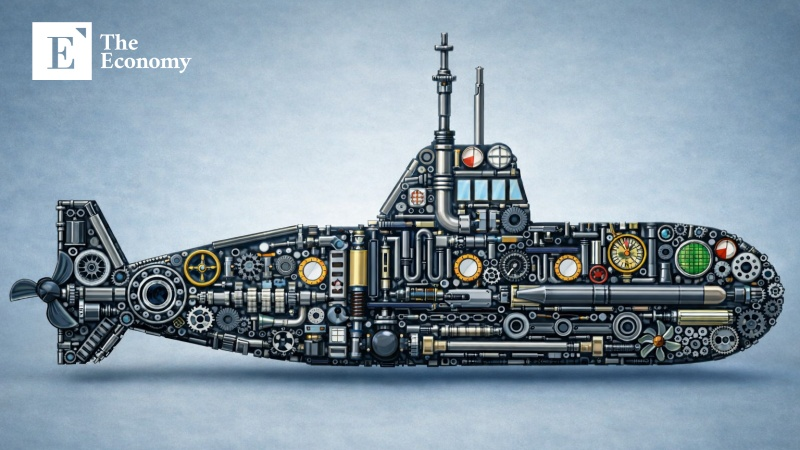
As Canada moves to replace its aging submarine fleet, Germany and South Korea have emerged as the leading contenders. With long-term operational stability and sustainment capacity identified as core evaluation criteria, the competition is expanding beyond comparisons of platform specifications to encompass the components that make up submarines, their operational systems, and models for local industrial participation. Government and industry roles that underpin these capabilities have also come under scrutiny, making this procurement a contest shaped by criteria very different from headline performance metrics.
A comprehensive test of national defense-industrial policy
On the 16th, Matthew Lombardi, co-founder of Canada’s defense innovation network Icebreaker, wrote in a contribution to domestic defense outlet Betakit that the next-generation submarine program should be filled with Canadian technology rather than relying on foreign systems. He defined the potentially decade-long period from contract signing to delivery as a “gap period,” arguing that during this window Canadian companies could design and build autonomous underwater vehicle networks to monitor Arctic waters.
These remarks came as South Korea and Germany compete for the patrol submarine program ordered by the Royal Canadian Navy. The project aims to replace four Victoria-class submarines introduced in the 1990s with up to twelve diesel-electric submarines exceeding 3,000 tons, intended as strategic assets for Arctic route management, territorial surveillance, and allied operations. The overall project value is estimated at about 40.8 billion USD, encompassing acquisition as well as long-term maintenance, repair, and overhaul, crew training, and infrastructure construction.
Domestically, the program is widely seen as a litmus test for Canada’s broader defense-industrial policy. Ottawa faces two simultaneous challenges: how to bridge the capability gap before delivery, and how far to localize technology and maintenance capacity after induction. Lombardi’s emphasis on “using the gap period” stems from this context. Even if foreign submarines are procured, he argues, Canadian firms could still build capabilities in unmanned systems, sensors, and communications, laying the groundwork for long-term technological autonomy.
The leading bidders are Germany and South Korea. Germany’s Thyssenkrupp Marine Systems highlights its extensive export experience and proven air-independent propulsion diesel-submarine technology, emphasizing long-term operational reliability and trust. It has presented a large-scale cooperation model that includes technology transfer and workforce training. The German government, meanwhile, is accelerating a shift toward defense production through broader strategic-industry discussions, positioning its ability to absorb automotive and heavy-industry manufacturing bases into defense as a competitive advantage.
From procurement to technology accumulation
South Korea, led by Hanwha Ocean with support from HD Hyundai Heavy Industries, has assembled a “K-submarine” package for the Canadian Patrol Submarine Project and is actively preparing its bid. In November, Hanwha Ocean began preliminary groundwork by holding discussions with Canadian construction giant PCL Construction on cooperation frameworks for the submarine project. The aim is to design a role-sharing structure that goes beyond vessel delivery to include maintenance, production, and training infrastructure. Given Canada’s emphasis on job creation and industrial-ecosystem development through this program, such early collaboration is effectively a baseline requirement in the competition.
The partnership drew attention by presenting concrete delivery timelines. PCL stated that if Hanwha Ocean secures the contract in 2026, it could deliver four KSS-III submarines to the Canadian Navy by 2035, offering a realistic schedule for replacing aging assets. The plan also envisions producing one submarine per year thereafter, completing a twelve-boat fleet by 2043 in line with Canada’s long-term operational roadmap. This approach is projected to generate cost savings of roughly 725 million USD.
Experts note that while the contest appears outwardly to be a competition between major shipbuilders, much of the real competitiveness will be determined by internal systems and components. South Korea’s strengths lie less in the platform alone than in the sonar, combat systems, and propulsion-related core components developed through its indigenous submarine programs. As Hanwha Ocean advances its bid through partnerships with Canadian firms, many South Korean defense materials, components, and equipment suppliers are quietly exploring cooperation with local companies behind the scenes.
LIG Nex1 is a representative example. The company recently visited Canadian underwater acoustics developer GeoSpectrum to discuss cooperation. GeoSpectrum specializes in underwater acoustic transducers, hydrophones, and towed sonar systems used in submarines and unmanned underwater vehicles, and has already established a presence in North American defense and maritime markets. Such partnerships carry independent commercial and strategic value, even beyond the immediate Canadian submarine program.
South Korea’s submarine localization rate stood at just 38.6 percent during the early-2000s Jangbogo-II program, but rose to 78 percent with the launch of the 3,000-ton Dosan Ahn Chang-ho-class submarine in 2018, surpassing 80 percent through the Jangbogo-III program. This reflects not merely substitution of foreign parts but the establishment of independent technologies and production systems. Capabilities in hydrogen fuel cells, hydrogen storage alloys, sonar, satellite antennas, and flow-noise suppressors provide a practical basis for component-level exports even if full-platform bids do not succeed.
The misconception of the “one-team” approach
The South Korean government has framed the Canadian submarine project as a strategic export initiative, emphasizing a “one-team” civil–military approach that combines export financing with diplomatic support. Given that Canada’s next-generation submarine program presupposes decades of operation and security cooperation, government involvement is widely viewed as a natural choice. As performance differentials narrow and the focus of competition shifts, Seoul has placed its strategy on reducing perceived risk for the counterpart through financial backing and high-level engagement.
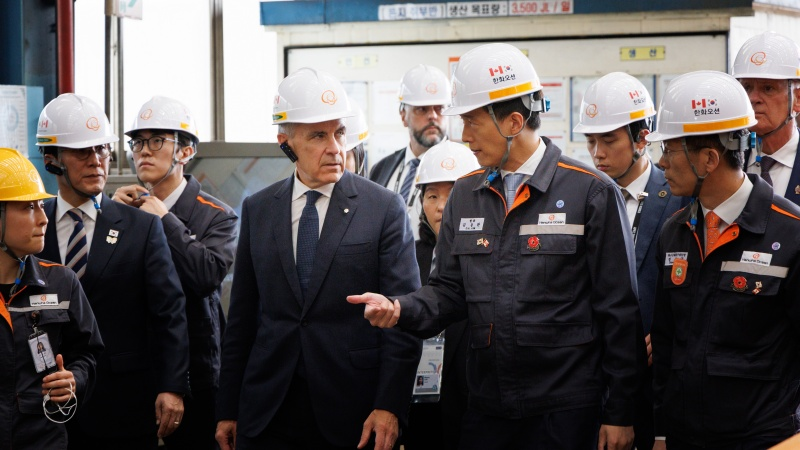
In concrete terms, diplomatic support has taken on a field-based form. In late October, Prime Minister Kim Min-seok visited Hanwha Ocean’s Geoje shipyard alongside Canadian Prime Minister Mark Carney, who was in South Korea for the Asia-Pacific Economic Cooperation summit. The two leaders listened to briefings from Hanwha Ocean, toured advanced assembly lines and facilities, and boarded the ROKS Jang Yeong-sil to inspect internal systems and equipment. At the site, Carney said he hoped bilateral security and defense cooperation would deepen, while stressing that decisions on next-generation submarine acquisition would be made strictly from the standpoint of Canada’s national security strategy.
This has prompted criticism that if the government’s “one-team” slogan becomes overly focused on leader-level sales diplomacy, it risks overlooking the substantive entry conditions demanded by the market. What Canada ultimately prioritizes is whether maintenance, repair, overhaul, training, parts supply, and availability management can function seamlessly over several decades. Critics argue that government support must extend beyond finance and diplomacy to include the long-term design of infrastructure, workforce pipelines, supply chains, and responsibility-sharing structures before it can be considered complete.
Similar Post