Takaichi, Cornered on Diplomacy, Backs Down Under Chinese Pressure and U.S. Indifference: “I Reflect on My Taiwan Remarks”

Siobhán Delaney is a Dublin-based writer for The Economy, focusing on culture, education, and international affairs. With a background in media and communication from University College Dublin, she contributes to cross-regional coverage and translation-based commentary. Her work emphasizes clarity and balance, especially in contexts shaped by cultural difference and policy translation.
Authored On
Modified
Unusual mention of “reflection” during a Diet response
Diplomatic, military, and economic tensions intensify amid Japan-China frictions
China’s influence reaffirmed in East Asia’s hegemonic contest
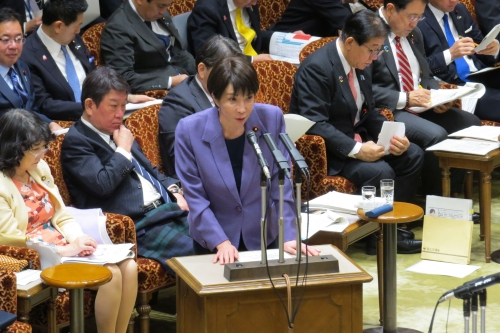
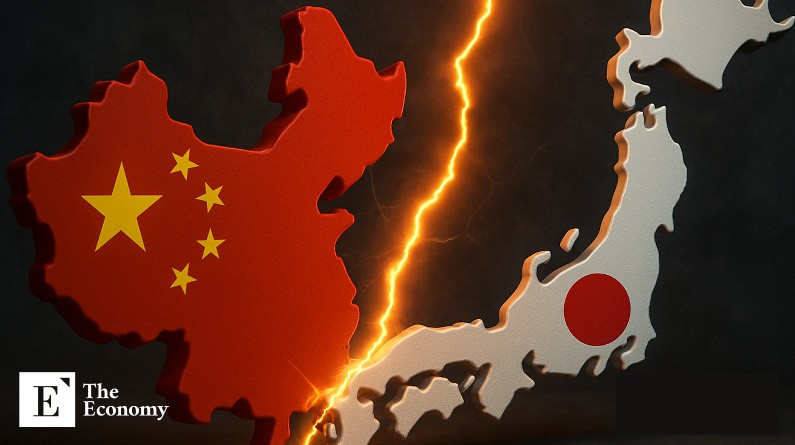
Japanese Prime Minister Sanae Takaichi has repeatedly expressed “reflection” over her remarks on “intervening in a Taiwan contingency (a state of emergency such as war).” Analysts say the political and diplomatic burden of publicly addressing the highly sensitive Taiwan issue—unlike past cabinets that maintained strategic ambiguity—has weighed on the administration. With Washington’s tepid posture, Beijing’s all-front pressure, and a slide in approval ratings compounding the strain, a growing view is that the Takaichi cabinet’s hardline stance toward China is entering a phase of recalibration.
Renewed ‘Reflection’ Under Sustained Grilling in the Diet, With Additional Clarifications
According to the Mainichi Shimbun on the 17th, Takaichi told the House of Councillors (upper chamber) Budget Committee that, regarding her Diet statement that “a Taiwan contingency could become a situation threatening Japan’s very survival,” “if it was taken as a remark that went beyond the government’s established position, then there are aspects I should reflect on.” While successive prime ministers had largely confined themselves to maintaining strategic ambiguity, her specific reference to a Taiwan contingency is being read as an acknowledgment of having crossed a sensitive line.
At the Budget Committee session that day, procedural issues within the government surrounding her remarks were put under scrutiny. It was confirmed that the phrase in question was not included in the Diet briefing materials prepared in advance by the Cabinet Secretariat; on the contrary, those materials reportedly stipulated a policy of “the government will not answer.” In this context, Hajime Hirota, a lawmaker from the Constitutional Democratic Party, pressed the prime minister, asking, “Why did you not refrain from answering?”
In response, Takaichi explained that her remarks had emerged from the context of discussing various hypotheticals with Katsuya Okada of the Constitutional Democratic Party at a House of Representatives Budget Committee session on the 7th of last month. She said, “There was no prior coordination of the response,” adding, “I will take as a point of reflection the fact that it was received as a remark beyond the government’s established position, and I will proceed in future Diet deliberations with that in mind.” Hirota criticized her, saying, “You must not shift responsibility onto the side that is listening.”
A Lukewarm United States, Contrary to Japan’s Expectations
Analysts say Washington’s neutral posture helped drive Takaichi’s renewed retreat—after she had already backed down once on the 10th of last month. On the 12th, U.S. Defense Secretary Pete Hegseth and Japan’s Defense Minister Shinjiro Koizumi spoke by phone to share information regarding an incident in which Chinese forces locked radar onto Japanese Self-Defense Force fighter jets, but the U.S. reaction was lukewarm, contrary to Japanese expectations. A brief statement afterward referenced the importance of the U.S.-Japan alliance, but avoided detailing concrete cases of China’s military threat, substituting instead a broad phrase—“China’s military activities.”
This has been interpreted as aligning with President Donald Trump’s repeated remarks amid Japan-China frictions. White House Press Secretary Karoline Leavitt has said, “President Donald Trump believes the United States should be in a position to maintain a very strong alliance with Japan while also maintaining a good cooperative relationship with China.” The calculus, as read in Tokyo, is to avoid damaging the U.S.-Japan alliance while also refusing to take sides—given U.S. interests amid a trade-war truce with China.
In practice, Trump has neither indicated support for Takaichi’s position nor even put Japan-Taiwan issues on the agenda for discussion. It has been reported that, even in a call with Takaichi, he did not voice support for Japan and instead urged restraint on further actions that could worsen disputes with China. The Japanese government denies this, but it is being interpreted as a request to preserve strategic ambiguity—and, in effect, an acknowledgment that responsibility for the current flare-up rests with Takaichi. For Japan, which pledged $550 billion in investment through U.S.-Japan tariff talks, it amounts to being blindsided by Washington.
A barrage of Chinese countermeasures also appears to have increased the burden. While backlash was fully foreseeable given that Beijing has defined the Taiwan issue as a “red line,” diplomatic circles say China’s reaction is different in tone and intensity from the past. Immediately after Takaichi’s remarks, Xue Jian, China’s consul general in Osaka, used language that would be startling even by the standards of a diplomat, maligning Japan with an expression to the effect of “I’ll cut your throat.” China has since escalated pressure on Japan by raising the level of measures such as advisories discouraging Chinese nationals from studying in or traveling to Japan, restrictions on imports of Japanese seafood, and the suspension of Japanese cultural and arts performances in China. The sight of a Japanese female singer (Maki Otsuki) being forcibly removed from a stage during a performance in China was likewise unprecedented. China has also conducted high-intensity military drills in areas including the Bohai Sea. On the 6th, aircraft from a Chinese aircraft carrier reportedly “locked radar” onto a Japanese Self-Defense Force fighter jet over the high seas near Okinawa, and on the 9th, China and Russia even carried out a joint exercise in which bombers flew toward Tokyo.
The Price of Strategic Absence, Shaking the Hardline China Posture
Japan, however, has little in the way of effective countermeasures. Beyond steps such as Defense Minister Koizumi and Chief Cabinet Secretary Minoru Kihara visiting sites in Okinawa Prefecture—including Ishigaki and Yonaguni islands—and presenting missile plans in preparation for a Taiwan contingency, options appear limited. Japan has also sought to apply the brakes on exports to China of certain advanced semiconductor materials, reminiscent of the 2019 Japan–South Korea trade dispute, but questions are being raised about the effectiveness of that approach as well.
The absence of a coherent China strategy within the Takaichi cabinet is also deepening uncertainty over an exit path. In the past, when Japan-China tensions rose, unofficial reconciliation channels tended to activate. When frictions erupted during the Shinzo Abe era over visits to Yasukuni Shrine, former Prime Minister Yasuo Fukuda and former LDP Secretary-General Toshihiro Nikai traveled to China to help restore ties, and under the Shigeru Ishiba government, former Secretary-General Hiroshi Moriyama visited China twice. Under the Takaichi administration, however, such pipelines are effectively absent.
The departure of Komeito, a long-standing coalition partner, is also being cited as a negative factor. The late Daisaku Ikeda, founder of Komeito and honorary president of Soka Gakkai, was a figure credited with contributing to the normalization of Japan-China relations. Since the 1990s, Komeito has maintained close exchanges by visiting China regularly. Its withdrawal means one key buffer in Japan’s China diplomacy has disappeared.
Against this backdrop, approval ratings are also showing signs of decline. Takaichi built her popularity on the image of a “strong Japan” and “saying what must be said,” but that momentum appears to be faltering. According to an NHK survey conducted from the 5th to the 7th of this month among 1,192 men and women aged 18 and older, support for the Takaichi cabinet stood at 64%, in sharp contrast to the 75% recorded immediately after her Taiwan-contingency remarks. This reflects concern that Japan-China tensions could spill into the economy: on an economy-related question, 54% expressed anxiety—“very concerned” (14%) and “somewhat concerned” (40%). In fact, even hardliners who initially said they did not mind if “nuisance Chinese tourists” stopped coming fell silent amid China’s sustained retaliatory measures. With the tourism sector also voicing concern—and analyses now warning of economic losses of around $1.36 billion due to a drop in Chinese visitors—the unease is spreading.
Siobhán Delaney is a Dublin-based writer for The Economy, focusing on culture, education, and international affairs. With a background in media and communication from University College Dublin, she contributes to cross-regional coverage and translation-based commentary. Her work emphasizes clarity and balance, especially in contexts shaped by cultural difference and policy translation.
Similar Post