SK pauses to catch its breath while Doosan raises the stakes, the practical calculus behind the SK Siltron sale

Authored On
Modified
A deal largely aimed at easing SK Group’s financial burden
Acquisition capacity shaped by Doosan subsidiaries’ earnings
Strategic synergies stand out versus financial investors
SK’s plan to divest SK Siltron as part of its broader group rebalancing has moved into a more concrete phase with Doosan selected as the preferred bidder. Market attention has focused less on the headline price and more on the fact that SK is prioritizing near-term cash inflows and balance-sheet relief through the disposal of a non-core asset. Combined with Doosan’s funding conditions and the scope for post-acquisition utilization, the Siltron sale is being read not as a simple equity transaction but as a test case for the two groups’ medium- to long-term strategies.
Financial buffer amid battery-sector weakness
According to investment banking sources on the 18th, SK disclosed the previous day that it had selected Doosan as the preferred bidder for its stake in SK Siltron, adding that detailed terms would be re-disclosed within three months. The assets up for sale include SK’s 70.6% stake, consisting of a directly held 51% and a further 19.6% managed through total return swap arrangements, which may also be included in the transaction. The 29.4% personal stake held by SK Group Chairman Chey Tae-won is widely expected to be excluded. Market estimates place SK Siltron’s enterprise value at up to $3.4 billion.
The selection of a preferred bidder is seen as another visible step in SK’s multi-year portfolio restructuring. With capital needs concentrated in businesses requiring large upfront investment, such as batteries, artificial intelligence, and data centers, SK has pursued asset sales to shore up financial flexibility. The Siltron divestment is widely viewed as a choice driven more by cash recovery than by growth considerations.
The deal’s significance is underscored by mounting financial pressure at battery subsidiary SK On. As electric vehicle demand softens and the global battery industry enters an adjustment phase, scrutiny over SK On’s additional investment needs and funding plans has intensified. Against this backdrop, a Siltron sale capable of generating billions of dollars in cash within a short timeframe could act as a stabilizing buffer for the group’s balance sheet.
The transaction structure also reflects SK’s emphasis on securing definitive cash inflows. By including not only the directly held 51% stake but also the 19.6% managed via TRS, the potential proceeds increase substantially. However, the TRS portion remains a key variable, as final settlement terms and maturity conditions could affect profit attribution and valuation. This uncertainty explains SK’s plan to re-disclose detailed terms at a later stage.
Acquisition funded by internal resources rather than heavy borrowing
Some observers initially questioned whether Doosan could shoulder such a large acquisition. The group has previously seen financing plans derailed by investor resistance during affiliate merger efforts. This time, however, steady earnings and cash-generation capacity at key subsidiaries have eased much of that concern. In the first half of the year, Doosan raised about $374 million using a portion of its stake in Doosan Robotics as collateral, another $245 million backed by Doosan Enerbility shares, and an additional $61 million through general credit facilities, securing roughly $680 million in liquidity. Notably, these funds were raised through collateralization rather than equity sales, limiting concerns over dilution or loss of control.
When measured against market estimates for SK Siltron, Doosan’s burden appears more manageable than previously assumed. While Siltron’s enterprise value is estimated at around $3.4 billion, subtracting net debt of roughly $2.0 billion reduces the equity value to about $1.4 billion. Applying the 70.6% stake under consideration brings the implied acquisition price to around $1.0 billion. Compared with Doosan’s available and potential liquidity, the deal does not appear to require full reliance on external funding.
Recent changes to Doosan’s holding-company status further alter perceptions of its acquisition capacity. By relinquishing holding-company designation, Doosan has escaped statutory requirements such as maintaining a debt ratio below 200% and minimum ownership thresholds for subsidiaries and sub-subsidiaries. This provides greater flexibility in post-acquisition balance-sheet management and follow-on investment. As a result, discussions around Doosan’s financial capacity are shifting from narrow concerns about leverage to a broader assessment that includes subsidiary performance and asset utilization.
Expanding Doosan’s semiconductor value chain
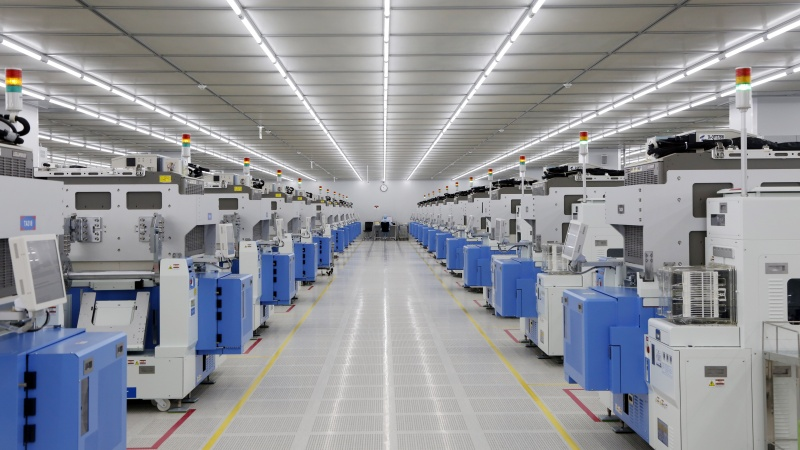
Market focus is also shifting beyond price toward industrial utilization after the acquisition. SK Siltron’s silicon wafer manufacturing capabilities link directly to Doosan’s existing semiconductor front- and back-end businesses. Through its electronics business unit, Doosan has expanded its presence in semiconductor and electronic materials via copper-clad laminates, and in 2022 it strengthened back-end operations by acquiring system semiconductor testing firm Tesna for $313 million.
SK Siltron ranks third globally in 12-inch wafer market share and is one of the few suppliers serving both memory and system semiconductor customers. As wafers form the starting point of semiconductor manufacturing, acquiring this asset would allow Doosan to internalize a supply flow spanning from materials through back-end testing. Such integration-driven synergies are difficult to achieve in transactions driven purely by financial returns.
This context also explains the shift in how Doosan is viewed as an acquirer. Unlike financial investors, strategic buyers must consider post-acquisition operations, capital investment, and customer relationships. Reports suggest that many within SK Siltron favor a transfer to Doosan over a sale to private equity firms such as MBK Partners or Hahn & Company, reflecting concerns that private equity ownership and eventual resale may not guarantee employment continuity.
Similar Post