“From Offshore Wind to Solar”: Trump Administration Slams the Brakes on Renewables, Deepening Energy-Security Concerns

Aoife Brennan is a contributing writer for The Economy, with a focus on education, youth, and societal change. Based in Limerick, she holds a degree in political communication from Queen’s University Belfast. Aoife’s work draws connections between cultural narratives and public discourse in Europe and Asia.
Authored On
Modified
Trump Administration Halts Offshore Wind Projects Along the U.S. East Coast
“I Don’t Support Wind Power”: Pressure Mounts After Launch of Second Trump Term
U.S. Renewables Market Reels as Budget Cuts and Project Cancellations Pile Up
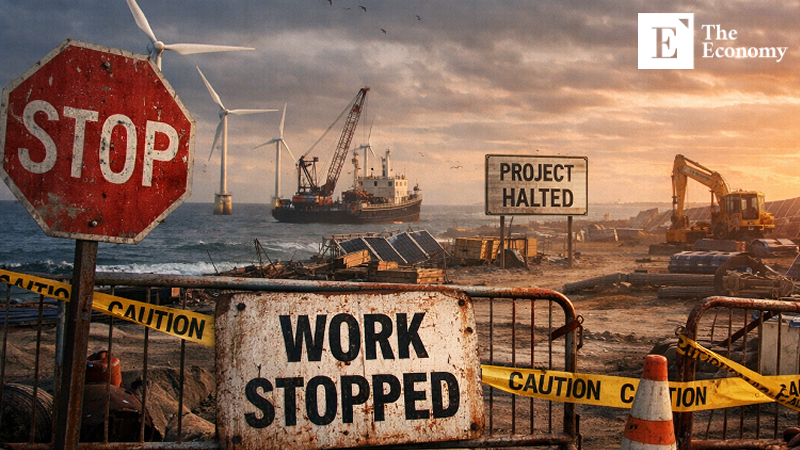
The Donald Trump administration has halted the progress of offshore wind projects in the United States, citing national security risks. Since the start of his second term, President Trump has maintained a hardline stance against renewable energy industries, including offshore wind, and pressure on the sector has continued to intensify. Experts warn that this strategy could trigger economic and energy-security risks for the United States.
Trump Moves to Put the Brakes on Offshore Wind Projects in the U.S.
According to The Wall Street Journal (WSJ) on the 22nd (local time), the U.S. Department of the Interior announced it will temporarily suspend seabed lease contracts for five East Coast projects spanning Massachusetts to Virginia. The decision was based on “national security risks” identified in a recent classified report by the U.S. Department of Defense. Interior Secretary Doug Burgum said the move is intended to address new national security risks, including vulnerabilities stemming from rapid advances in adversarial technologies and the construction of large-scale offshore wind farms near densely populated areas along the East Coast. The argument is that the rotating blades of large wind turbines and highly reflective towers can cause “radar clutter,” interfering with radar by obscuring real moving targets or generating false ones.
The projects affected by the suspension include Vineyard Wind 1 off Massachusetts, Revolution Wind in Rhode Island, Coastal Virginia Offshore Wind, Sunrise Wind off New York, and Empire Wind 1 south of Long Island. According to Oceanic Network, an offshore wind industry group, the facilities built through these projects were expected to supply a combined total of about 6 gigawatts (GW) of electricity to the United States in the future—roughly equivalent to the amount of power supplied to Manhattan, New York. WSJ described the announcement as a sweeping step that would effectively neutralize offshore wind, one of the industries the president most dislikes, and said it was the most significant action the administration has taken so far targeting the rapidly growing U.S. offshore wind sector.
Pressure on the Offshore Wind Industry Prolongs
This is not the first time the Trump administration has moved to block offshore wind projects. Since taking office in January, President Trump has voiced strong opposition to offshore wind power, declaring that he does not support “massive, ugly wind farms that threaten wildlife.” On his first day in office, he signed an executive order suspending permits for new offshore wind projects and withdrew $679 million in federal funding that had been earmarked for 12 offshore wind developments in the United States. In February, the administration also dismissed staff at the National Oceanic and Atmospheric Administration (NOAA) who had been monitoring the impact of offshore wind projects on marine wildlife.
In April, Interior Secretary Doug Burgum ordered the Bureau of Ocean Energy Management (BOEM) to halt Empire Wind 1, a large offshore wind project planned off Long Island. The move was based on claims that the Biden administration had rushed approval of the project without sufficient analysis, warranting further review. The project, which had signed a federal lease in 2017, planned to install 54 wind turbines, create more than 1,500 jobs, and supply electricity to about 500,000 households at full operation. The suspension order, however, was lifted roughly one month later following negotiations between the federal government and the state of New York.
In August, BOEM also issued a stop order for Revolution Wind, an offshore wind project off Rhode Island. The project was being developed through a 50–50 joint venture between Danish wind power company Ørsted and Skyborn Renewables, a unit of Global Infrastructure Partners, and involved installing 65 turbines off the Rhode Island coast. Once completed, it was expected to supply electricity to about 350,000 households in Rhode Island and Connecticut.
Ørsted and Skyborn argued that the government’s action was “arbitrary, capricious, unlawful, and taken in bad faith,” and filed a lawsuit. In September, a federal court in Washington, D.C., issued a preliminary injunction against the government’s suspension order, ruling that the administration’s decision appeared arbitrary and inconsistent, and that halting the project risked causing irreparable harm to the developers. As a result, Ørsted has been allowed to continue construction of the Rhode Island offshore wind project while the main lawsuit proceeds.

U.S. Renewables Market Suffers Under “Government Risk”
The Trump administration has maintained a hostile stance not only toward offshore wind but also toward a wide range of renewable-energy projects. In October, the U.S. Department of Energy (DoE) announced it would cancel budgets worth billions of dollars for hydrogen projects, grid upgrades, carbon capture, and other energy programs allocated to so-called “blue states” that lean heavily Democratic. More recently, it also emerged that the administration had cut $7.6 billion in funding designated for clean-energy projects, prompting the DoE’s inspector general to launch a formal audit. The cuts are said to have directly targeted initiatives critical to meeting climate goals, including solar, wind, and transmission expansion.
The United States’ largest solar project, Esmeralda 7, was also abruptly canceled in October. The project aimed to install solar panels and large-scale batteries on 118,000 acres of federally owned land in the Nevada desert. Once completed, it was expected to generate 6.2 GW of electricity—enough to power about two million households. After the Trump administration took office and began a broad review of renewable-energy projects, work on the project stalled, and in October the Bureau of Land Management (BLM) changed its status to “cancelled” on its website.
Experts warn that these choices by the Trump administration could destabilize the U.S. economy and energy security. According to Climate Power’s recently released report, December Energy Crisis Snapshot (2025), the cancellation of clean-energy projects under the Trump administration has led to 324 projects being halted or delayed and 165,000 jobs being lost. The report estimates that roughly $53.0 billion in investment has been wiped out and that enough power to supply about 13.17 million households has been lost. The report argues that the Trump administration and Republican policies have effectively created a “self-inflicted crisis.”
Aoife Brennan is a contributing writer for The Economy, with a focus on education, youth, and societal change. Based in Limerick, she holds a degree in political communication from Queen’s University Belfast. Aoife’s work draws connections between cultural narratives and public discourse in Europe and Asia.
Similar Post