“Robotaxis Arrive in London”: Baidu Teams Up with Uber and Lyft, Reigniting Safety Debate

As one of the youngest members of the team, Tyler Hansbrough is a rising star in financial journalism. His fresh perspective and analytical approach bring a modern edge to business reporting. Whether he’s covering stock market trends or dissecting corporate earnings, his sharp insights resonate with the new generation of investors.
Authored On
Modified
Baidu Teams Up with Uber and Lyft to Roll Out Robotaxi Services in the UK
“Is It Safe to Expand This Fast?” Safety Concerns Linger
With Safety Data Already Accumulated, Robotaxis Push Past Controversy Toward Commercialization
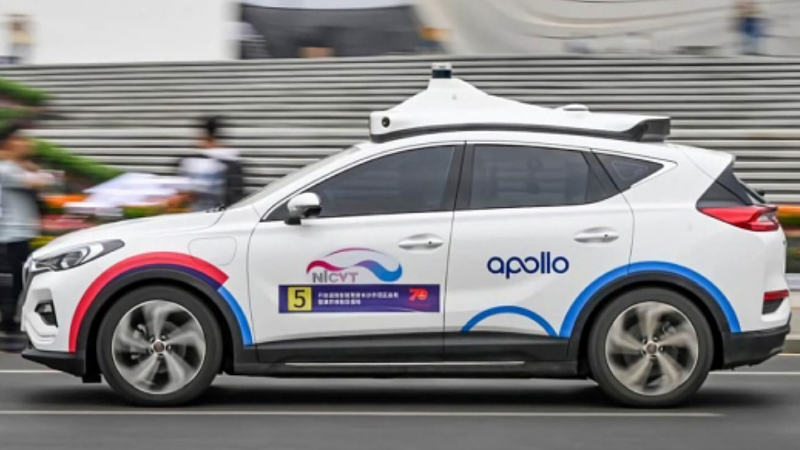
Chinese tech giant Baidu is accelerating its push into the robotaxi market through partnerships with global ride-hailing platforms Uber and Lyft. The company plans to launch robotaxi services in London in the first half of next year, marking a full-scale entry into the European market. As robotaxi markets begin to take shape around the world, concerns over safety continue to surface in many regions. Industry players, however, are pushing back with data, arguing that robotaxis may in fact be safer than vehicles driven by human drivers.
Baidu Robotaxis Head to Europe with Uber and Lyft
On the 22nd, Baidu said via its official X (formerly Twitter) account that it will begin pilot robotaxi operations in London with Uber in the first half of next year. The move follows a partnership the two companies announced in July, under which they agreed to deploy thousands of robotaxis in global markets outside China. Under the arrangement, Baidu will supply the robotaxis, which users will be able to hail through Uber’s app.
The partnership is seen as an extension of Uber’s “partnership strategy” adopted after it halted in-house autonomous-driving development. By doing so, Uber aims to reduce the cost burden associated with technology development and capital investment while maintaining its foothold in the fast-growing robotaxi market. Uber is already operating driverless ride-hailing services with other autonomous-driving companies in the Middle East and has said it plans to expand into more than 10 markets. Baidu, meanwhile, is rapidly scaling its robotaxi business beyond China into Europe and the Middle East.
On the same day, Lyft co-founder and CEO David Risher said on his official X account and LinkedIn that the company will also conduct pilot operations of several dozen Baidu robotaxis in London early next year. Risher said the trials will begin once approvals are secured from local regulators, adding that Lyft plans to scale up to hundreds of units of Baidu’s electric autonomous SUV model, the RT6. He did not disclose a specific timeline for full commercialization.
Safety Concerns Over Robotaxis Persist
As the robotaxi industry grows rapidly around the world, public concerns have not faded. The safety debate over robotaxis has yet to be fully settled. Caixin, a Chinese business outlet, reported on the 6th that an accident occurred in Zhuzhou, Hunan Province, in which two people were pinned under a “Hello” robotaxi. Witnesses said the road surface at the scene was wet from rain, and it is likely that an electric bike slipped, causing the rider to fall and be pulled under the robotaxi. Based on reporting across Chinese media, the accident is believed to have involved a Baidu robotaxi rather than a model developed in-house by Hello. Since August, Hello has been purchasing and running pilot services using Baidu-developed robotaxis in Zhuzhou, Hunan, and Liyang, Jiangsu.
In August, another incident involved Baidu’s robotaxi “Luobo Kuaipao,” first developed in 2021, which fell into a pit while carrying passengers. Local media reports said a pit about three meters deep had been dug for pipeline installation, and barriers and warning signs had been placed around the construction site. The exact circumstances of how the taxi ended up falling into the pit were not disclosed. The passenger did not suffer serious injuries and reportedly climbed out using a ladder with help from nearby merchants.
Tesla’s robotaxi has also not avoided controversy. Data compiled so far show Tesla’s robotaxi has been involved in one accident for roughly every 40,000 miles (about 64,000 km) driven. That is about 10 times higher than the average accident frequency for ordinary drivers in the United States. In materials Tesla submitted directly to the National Highway Traffic Safety Administration (NHTSA), there have been eight accidents linked to its self-driving system to date. Most were minor collisions, with no major casualties. The issue is that all of those accidents occurred while the system was operating in supervised FSD mode with a safety driver on board. Supervised FSD requires the driver to continuously monitor driving conditions and intervene immediately when necessary. In a fully driverless setting, instant intervention is not possible, meaning the risk could become more pronounced.
“Safer Than Humans”: Industry Pushes Back With Data
The robotaxi industry is countering these concerns with data that point in the opposite direction, arguing that robotaxis may in fact be safer than human-driven vehicles. An analysis of 56.7 million miles (about 91.2 million km) of autonomous driving published by Waymo, the self-driving unit of Google parent Alphabet, in the international academic journal Traffic Injury Prevention in 2025 shows that injury-causing accidents per 1 million miles stood at 2.78 for human drivers, compared with just 0.41 for Waymo. The overall accident rate reported to police was also lower for Waymo, at 2.1 cases per 1 million miles, versus 4.85 for human drivers—a 57% gap. Of 38 serious accidents involving Waymo between July 2024 and February 2025, only one was clearly attributable to a Waymo vehicle, while the remaining 34 were caused by the other party, namely human drivers.
Baidu has also presented data to support the safety of its robotaxis. At the 2025 Baidu World Conference, the company disclosed that fully driverless vehicles running on its Apollo autonomous-driving platform experienced a major accident—defined as one involving airbag deployment—once every 10.14 million km on average. Baidu CEO Robin Li emphasized that this figure is lower than not only that of human drivers but also Waymo.
The fact that robotaxi operators are already overcoming safety controversies and proving commercial viability adds weight to the industry’s argument. Baidu’s Apollo Go service has handled more than 17 million cumulative rides across 22 cities. Fully driverless paid rides have reached 250,000 per week, putting it on par with Waymo in the United States. Total mileage has surpassed 240 million km, including 140 million km driven with no one in the driver’s seat. In addition, Baidu has cut per-vehicle costs by about 50% by producing its own electric robotaxis rather than relying on third parties, with the manufacturing cost of its sixth-generation model coming in at roughly $28,000.
Pricing advantages are also becoming increasingly apparent. Around 60% of conventional taxi fares go toward driver labor costs, while energy costs amount to just $0.014 per km, making up only a small share of total operating expenses. Running fully driverless robotaxis would therefore eliminate more than half of costs outright. The industry expects robotaxi fares to fall to about $0.25 per km by 2030. Goldman Sachs has projected that operating costs will drop from $1.95 per km in 2024 to below $0.62 by 2030, and further to $0.36 by 2040. Total costs including R&D and headquarters overhead are also forecast to plunge, from about $114 per km in 2024 to $7.5 by 2030 and around $0.62 by 2040.
As one of the youngest members of the team, Tyler Hansbrough is a rising star in financial journalism. His fresh perspective and analytical approach bring a modern edge to business reporting. Whether he’s covering stock market trends or dissecting corporate earnings, his sharp insights resonate with the new generation of investors.
Similar Post