Trump Unveils ‘Golden Fleet’ to Rebuild U.S. Naval Power, Signals Cooperation with South Korea Amid Shipbuilding Constraints

Oliver Griffin is a policy and tech reporter at The Economy, focusing on the intersection of artificial intelligence, government regulation, and macroeconomic strategy. Based in Dublin, Oliver has reported extensively on European Union policy shifts and their ripple effects across global markets. Prior to joining The Economy, he covered technology policy for an international think tank, producing research cited by major institutions, including the OECD and IMF. Oliver studied political economy at Trinity College Dublin and later completed a master’s in data journalism at Columbia University. His reporting blends field interviews with rigorous statistical analysis, offering readers a nuanced understanding of how policy decisions shape industries and everyday lives. Beyond his newsroom work, Oliver contributes op-eds on ethics in AI and has been a guest commentator on BBC World and CNBC Europe.
Authored On
Modified
Construction of two largest-ever Trump-class warships
Plan to ultimately secure up to 25 next-generation battleships
Cooperation with South Korea’s Hanwha on new frigate construction
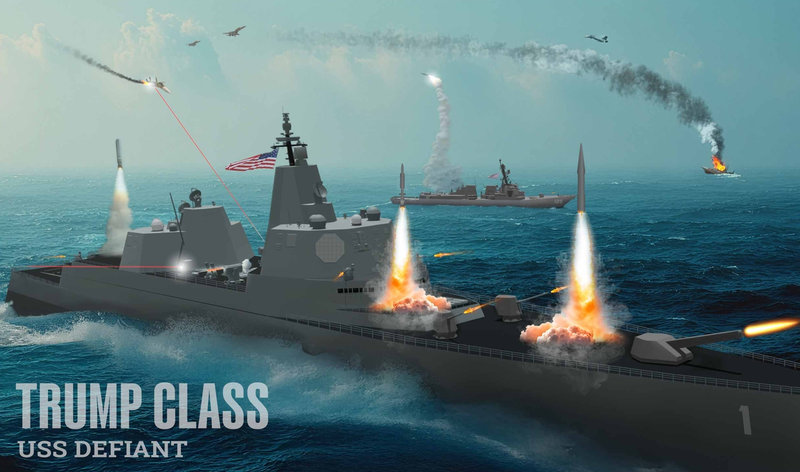
As the U.S. Navy confronts a dual crisis of fleet obsolescence and the erosion of domestic shipbuilding capacity, President Donald Trump has unveiled a sweeping naval expansion initiative dubbed the “Golden Fleet,” marking an aggressive push to restore American sea power. Notably, the Trump administration explicitly cited cooperation with Hanwha, a South Korean conglomerate operating the Philadelphia Shipyard, in connection with new frigate construction, underscoring the limitations of U.S. shipyards plagued by chronic delays. Industry observers say the announcement signals a concrete shift toward leveraging allied shipbuilding infrastructure, including South Korea’s, as U.S. construction and maintenance capabilities reach their practical limits.
U.S. Navy Activates Project to Bolster Competitiveness Against China
On the 21st (local time), President Trump formally announced the Golden Fleet project, a plan to construct next-generation battleships equipped with hypersonic missiles and designed to dramatically expand both combat power and scale. Speaking at a press conference at his Mar-a-Lago residence in Florida, Trump said, “It is a great honor to announce plans to build two of the largest battleships ever constructed,” adding that the initiative would ultimately secure between 20 and 25 vessels. According to the U.S. Navy, the Golden Fleet will comprise not only Trump-class battleships but also aircraft carriers, submarines, and smaller escort vessels. The lead ship of the new Trump-class has been named USS Defiant, with competitive bidding set to begin shortly and first hull delivery targeted for 2030.
Trump has long criticized the aging state of America’s battleship fleet, repeatedly calling for a comprehensive overhaul. Earlier this year, the White House and the U.S. Navy initiated plans to establish a new fleet capable of responding effectively to threats ranging from strategic competition with China to hemispheric security challenges. The latest announcement follows last week’s disclosure of a new frigate construction program. The Wall Street Journal reported that the initiative reflects Trump’s preference for “gold-themed” branding—echoing projects such as the next-generation missile defense system dubbed Golden Dome—while fundamentally aimed at strengthening U.S. naval competitiveness vis-à-vis China.
At the briefing, Trump remarked that during World War II the United States produced one warship per day, whereas today it builds little beyond a limited number of naval vessels. He argued that many historically iconic U.S.-built ships—from Iowa and Missouri to Wisconsin and Alabama—have steadily diminished in scale, no longer aligning with a doctrine of “peace through strength.” The newly built battleships, he said, would possess “100 times the power” of their predecessors, displacing more than 30,000 to 40,000 tons and serving as the flagships of the U.S. Navy. According to the Navy, these vessels will be designed to carry long-range missiles including hypersonic weapons, naval guns, advanced electromagnetic railguns, and high-energy laser systems, with provisions allowing for potential nuclear armament.
Trump also made clear that medium-sized combatants such as frigates would be built in U.S. shipyards. Referring to last week’s frigate program, he said, “Because this must move forward immediately, we will work with Hanwha, an excellent Korean company,” noting that Hanwha recently acquired the Philadelphia Shipyard and committed to investing $5 billion. He added that the once-idled Philadelphia facility is being brought back online and that he will meet major defense contractors next week to discuss production timelines.
Tailwind for Korea–U.S. Shipbuilding Cooperation Under MASGA
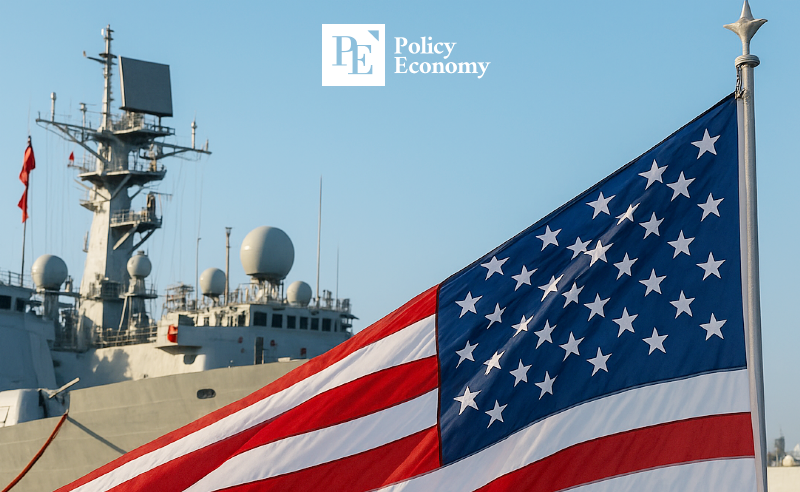
Industry participants expect the announcement to further bolster MASGA (Make American Shipbuilding Great Again), the Korea–U.S. shipbuilding cooperation initiative. Hanwha, personally referenced by Trump, has rapidly expanded its footprint within the U.S. Navy supply chain, most recently becoming the largest shareholder of Australian shipbuilder Austal earlier this month. Austal operates production facilities not only in Henderson, Western Australia, but also in Mobile, Alabama, and San Diego, California, and is estimated to hold a 40% to 60% share of the U.S. market for small frigates and logistics support vessels.
In the frigate segment, HD Hyundai Heavy Industries—which has signed a memorandum of agreement with Huntington Ingalls Industries (HII) covering cooperation in commercial and naval ship design and construction—may see its role expand as a subcontractor or strategic partner. The U.S. Navy initially awarded construction of Constellation-class frigates to Fincantieri’s Wisconsin shipyard in 2020, but repeated design changes and delays drove costs sharply higher, prompting the cancellation last month of four out of six planned vessels, excluding two already under construction.
On the 19th, the Navy selected HII, the largest U.S. military shipbuilder, as the new prime contractor. Yet the domestic industry continues to struggle with shortages of skilled labor, supply-chain instability, and aging facilities, making on-time delivery increasingly difficult. Trump directly criticized HII, stating that remaining U.S. shipyards are so slow that a single aircraft carrier refueling and overhaul can take six years. In response, HII has announced plans to invest $1 billion in infrastructure and capacity expansion, while actively exploring cooperation with overseas shipbuilders to supplement production.
Senior Navy officials have openly acknowledged the need to tap allied capabilities. Secretary of the Navy John Phelan said the service is considering cooperation with foreign shipyards not only for non-combat vessels but also for components of combat ships, while Chief of Naval Operations Admiral Daryl Caudle emphasized the necessity of leveraging the capabilities of South Korea and Japan to reinforce construction capacity. These signals are widely interpreted as favorable for South Korea’s shipbuilding industry. Should the Navy opt for Korean-designed frigates or subcontract portions of production to Korean yards, the benefits could prove long-lasting.
Potential Expansion of Allied Cooperation Into Maintenance and Repair
Parallel to construction plans, analysts also see growing prospects for expanded forward-deployed naval infrastructure across Asia. Defense experts suggest the emergence of a maritime defensive arc linking Japan, the Philippines, and Singapore, accompanied by phased expansion of shipyards and maintenance, repair, and overhaul (MRO) facilities in the region. With U.S. domestic shipbuilding constrained by workforce, equipment, and productivity limitations, reliance on allied infrastructure in Asia appears increasingly inevitable to ensure rapid maintenance and force regeneration in contingency scenarios.
The U.S. Navy is already experiencing severe bottlenecks in sustaining its existing fleet. The Wall Street Journal reported that roughly one-third of ships scheduled for maintenance in recent years failed to complete repairs on time. In the case of the USS Helena, an overhaul that began in late 2017 dragged on for years, leaving the vessel confined to shipyard status; after delivery, additional defects emerged, leading to its retirement last month. The paper attributed these chronic delays to declining competitiveness in manpower, equipment, and technical know-how.
Meanwhile, the gap with China continues to widen. Backed by the world’s largest shipbuilding capacity, China has already secured numerical superiority at sea. Over the past decade, the U.S. Navy commissioned just 67 vessels, compared with China’s 157, resulting in the world’s largest fleet. Moreover, while U.S. naval forces are globally dispersed, China’s fleet remains concentrated near the western Pacific, complicating any assurance of U.S. superiority in a direct conflict. Last year, the Center for Strategic and International Studies warned for the first time in half a century that the likelihood of U.S. defeat in a major maritime confrontation is rising.
Oliver Griffin is a policy and tech reporter at The Economy, focusing on the intersection of artificial intelligence, government regulation, and macroeconomic strategy. Based in Dublin, Oliver has reported extensively on European Union policy shifts and their ripple effects across global markets. Prior to joining The Economy, he covered technology policy for an international think tank, producing research cited by major institutions, including the OECD and IMF. Oliver studied political economy at Trinity College Dublin and later completed a master’s in data journalism at Columbia University. His reporting blends field interviews with rigorous statistical analysis, offering readers a nuanced understanding of how policy decisions shape industries and everyday lives. Beyond his newsroom work, Oliver contributes op-eds on ethics in AI and has been a guest commentator on BBC World and CNBC Europe.
Similar Post