“EVs and AI both loosened”: Regulation spearhead EU pivots toward easing under industry pressure

Aoife Brennan is a contributing writer for The Economy, with a focus on education, youth, and societal change. Based in Limerick, she holds a degree in political communication from Queen’s University Belfast. Aoife’s work draws connections between cultural narratives and public discourse in Europe and Asia.
Authored On
Modified
EU eases carbon-fiber rules for cars as it shifts its policy course
‘2035 ban on sales of new ICE cars’ also effectively headed for rollback
Amid industry pushback, EU delays AI Act rollout; possible slowdown for DMA and DSA also raised
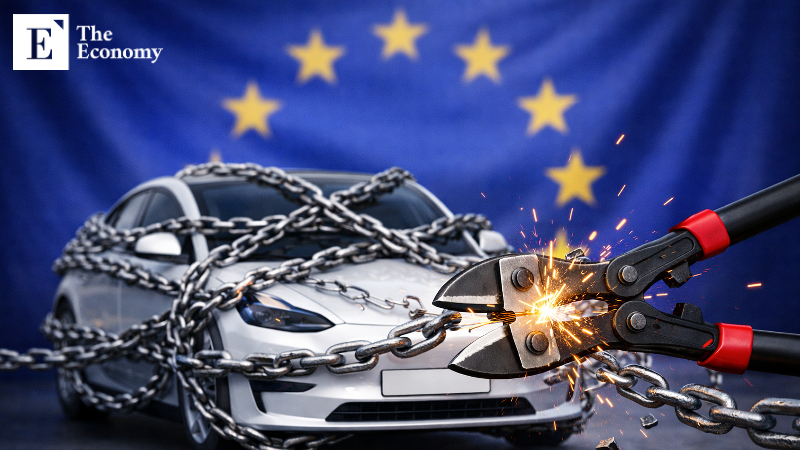
The European Union has scrapped its earlier plan to restrict the use of carbon fiber in car manufacturing. It is the latest sign of a softer regulatory stance, following a recent adjustment to its “full transition to electric vehicles” goal that effectively kept the door open to continued production of internal combustion engine cars. This more flexible approach is also carrying over beyond the auto sector to digital-market regulation, including the EU’s AI Act.
EU drops plan to curb carbon-fiber use in cars
On December 29, Japan’s Nikkei reported that three EU institutions—the European Commission, the European Parliament, and the Council of the European Union—agreed to revise the End-of-Life Vehicles (ELV) directive, which governs recycling of scrapped cars, and to remove carbon fiber from the list of restricted substances that cannot be used in vehicle bodies. In April, the European Parliament had begun considering changes to the ELV directive on the grounds that carbon fiber could pose risks to human health and is difficult to recycle. The idea was to limit carbon-fiber use in the same way the directive currently bans hazardous substances such as mercury, lead, and cadmium in car bodies.
The shift was driven in large part by strong lobbying from Japanese companies. The Japan Chemical Fibers Association—whose key members include Toray, Mitsubishi Chemical, and Teijin—called for an immediate reversal in April, arguing that there was insufficient evidence that carbon fiber harms human health. In May, the Japan Business Council in Europe, based in Brussels, launched a dedicated task force and began engaging EU policymakers directly. By mid-November, Japanese firms and U.S. composite materials company Hexcel had also set up a carbon-fiber industry group in Europe to step up lobbying efforts.
Sports car makers that rely heavily on carbon fiber for lightweighting, including Italy’s Lamborghini and the UK’s McLaren Automotive, also joined the opposition. The European Composites Industry Association likewise said carbon fiber is not classified as a hazardous substance under World Health Organization criteria, and urged the EU to incorporate carbon fiber appropriately within its regulatory framework. While the EU has stepped back in response to industry pressure, it plans to maintain a tougher stance on traceability. The revised proposal is expected to designate carbon fiber as a “substance of concern” and include provisions requiring ongoing monitoring and investigation.
EV-only transition target bends under reality
Earlier this month, on December 16 (local time), the EU unveiled an amendment in Brussels that conditionally allows the sale of internal combustion engine vehicles, effectively rolling back part of its electric-vehicle regulations. Under the European Green Deal adopted in 2023, the bloc had mandated that all new cars sold from 2035 must achieve “zero” carbon emissions, amounting to a de facto ban on ICE vehicle sales.
The core of the amendment is to allow up to 10% residual carbon dioxide emissions per vehicle even after 2035, provided they are offset with credits generated through the use of synthetic fuels (e-fuels), sustainable biofuels, or low-carbon steel. In practice, automakers will be allowed to continue producing and selling ICE and hybrid vehicles after 2035 as long as they achieve a 90% reduction in emissions compared with 2021 levels.
Behind this policy shift lies a more fundamental question over the actual carbon-reduction effect of electric vehicles themselves. For EV adoption to genuinely drive decarbonization, emissions must also be reduced at the power-generation stage. Within Europe, concerns have long been raised that in regions with a high reliance on coal and gas—and wide disparities in energy mixes—wider EV adoption may not translate directly into lower greenhouse gas emissions.
Cost burdens and infrastructure gaps have also emerged as key obstacles. According to Daimler Truck CEO Karin Rådström, Europe currently has only about 1,500 public charging stations for heavy-duty trucks. Given that roughly 35,000 chargers are needed to support large-scale electrification, nearly 500 new stations would have to be installed every month through 2035. Electric truck prices are also steep: a 40-ton, two-axle model costs around €300,000, roughly twice the price of a diesel counterpart.
Industrial realities have added further pressure on EU policymakers. Automakers, particularly in Germany and Italy, have repeatedly warned that a rapid shift to EVs would impose a “double burden” by forcing them to maintain both legacy ICE technologies and new EV production systems simultaneously. They argue that this could deal a severe blow to the broader auto industry and lead to job losses. This backdrop explains why the EU lowered the 2030 CO₂ reduction target for vans from 50% to 40% and included flexibility measures allowing credit borrowing and banking between 2030 and 2032.

Barriers to digital and advanced-technology regulation also lowered
This regulatory rollback is not limited to the EV sector but is becoming increasingly evident across the technology industry as well. In August 2024, the EU brought into force the world’s first comprehensive AI regulatory framework, the AI Act, introducing a system that classifies and governs AI according to risk levels. At its core, the AI Act requires companies to comply with strict EU rules when deploying “high-risk” AI systems that could seriously threaten health, safety, or fundamental rights.
The problem has been the backlash EU authorities encountered during the implementation phase. Not only U.S. Big Tech firms but also many major European companies—including Airbus, Lufthansa, and Mercedes-Benz—argued that the law could stifle innovation and constrain technological development, calling for a delay in enforcement. In response, the EU last month unveiled a “digital simplification package” that lowers the regulatory burden. The package includes a 16-month delay in the application of key AI rules, pushing the timeline from August next year to December 2027, and grants companies greater discretion to access personal data when training AI models for legitimate interests. The European Commission expects the simplification measures to help bolster the competitiveness of European firms that lag in AI and other advanced technologies, while also reducing dependence on non-EU tech companies such as those in the United States and China.
Some analysts also suggest that the EU may eventually streamline regulations embedded in the Digital Markets Act (DMA) and the Digital Services Act (DSA). Together, the DMA and DSA form the backbone of the EU’s effort to reshape order in the digital market. The DMA focuses on curbing the market power of so-called “gatekeepers” such as app stores, search engines, social media platforms, and online advertising services. It bans practices like self-preferencing and blocking rival services, and allows fines of up to 10% of global revenue—or 20% for repeat offenses.
The DSA complements the DMA’s framework. It applies to all online services, while imposing stricter obligations on Very Large Online Platforms and search engines with more than 45 million users. These entities must assess and mitigate systemic risks and provide relevant data to approved researchers. Failure to comply can result in penalties of up to 6% of global revenue. The DSA has been rolled out in stages since 2023 and has applied fully to all platforms since February 17, 2024. In April, fines were imposed under the DMA and DSA, including about $540 million on Apple and roughly $216 million on Meta.
The concern is that the compliance burden under these laws has gone too far, weighing on the growth of companies within the bloc. One market expert said investment in Europe’s technology sector is increasingly shrinking due to regulatory complexity, while local firms are losing growth momentum as they pour resources into interpreting regulations and meeting reporting obligations. The expert added that easing interpretive burdens and administrative costs, and removing uncertainty through clearer design standards, is essential to ensure regulation becomes a foundation for growth rather than a shackle.
Aoife Brennan is a contributing writer for The Economy, with a focus on education, youth, and societal change. Based in Limerick, she holds a degree in political communication from Queen’s University Belfast. Aoife’s work draws connections between cultural narratives and public discourse in Europe and Asia.
Similar Post