A Wave of Hiring Pullbacks Spreads Across Corporate America as AI Separates Growth from Employment

Niamh O’Sullivan is an Irish editor at The Economy, covering global policy and institutional reform. She studied sociology and European studies at Trinity College Dublin, and brings experience in translating academic and policy content for wider audiences. Her editorial work supports multilingual accessibility and contextual reporting.
Authored On
Modified
Two-thirds of companies plan workforce cuts or freezes
Growth increasingly driven by technology, not labor
AI-friendly roles expand amid selective hiring

As U.S. companies continue to release their business plans for next year, a clear pattern is emerging: hiring expansion is being effectively taken off the table. Even as growth indicators such as revenue and earnings remain relatively stable amid economic uncertainty, employment is stagnating or contracting. Analysts increasingly argue that the spread of artificial intelligence and automation, combined with selective hiring focused on specific roles, signals that the labor market is entering not a temporary adjustment but a broad structural transition.
The Reality of “Jobless Growth”
According to job search platform Indeed on the 29th (local time), a growing number of U.S. companies are opting to maintain or reduce current headcount rather than expand hiring, citing economic uncertainty. At a CEO roundtable hosted earlier this month by Yale School of Management in Manhattan, 66 percent of surveyed executives said they plan to cut staff or keep workforce levels unchanged next year. By contrast, only one-third indicated plans to increase hiring. Indeed concluded that expanding employment is no longer the default choice for companies.
The Wall Street Journal also reported recently that large U.S. corporations are effectively excluding hiring expansion from their 2026 business plans. Citing companies such as e-commerce platform Shopify and fintech firm Chime Financial, both of which have already announced headcount freezes for next year, the paper noted that “choosing not to hire is no longer a defensive decision by a handful of companies, but a trend spreading across entire industries.”
A notable feature of the current environment is the widening gap between macroeconomic indicators and labor market data. U.S. economic growth in the third and fourth quarters posted an annualized quarter-on-quarter rate of 4.3 percent, the strongest pace in two years since the third quarter of 2023. During the same period, personal consumption rose 3.5 percent, contributing 2.39 percentage points to growth and exceeding the market forecast of 3.2 percent. Meanwhile, the unemployment rate climbed from 4.4 percent in September to 4.6 percent in November, marking the highest level in four years and two months since September 2021. In short, growth indicators remain solid while employment conditions deteriorate.
On the ground, hiring stagnation is becoming increasingly visible. Major companies including Amazon, Verizon, Target, and United Parcel Service have cut tens of thousands of white-collar positions over recent months. Worker mobility has declined sharply as a result. At IBM, for example, the voluntary attrition rate has fallen below 2 percent, the lowest level in 30 years. Laura Woolley, head of economic research at Indeed, noted that new hiring has been particularly weak in high-paying sectors such as data analytics, software development, and marketing, adding that “it is difficult for an economy to sustain growth for long with almost no hiring.”
AI and Automation Investment Replacing New Hiring
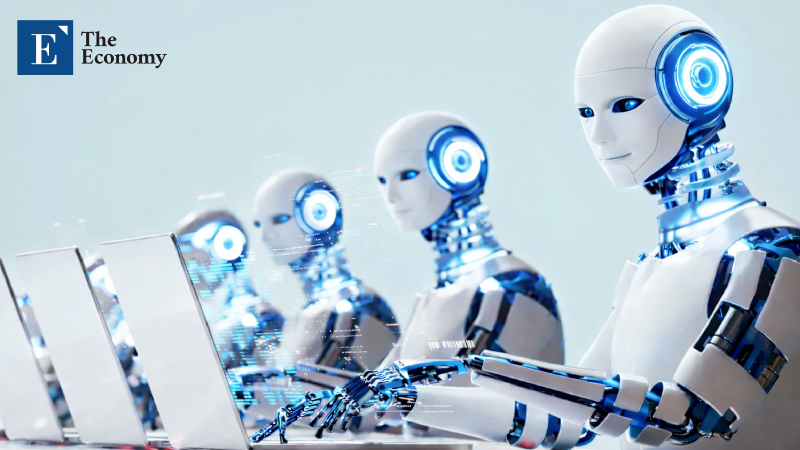
Despite the economic expansion, companies remain reluctant to hire, driven by both concerns about the outlook and the belief that artificial intelligence will be able to replace a growing share of work. Many firms increasingly view new hiring as a cost burden and are choosing to maintain current staffing levels while observing how productivity evolves. This mindset is also evident in remarks from U.S. Federal Reserve officials. Fed Chair Jerome Powell said recently that while AI can boost economic growth and productivity, it may also weaken employment in certain areas, pointing to the potential divergence between growth and jobs.
Christopher Waller, a Fed governor often mentioned as a future chair candidate, echoed this view at a Yale University event, saying that executives across the country are delaying hiring because they remain uncertain about which tasks AI will replace. “The prevailing corporate mindset is that additional workers are not yet necessary,” he said. Fed Governor Lisa Cook similarly described AI as a “general-purpose technology” akin to electricity or the printing press, emphasizing that while it raises labor productivity, it can also displace certain jobs.
Rising levels of technology investment reinforce this assessment. Goldman Sachs Research estimates that capital expenditures by major global technology companies in the AI sector will reach $527 billion next year, up roughly 13 percent from its third-quarter forecast of $465 billion. The rapid upward revision highlights how companies are channeling capital toward servers, data centers, semiconductors, and software rather than expanding payrolls. As returns on these investments become more visible, firms can achieve similar revenue and performance with fewer workers, reinforcing decisions to delay new hiring.
Individual company examples underscore this shift. Wells Fargo CEO Charlie Scharf has said that AI’s impact on workforce management will be “extremely significant,” noting that while AI will not fully replace humans, it is fundamentally changing how work is done. Wells Fargo’s workforce has already declined from roughly 275,000 employees in 2019 to about 210,000 today. The trend signals a broader strategic shift away from growth driven by headcount expansion toward performance sustained through technology investment and organizational efficiency.
Conservative Hiring Likely to Persist Regardless of the Business Cycle
Market experts broadly agree that the labor market restructuring that gained momentum in the second half of last year is likely to accelerate through 2026 and 2027. They argue that companies have already entered a stabilization phase in which the focus has shifted decisively from workforce expansion to technology investment and organizational efficiency. Silicon Valley is frequently cited as evidence. Home to global technology giants such as Google, Meta, and Apple, the region boasts some of the highest average wages in the United States. Technology-related roles account for 12.6 percent of all jobs in the area, and hiring by tech firms has long been a constant. Foreign workers represent 48 percent of the workforce, the highest share nationwide.
Behind these high wages and global talent inflows, however, restructuring has advanced rapidly. Since the pandemic, tech companies in Silicon Valley have laid off more than 48,500 workers based on mass layoff notices filed with the California Employment Development Department under the Cal-WARN Act. Over the past three years, Meta cut 5,195 jobs, Tesla reduced headcount by 3,652, and companies including Google, Intel, Broadcom, and Salesforce each eliminated more than 1,000 positions. The trend has continued into 2025. In the first two months of this year alone, 8,700 jobs disappeared in Silicon Valley, accounting for the vast majority of the 9,900 jobs lost across the region during that period.
Experts view this restructuring as a consequence of shifts in corporate medium- to long-term strategy. With financing conditions tightening amid a prolonged high-interest-rate environment, both big tech firms and startups have intensified “selective focus” strategies that concentrate resources on core businesses. Google has been operating a voluntary exit program since January while scaling back staffing on hardware projects, while Meta has sharply reduced both headcount and investment in its metaverse division. As layoffs continue across other companies, uncertainty within both corporate organizations and the job market is steadily rising.
That said, the restructuring does not imply an across-the-board contraction in hiring. Demand is increasing for software engineers, full-stack developers, and professionals in artificial intelligence and network security, leading to rapid hiring growth in select fields such as AI, biotechnology, and fintech. Salesforce has announced plans to hire around 2,000 employees following the launch of its AI solution Agentforce, while Google and Meta have expanded research hiring in AI and machine learning. Databricks recently announced a $7.0 billion Series J funding round, stating that the capital will be used to secure AI talent and develop new products.
Niamh O’Sullivan is an Irish editor at The Economy, covering global policy and institutional reform. She studied sociology and European studies at Trinity College Dublin, and brings experience in translating academic and policy content for wider audiences. Her editorial work supports multilingual accessibility and contextual reporting.
Similar Post