U.S. invasion of Venezuela faces global backlash as escalation risks emboldening China on Taiwan

Authored On
Modified
International community warns U.S. invasion of Venezuela and forced transfer of Maduro sets a “dangerous precedent”
Public comparisons grow between the current crisis and China–Taiwan relations, strengthening the case for intervention
U.S. adopts a hard-line approach “more overt than the bin Laden operation,” with intervention expected if China–Taiwan clash

As the Donald Trump administration attacked Venezuela and forcibly transferred Venezuelan President Nicolás Maduro to the United States, concern across the international community is intensifying. Critics warn the episode could leave an inappropriate precedent, effectively handing countries such as China—seen as looking for an opening to justify military intervention against Taiwan—a pretext. Some also argue the U.S. operation looks markedly different from the 2011 mission targeting Osama bin Laden, and that this harder-line approach may persist.
Rising risk of escalating China–Taiwan tensions
On the 4th (local time), Bloomberg reported that President Trump’s operation to apprehend Maduro drew intense attention on Weibo, China’s largest social media platform. The issue climbed into the top ranks of Weibo’s real-time trending list over the weekend, and related posts recorded roughly 440 million views. In particular, posts comparing Venezuela and Taiwan were reported to have spread rapidly among Chinese users.
Some users pointed to the U.S. using military force to detain a foreign leader, arguing that it sent a signal China could choose a tougher course on the Taiwan issue. The logic was that if Venezuela became a target of direct U.S. intervention, Taiwan—claimed by China as its territory—could face a similar situation at any time. Bloomberg said the sheer scale of Taiwan-associated reactions spreading across Chinese social media was itself noteworthy.
Major news outlets have also begun to raise similar scenarios. Reuters said the U.S. military operation could weaken “international norms that deter disputes” involving China and Russia, and that if aggressive military intervention is treated as acceptable, it could become easier to justify such intervention elsewhere, including Taiwan. Reuters also noted China’s interest in strategic resources and assets across South America—such as Venezuelan oil, Peruvian ports, Bolivian lithium, Brazilian soybeans, and Chilean copper—arguing that the episode has revealed deeper geopolitical tensions behind what it described as a renewed U.S. push to assert hegemony in the Western Hemisphere.
The Guardian, citing Geoffrey Robertson—the founding head of London-based Doughty Street Chambers and a former president of the UN war crimes tribunal for Sierra Leone—said the precedent set by the Venezuela invasion could encourage other countries to undertake operations that violate international law. Robertson said, “The most obvious consequence of this invasion is that China will seize the opportunity to invade Taiwan,” adding that with precedents such as Trump’s invasion of Venezuela and a conciliatory U.S. posture toward Russia after its invasion of Ukraine, now is “the most appropriate time” for such a move.
International reaction to the U.S. decision
Across the international community, concerns are mounting that the episode could become a “dangerous precedent” that exacerbates global security instability. UN Secretary-General António Guterres, speaking through a spokesperson, stressed that all countries must fully respect international law, including the UN Charter. The European Union responded cautiously, mindful of potential violations of international law. Without directly addressing the U.S. military operation, European Commission President Ursula von der Leyen said the EU stands with the Venezuelan people in support of a peaceful and democratic transition, adding that any solution must respect international law and the UN Charter.
Countries in Latin America voiced strong criticism of the U.S. airstrikes. Brazilian President Luiz Inácio Lula da Silva wrote on X (formerly Twitter) that bombing Venezuelan territory and capturing its president crossed an unacceptable line, calling it a grave affront to Venezuela’s sovereignty and an extremely dangerous precedent for the international community. Cuban President Miguel Díaz-Canel, whose country has long faced U.S. economic sanctions, said the Caribbean as a zone of peace had been brutally violated, denouncing what he described as a near-criminal U.S. attack as an act of terror against the Venezuelan people and the Americas. Colombian President Gustavo Petro and Chilean President Gabriel Boric also urged the U.S. and Venezuela to pursue a peaceful resolution through dialogue.
Russia, China, and Iran—countries that had maintained friendly ties with Venezuela—also issued direct condemnations of the United States. China’s Foreign Ministry said it was deeply shocked by what it described as the U.S. use of force against a sovereign state and the targeting of its president, and strongly condemned the action while calling on Washington to stop infringing on the sovereignty and security of other countries. Iran said the U.S. airstrikes violated the UN Charter. Russia’s Foreign Ministry, responding to reports of the detention of President Maduro and his wife, said that if such actions had indeed occurred, they would constitute an unacceptable violation of an independent state’s sovereignty, stressing that respect for sovereignty is a core principle of international law.
Shift in the U.S. approach to military intervention
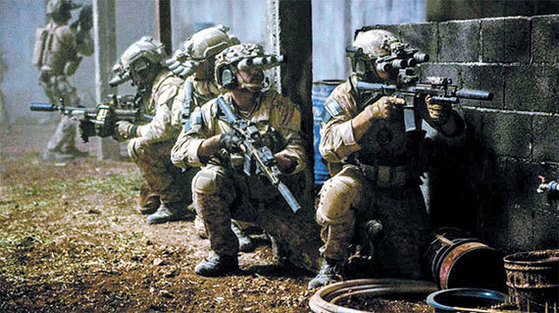
Some analysts argue that the level of U.S. military action has risen markedly compared with the 2011 operation targeting Osama bin Laden. Even when confronting bin Laden, a terrorist leader, the United States conducted the mission in secrecy. This time, it followed formal procedures and publicly detained an elected president, signaling a far more hard-line posture. Bin Laden was the mastermind of the 9/11 attacks and the leader of al-Qaeda, a Sunni Islamist extremist group.
U.S. intelligence agencies secured the first leads for the bin Laden operation in August 2010, then spent nine months secretly verifying intelligence and planning the mission. The actual raid took place in May 2011. The operation involved the U.S. Navy’s elite SEAL Team 6 and Delta Force, the Army’s top counterterrorism unit that also led the recent Maduro capture operation. After a ground firefight, more than 20 people, including bin Laden and his son, were killed or detained. U.S. forces recovered bin Laden’s body and confirmed his identity through DNA testing.
If concerns voiced by the international community materialize and China moves toward direct involvement in Taiwan, U.S. special forces—including SEAL Team 6—are widely expected to be deployed again. According to a 2024 report by the Financial Times citing sources familiar with the matter, SEAL Team 6 has been secretly planning and training for a Taiwan-related contingency for more than a year at Dam Neck base in Virginia Beach. Sean Naylor, who runs the defense-focused outlet The High Side, said it was not surprising that SEAL Team 6 was planning missions related to Taiwan, adding that as the Pentagon has reoriented in recent years toward great-power competition, the United States’ elite counterterrorism units have inevitably had to find roles in that arena.
Similar Post