AI and Aging Reshape Employment Landscape, Care Jobs Surge Amid AI-Driven Hiring Cliff

Authored On
Modified
Broadening Employment Contraction Driven by AI Adoption
Rising Care Employment Amid Deepening Super-Aging Trend
Acceleration of Labor and Industrial Reorganization Around Age-Tech

As workforce reductions spread across U.S. industries, artificial intelligence is increasingly cementing its role as a substitute for large segments of the labor market. By contrast, demand for occupations tied to Age-Tech—the convergence of caregiving services and information technology—is projected to surge as population aging accelerates. This is not a phenomenon unique to the United States. Major economies that have already entered super-aged society status, including South Korea and Japan, are also intensifying efforts to address labor shortages driven by demographic change through AI-centered care innovation. The global labor market now stands at a major inflection point, shaped simultaneously by AI-driven job reconfiguration and the expansion of the silver economy rooted in demographic transformation.
950,000 U.S. Jobs Replaced by AI
According to data released on the 4th (local time) by job platform Indeed, a growing share of U.S. industries is moving away from workforce expansion toward headcount maintenance or reduction. In a survey conducted at a CEO roundtable hosted last month in Manhattan by Yale School of Management, 66% of executives said they plan to either cut staff or keep headcount flat next year. Only one-third indicated intentions to increase hiring. Indeed noted that “employment expansion is no longer the default option.”
The Wall Street Journal also reported recently that large U.S. corporations are effectively excluding hiring expansion from their 2026 business plans. Citing companies such as Shopify and Chime Financial, which have already announced headcount freezes for next year, the paper observed that “the decision not to hire is no longer a defensive move by a handful of firms, but a trend spreading across industries.”
Corporate America is already reflecting this shift. Starbucks laid off 900 corporate employees last September, followed in October by Target, which eliminated 1,800 positions as part of organizational streamlining. Amazon, Verizon, Target, and United Parcel Service have each cut workforces numbering in the tens of thousands over recent months. According to a report by outplacement firm Challenger, Gray & Christmas, 950,000 jobs were lost in the United States last year—the largest annual decline since 2020.
This trend is closely tied to the rapid diffusion of AI technologies. A joint study by researchers at the Massachusetts Institute of Technology and Oak Ridge National Laboratory estimated that AI could substitute for 11.7% of the total U.S. labor market. The researchers decomposed the work performed by 151 million U.S. workers into granular “digital task inventories,” then assessed how many of those tasks AI systems could realistically perform. They matched more than 32,000 skills required across occupations against roughly 13,000 AI-enabled capabilities, analyzing the overlap between human and machine task sets.
The analysis found that the value of AI-applicable tasks across administrative, financial, clerical, and other sectors amounts to 11.7% of total U.S. labor compensation, or approximately $1.2 trillion. The study concluded that visible changes such as hiring freezes and partial job restructuring represent only a fraction of AI’s impact, with the volume of tasks potentially transferable to AI exceeding current perceptions by more than fivefold. These effects are not confined to Silicon Valley but are broadly distributed across all 50 U.S. states, including non-urban regions.
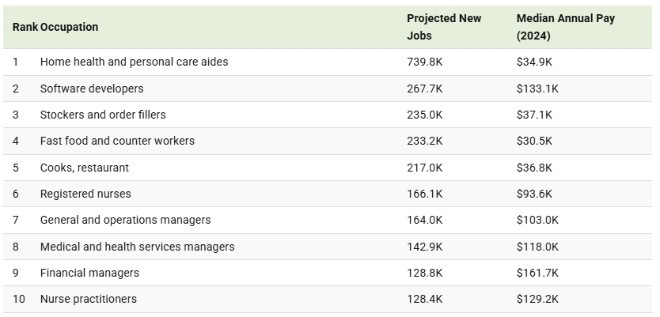
Fastest-Growing U.S. Jobs Center on Care Work
By contrast, employment tied to Age-Tech is projected to expand sharply. An analysis by Visual Capitalist, drawing on data from USAFacts and the U.S. Bureau of Labor Statistics, shows that home health aides and personal care workers will account for the largest number of new jobs created in the United States through 2034, with an estimated 739,800 additional positions over the next decade.
This growth reflects the rapid increase in the elderly population and the expansion of chronic disease prevalence. According to the U.S. Census Bureau, the share of Americans aged 65 and older rose from 12.4% in 2004 to 18% in 2024. The number of states where the elderly population exceeds the child population increased from three in 2020 to 11 in 2024. By 2030, more than 20% of the U.S. population will be aged 65 or older, marking a full transition into a super-aged society. The elderly share, which stood at 15.2% in 2016, is projected to rise to 23.4% by 2060.
Labor supply, however, is failing to keep pace. A report from Harvard T.H. Chan School of Public Health projects that 4.6 million caregiving positions will go unfilled by 2032. McKnight’s Senior Living has identified long-term care as the segment facing the most acute workforce shortages within healthcare, noting that staffing levels have declined by more than 7% since 2020.
To address rising elderly demand, the United States is accelerating not only job creation but also the deployment of digital health and AI-based care services. These include robots that assist with mobility, sensor-equipped objects that track movement and activity, and wearable devices that collect biometric data and transmit it to caregivers for remote health monitoring. The integration of AI is widely viewed as a decisive factor in shifting Age-Tech from reactive, post-incident care toward predictive, preventive management.

Super-Aged Societies Reorganized Around Age-Tech
Other super-aged economies face similar pressures. In South Korea, where the population aged 65 and older has reached 10.51 million, accounting for 20.3% of the total population, the Age-Tech market is expanding rapidly. According to Kyung Hee University’s Age-Tech Research Institute, the country’s senior industry was valued at approximately $63.8 billion in 2024 and is projected to grow to between $96.9 billion and $208.5 billion by 2030. The domestic market is increasingly focused on technologies that enhance quality of life in old age, including health management, rehabilitation, and cognitive training, reflecting growing demand for “well-aging” solutions among affluent seniors.
AI-powered care robots designed to support elderly individuals living alone are also gaining traction. The emotional care robot “Hyodol” is currently deployed by 180 local governments and more than 360 senior welfare institutions nationwide. Using conversational AI, the robot provides medication and meal reminders, safety monitoring, and cognitive engagement. It can issue alerts in the event of prolonged inactivity to prevent accidents and supports dementia prevention through quizzes and music-based interaction.
Japan, the world’s fastest-aging society, is similarly leveraging Age-Tech as a response. According to a report released late last year by the Korea Trade-Investment Promotion Agency on Japan’s Age-Tech landscape, the country entered super-aged status in 2005 and now has an elderly population share exceeding 29%, projected to reach 37% by 2050. This demographic shift is driving severe shortages in caregiving labor. Data from Japan’s Ministry of Health, Labour and Welfare indicate projected shortfalls of roughly 250,000 care workers next year and 570,000 by 2040, with job-opening ratios in the sector reaching 3.97 times, underscoring the severity of the labor crunch.
Concluding that workforce expansion alone is insufficient, the Japanese government has turned to efficiency gains through technology and automation. The diffusion of Age-Tech in Japan reflects close coordination between public policy and private enterprise. The Ministry of Health, Labour and Welfare’s “Needs–Seeds Matching” platform directly connects care facilities’ on-site challenges with technological solutions from firms, enabling the deployment of customized care robots and medication management systems in nursing homes.
The government is also scaling up pilot programs. As of last year, Japan’s budget for addressing population aging reached approximately $161.3 billion, an increase of about $4 billion from the previous year, alongside expanded subsidies supporting digital transformation among small and medium-sized enterprises. Backed by this policy support, Japan’s silver industry is growing rapidly. Mizuho Bank estimates the market at roughly $675.3 billion, equivalent to about $717.3 billion, marking a 61% increase compared with 2007.
Similar Post