“Samsung, SK hynix earnings seen rising” AI-driven memory supercycle continues, China readies its push

Aoife Brennan is a contributing writer for The Economy, with a focus on education, youth, and societal change. Based in Limerick, she holds a degree in political communication from Queen’s University Belfast. Aoife’s work draws connections between cultural narratives and public discourse in Europe and Asia.
Authored On
Modified
Global memory prices keep climbing as AI demand surges and supply stays tight
Samsung Electronics and SK hynix gain the upper hand in pricing talks, with earnings seen improving
Despite heavy investment, China’s memory profitability and market share stagnate, with an “IPO rally” a medium- to long-term wildcard
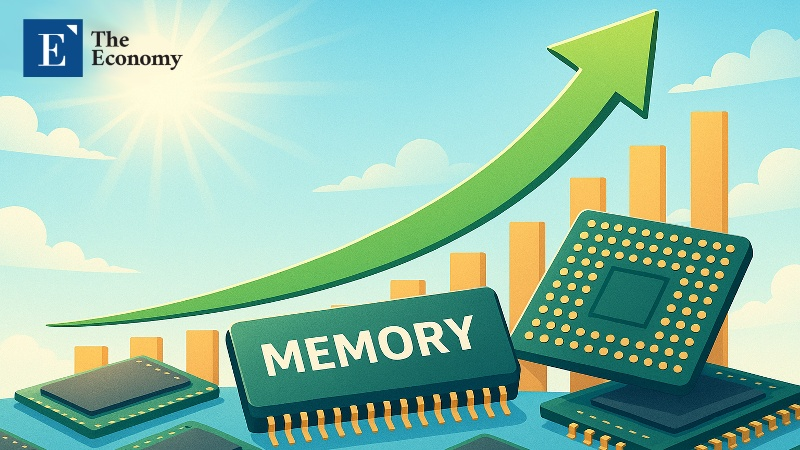
The global memory market is enjoying an unprecedented boom. As the AI industry expands at speed, demand for memory chips has surged, while supply has struggled to keep pace—driving sharp increases in prices across products. Even as Chinese memory makers, long seen as a potential game-changer, face difficulties in meaningfully expanding their influence, leading players such as Samsung Electronics and SK hynix are holding a steady advantage in the market and building expectations for improved earnings.
Memory prices surge amid AI-driven demand
According to the semiconductor industry on the 5th, memory products posted steep price gains across the board last year. Data from Taiwan-based Digitimes Research show that between late 2024 and last December, spot prices for DDR5 16Gb rose from $4.6 per module to $28, up more than 500%. Over the same period, DDR4 16Gb module prices jumped from about $3.2 to more than $62, a surge of over 1,800%, while NAND flash wafer prices climbed from $2.48 to about $11, up more than 300%. With the AI boom sharply lifting demand across memory products, major suppliers’ push to ramp up high-bandwidth memory (HBM) output has tightened supply of commodity DRAM.
Samsung Electronics, SK hynix, and Micron are also said to have proposed price hikes of more than 60% quarter-on-quarter in negotiations with key customers over first-quarter server DRAM prices, leveraging their advantage amid an acute supply crunch. The market expects major customers to accept that pricing stance. Research firm DRAMeXchange said large customers (CSPs) believe spending to build out AI infrastructure is “manageable,” and are prioritizing monetization of inference AI over cost cutting, adding that they are not pushing back hard on DRAM price increases and are instead focused on securing stable supply. Reflecting this, DRAMeXchange forecast that fixed contract prices for server DRAM in the first quarter will rise 60–65% from the previous quarter.
The boom is expected to persist for some time. DRAMeXchange projects DRAM price increases of 10–15% in the second quarter, 3–8% in the third quarter, and 0–5% in the fourth quarter. Global investment banks are also raising earnings forecasts for Samsung Electronics and SK hynix in line with the market trend. In December, Goldman Sachs projected Samsung Electronics’ operating profit this year at about $77.6 billion, while Citi on the 2nd put its estimate at about $107.3 billion—up 34.8% from its previous forecast of about $79.6 billion. For SK hynix, Citi’s operating profit forecast for this year stands at about $78.3 billion, while Morgan Stanley’s is about $102.5 billion.
Chinese memory makers’ market influence remains limited
China’s push—long cited as a key threat to Korean memory makers—has yet to translate into meaningful market clout. In response to technology controls led by the United States and other Western countries, Beijing has declared a drive for semiconductor self-sufficiency and poured more than $115 billion in public funds into the sector through the central government’s National Integrated Circuit Industry Investment Fund (the “Big Fund”) and local government vehicles. Supply-side expansion has also been aggressive, with construction starting on 18 new wafer fabs in 2024 alone.
The problem is that despite massive investment, the market power of Chinese chipmakers has weakened. According to TrendForce, the combined global market share of China’s top three foundries—SMIC, Hua Hong Group, and Nexchip—fell by 1 percentage point to 8.6% in the third quarter of last year from 9.6% in 2022. By company, SMIC’s share edged down from 5.3% to 5.1%, Hua Hong’s from 3.1% to 2.6%, and Nexchip’s from 1.3% to 0.9%. Even with production capacity sharply expanded on the back of government subsidies, firms have struggled to secure customers and grow revenues.
Profitability has also deteriorated. SMIC’s revenue more than doubled over four years, rising from $3.91 billion in 2020 to $8.03 billion in 2024. But its net margin plunged from 31.3% in 2021 to 6.1% in 2024, slipping further to 5.9% on a preliminary basis in the second quarter of last year. The contrast is stark with Taiwan’s TSMC, the world’s top foundry, which continues to post gross margins above 50% and net margins around 40%.
The root cause of weak competitiveness and eroding margins is widely seen as U.S. export controls on semiconductor equipment to China. SMIC remains unable to secure extreme ultraviolet (EUV) lithography tools—essential for advanced-node production—and instead relies on deep ultraviolet (DUV) equipment using multi-patterning, which layers circuits multiple times. A market expert noted that producing 7nm chips with DUV costs 40–50% more than with EUV and makes yield improvements difficult, rendering profitable mass production “a tall order.” With access to EUV blocked, prospects for achieving competitiveness at sub-5nm leading-edge nodes are remote, the expert added, forcing China into a vicious cycle of flooding the market with low-priced output at legacy nodes of 28nm and above.
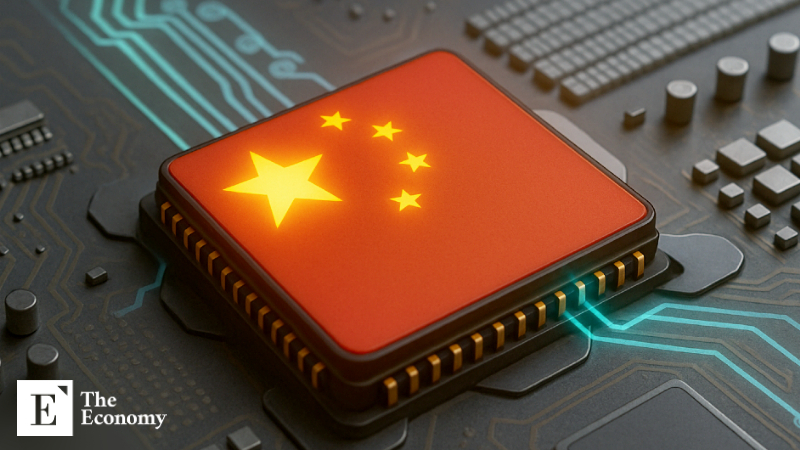
Chinese chipmakers seek funding, technology edge in focus
Still, the possibility of a sharp shift in market dynamics cannot be ruled out. Chinese semiconductor companies are increasingly tapping public markets to raise funding. Moore Threads and MetaX—two of the companies often cited as China’s “four most promising GPU contenders”—listed on the Shanghai stock market last month, raising about 8 billion yuan and 4.2 billion yuan, respectively. Biren Technology, also viewed as part of the same quartet, saw its shares jump 75.8% above the offer price on its Hong Kong debut on the 2nd this month, signaling a strong reception.
CXMT, China’s top DRAM maker, has also recently begun the process for an initial public offering. Based on its filing and market estimates, CXMT plans to raise about 29.5 billion yuan, with roughly 75%—22 billion yuan—allocated to technology upgrades and early-stage R&D. The move signals a shift away from a “quantity-driven” strategy focused on expanding capacity and output, toward “quality-driven” growth aimed at strengthening competitiveness through advanced manufacturing technology.
Industry watchers increasingly argue that Korea must preserve its technology lead to defend its position in the semiconductor market. Samsung Electronics, for example, has recently provided customers with samples of 16Gb DDR5 DRAM capable of 7,200Mbps. That is about 30% faster than its current mass-produced DDR5 products at 5,600Mbps. Samsung applied EUV lithography in a 12nm-class process to improve productivity and used through-silicon via (TSV) technology to build modules with capacities of up to 1 terabyte (TB). It also enhanced power efficiency with a power management IC (PMIC) and added on-die ECC to correct errors within the chip, meeting data-center demands for reliability. Samsung is expected to use the new product to aggressively capture surging AI-driven demand for data-traffic processing.
Aoife Brennan is a contributing writer for The Economy, with a focus on education, youth, and societal change. Based in Limerick, she holds a degree in political communication from Queen’s University Belfast. Aoife’s work draws connections between cultural narratives and public discourse in Europe and Asia.
Similar Post
















