After Venezuela, Greenland: Trump’s Post-Maduro ‘Invasion Instincts’ Come Into Full View

Matthew Reuter is a senior economic correspondent at The Economy, where he covers global financial markets, emerging technologies, and cross-border trade dynamics. With over a decade of experience reporting from major financial hubs—including London, New York, and Hong Kong—Matthew has developed a reputation for breaking complex economic stories into sharp, accessible narratives. Before joining The Economy, he worked at a leading European financial daily, where his investigative reporting on post-crisis banking reforms earned him recognition from the European Press Association. A graduate of the London School of Economics, Matthew holds dual degrees in economics and international relations. He is particularly interested in how data science and AI are reshaping market analysis and policymaking, often blending quantitative insights into his articles. Outside journalism, Matthew frequently moderates panels at global finance summits and guest lectures on financial journalism at top universities.
Authored On
Modified
The Trump administration openly signals its bid to expand influence across the Western Hemisphere
From Venezuela to Denmark, “We will have Greenland, one way or another”
Europe moves to block Trump’s territorial ambitions
Fresh off the successful military operation against Venezuela, U.S. President Donald Trump has turned his gaze toward Greenland, repeatedly laying bare his territorial ambitions over the Danish autonomous territory. The atmosphere suggests that even military force is not being ruled out as a means of securing Greenland. Under the banner of controlling Arctic sea lanes, securing strategic minerals, and blocking Chinese and Russian influence in the Western Hemisphere, Washington’s hegemonic blueprint for Greenland is increasingly explicit.
White House: “Trump Considering Use of U.S. Military to Acquire Greenland”
On the 6th, White House Press Secretary Karoline Leavitt said in a statement sent to CNN and the Financial Times that “President Trump has made it abundantly clear that acquiring Greenland is a top priority for the United States, and that it is essential to deterring adversaries in the Arctic region.” She added that Trump and his aides are “discussing a range of options to pursue this critical foreign policy objective,” noting that “one of the options always available to a commander in chief is the use of the U.S. military,” thereby signaling the possibility of military intervention.
The statement came just two days after Trump, following the arrest of Venezuelan President Nicolás Maduro, warned that other countries could face U.S. intervention similar to Venezuela, once again underscoring his territorial appetite for Greenland. Since taking office in January, Trump has consistently asserted U.S. jurisdiction over Greenland. Earlier, in a phone interview with The Atlantic on the 4th, Trump said that “other countries could be subject to U.S. intervention just like Venezuela” and added, “We need Greenland. We absolutely need it for our defense.” The remarks were widely interpreted as implying that Greenland’s territorial control could be seized by force, as in Venezuela.
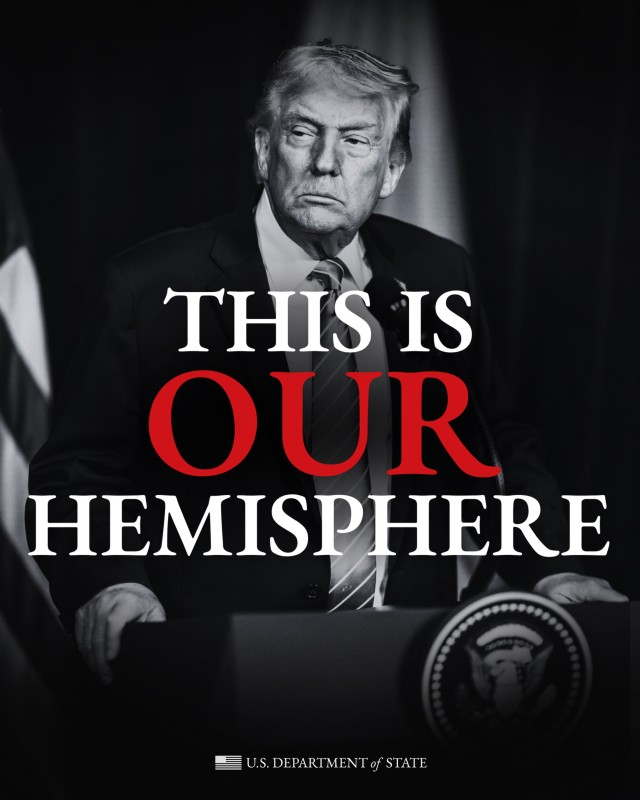
The U.S. State Department also amplified the message on the 5th by posting an image on its official X account showing Trump with the caption “This is Our Hemisphere,” openly declaring Washington’s determination to dominate the Western Hemisphere. The post added that “President Trump will not allow the United States to be threatened.” Trump’s closest allies have likewise continued to make public remarks supporting Greenland’s annexation. Stephen Miller, deputy White House chief of staff for policy, said in a CNN interview on the 5th that “no one should try to fight the United States over Greenland’s future,” adding that “the world is governed by power and force.” His wife, Katie Miller, a far-right podcaster, further provoked Denmark by posting an image of Greenland draped in the U.S. flag on X with the caption “SOON.”
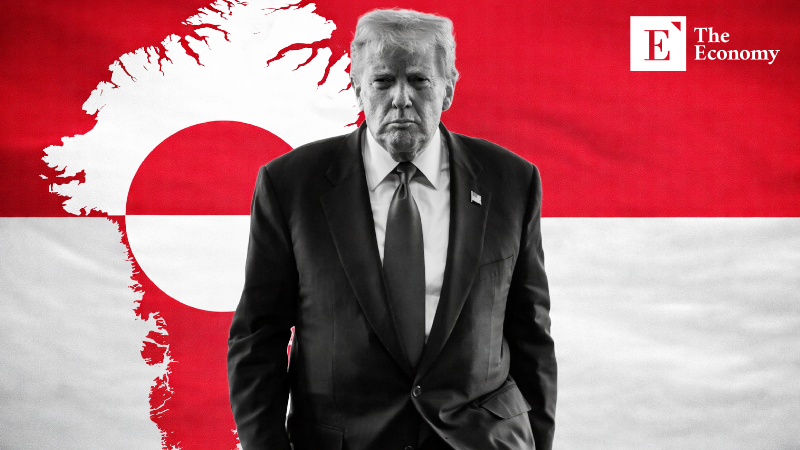
The Unrestrained ‘Don-roe Doctrine’: The Bare Face of Maritime Hegemony and Territorial Expansion
Trump’s stated rationale for coveting Greenland centers on national security. As climate change melts Arctic ice, waters around Greenland are emerging as the shortest maritime routes linking Europe, Asia, and North America. The Arctic Sea Route is divided into the Northern Sea Route (NSR) and the Northwest Passage (NWP). The NSR runs through the Bering Sea between Russia and Alaska, across the Russian Arctic, connecting Europe and Asia. The NWP also passes through the Bering Sea, cutting across Alaska and Canada’s Arctic coastline toward Europe, but is shallower, more complex, and dotted with numerous islands, making navigation more difficult.
Located near the western terminus of these routes, Greenland holds potential as a logistics hub linking North America and Europe and is also considered suitable for missile early-warning systems. Control of Greenland would therefore grant dominance over Arctic maritime traffic and logistics. China and Russia have long shown strong interest in the territory. In 2023, the two countries formed a working group to develop Arctic sea routes and recently agreed to coordinate Arctic maritime law enforcement, beginning with joint patrols. Trump has repeatedly voiced strong concerns, insisting that Arctic influence must not fall into the hands of “hostile states.” He recently reiterated that “Greenland is extremely strategic right now,” adding that “Russian and Chinese ships are everywhere. From a national security perspective, the United States needs Greenland, and Denmark cannot handle it.”
Trump has also argued that Greenland’s critical mineral resources must not be ceded to adversarial powers. Greenland is seen as a strategic counterweight to China’s dominance in rare earths. As glaciers melt, access has opened to an estimated $10 trillion worth of resources, including rare earth elements, oil, and natural gas. China has pursued investments and sought to expand its military footprint under its Polar Silk Road initiative, aiming to leverage resource-based economic influence and strengthen strategic positioning.
In addition, Greenland sits astride the Greenland-Iceland-UK (GIUK) Gap, a linchpin of NATO strategy that blocks Russia’s access to the Atlantic. It also hosts the Pituffik Space Base, which supports U.S. missile early warning and space surveillance, underscoring its military significance. Ultimately, Trump has made clear his intention to mobilize political, military, and economic power to consolidate U.S. dominance across the Western Hemisphere.
This determination to suppress Chinese and Russian influence and restore singular U.S. hegemony is encapsulated in Trump’s so-called “Don-roe Doctrine,” a portmanteau of “Donald” and the Monroe Doctrine articulated by President James Monroe in the 19th century. The Trump administration’s National Security Strategy released on December 4 explicitly identified expanding influence in the Western Hemisphere as a key priority, emphasizing the need to prevent external powers such as China from acquiring military or strategic assets in the region.
“Greenland Is for Denmark and Greenland to Decide”: Europe Pushes Back
European leaders, however, view this posture as a clear violation of sovereignty and a potential security threat. Danish Prime Minister Mette Frederiksen on the 4th flatly rejected Trump’s rhetoric, stating, “Greenland is not for sale. Nothing has changed,” and urged him to halt his threatening language. She warned that any U.S. attack on Denmark would signal the end of the NATO alliance, as military action in Greenland would be treated as an attack on all members under NATO’s collective defense principle. In an interview with Danish media on the 5th, Frederiksen said, “Greenland is part of Denmark and therefore a NATO ally,” adding that “if the United States were to militarily attack another NATO member, the entire security order built since the end of World War II would collapse.” No NATO member has ever gone to war against another. Bloomberg observed that “even the possibility of U.S. force being used against Greenland risks destabilizing the entire Western security order.”
Major European countries have also rallied behind Denmark and Greenland, seeking to rein in Washington’s unilateralism. On the 6th, the German federal government, together with the leaders of the United Kingdom, France, Italy, Poland, Spain, and Denmark, emphasized that Greenland, a strategically vital and resource-rich Arctic island, “belongs to its people.” They stressed that matters concerning Denmark and Greenland can only be decided by Denmark and Greenland themselves. The seven leaders stated that “Arctic security is a core European priority and of great importance to international and transatlantic security,” noting that NATO has clearly identified the Arctic as a priority and that European allies, together with other partners, are increasing deployments, activities, and investments to ensure Arctic security and deter hostile actors.
They further underscored that Denmark is a NATO member and that Arctic security must be pursued in line with the principles of the UN Charter, including sovereignty, territorial integrity, and the inviolability of borders, through cooperation among NATO allies, including the United States. At the same time, they described the United States as an indispensable partner under NATO and the 1951 defense agreement with Denmark, signaling a preference for diplomatic resolution grounded in international law and alliance norms while issuing a clear warning against unilateral action.
Concerns have also emerged within the U.S. Congress. Representatives Blake Moore, a Republican, and Steny Hoyer, a Democrat, co-chairs of the bipartisan Congressional Friends of Denmark caucus, said in a statement on the 6th that “talk of annexing Greenland is an unnecessary and dangerous provocation,” adding that “Greenland is a core part of NATO, and any attack on it would be an attack on NATO.” The same day, Democratic Senator Ruben Gallego announced plans to introduce a resolution to block any Trump attempt to invade Greenland. If submitted, the Senate would be required to consider the measure under the War Powers Act. In a CNN interview, Gallego said the Constitution’s allocation of foreign policy authority to Congress exists “to prevent presidents like Trump from making reckless decisions without checks and balances.”
Matthew Reuter is a senior economic correspondent at The Economy, where he covers global financial markets, emerging technologies, and cross-border trade dynamics. With over a decade of experience reporting from major financial hubs—including London, New York, and Hong Kong—Matthew has developed a reputation for breaking complex economic stories into sharp, accessible narratives. Before joining The Economy, he worked at a leading European financial daily, where his investigative reporting on post-crisis banking reforms earned him recognition from the European Press Association. A graduate of the London School of Economics, Matthew holds dual degrees in economics and international relations. He is particularly interested in how data science and AI are reshaping market analysis and policymaking, often blending quantitative insights into his articles. Outside journalism, Matthew frequently moderates panels at global finance summits and guest lectures on financial journalism at top universities.
Similar Post