AI-Driven Productivity Ushers in a New Normal of ‘Jobless Growth’

Siobhán Delaney is a Dublin-based writer for The Economy, focusing on culture, education, and international affairs. With a background in media and communication from University College Dublin, she contributes to cross-regional coverage and translation-based commentary. Her work emphasizes clarity and balance, especially in contexts shaped by cultural difference and policy translation.
Authored On
Modified
Growth Exceeds 4%, Yet Employment Cools
Firms Opt for AI Over Hiring, Pursuing ‘Slimmed-Down’ Strategies
AI Boosts Productivity but Weighs on Job Creation

The prevailing keyword defining corporate hiring strategies in the United States has become “hiring freeze.” Despite clear evidence of robust economic growth, employment remains largely stagnant. Analysts note that this marks a departure from past cycles in which labor markets responded sensitively to economic fluctuations, instead signaling the emergence of a new equilibrium in which low employment functions as a baseline condition.
U.S. Job Openings in November Fall to Lowest Level in a Year
According to the Job Openings and Labor Turnover Survey (JOLTS) released on the 7th by the U.S. Department of Labor, seasonally adjusted job openings totaled 7.146 million in November of last year. This figure came in well below the market consensus of 7.6 million compiled by Bloomberg and marked the lowest level in a year. October job openings had already been revised down from an initial 7.67 million to 7.449 million, and November’s figure fell even further.
By sector, healthcare and social assistance recorded the highest number of openings at 1.335 million. Professional and business services followed closely with 1.334 million, while trade, transportation, and utilities posted 1.26 million, and leisure and hospitality 837,000. However, with the exception of professional and business services, all of these sectors saw job openings decline from October levels.
Although new hiring slowed, layoffs also decreased, preventing an abrupt contraction in the labor market. Total separations rose slightly to 5.08 million from 5.069 million in the prior month, while the separation rate held steady at 3.2%. Quits increased to 3.161 million from 2.973 million, with the quits rate unchanged at 2.0%. In contrast, involuntary separations due to layoffs fell sharply to 1.687 million from 1.85 million in October. After reaching the highest level since 2023 in October, layoffs declined to their lowest point in six months in November, and the layoffs rate eased from 1.2% to 1.1%.
A ‘Low Hiring, Low Layoff’ Climate Driven by Labor Hoarding
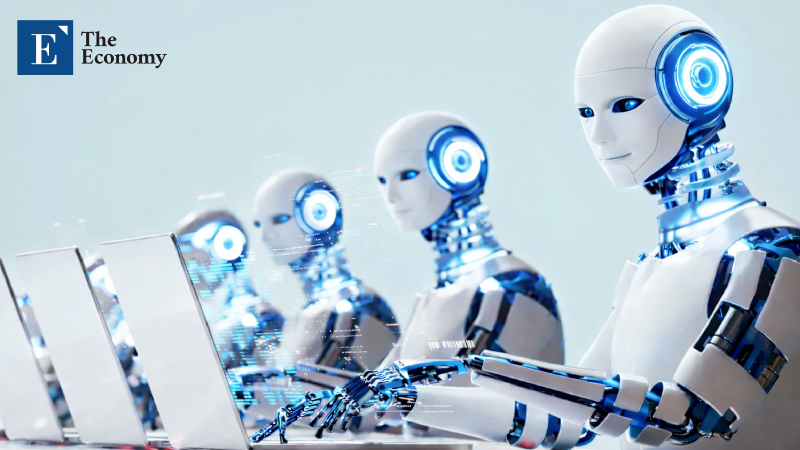
This slowdown in new hiring is widely interpreted as evidence that the U.S. labor market is gradually cooling. Rather than engaging in immediate, large-scale workforce reductions, firms are opting to curb hiring while adopting a wait-and-see approach, allowing a low-hiring environment to take hold. Underpinning this shift is the growing belief that artificial intelligence can replace an expanding share of tasks. According to the report “United States: Accelerating AI Adoption and Changes in the Labor Market,” published last month in the International Labor Brief by the Korea Labor Institute, the frequency of AI use in the U.S. has surged dramatically in recent years.
Survey data from the Pew Research Center show that 21% of U.S. workers report using AI as part of their job, up 5 percentage points from just a year earlier. A separate survey conducted by Gallup last June found that the share of workers using AI several times a year jumped from 21% in 2023 to 40% in 2025, nearly doubling in two years, while the proportion reporting daily use rose from 4% to 8%. AI adoption was most prevalent in the technology sector at 50%, followed by professional services at 34% and finance at 32%.
As AI capabilities become embedded in everyday work, labor market polarization is accelerating. A clear sorting mechanism is now evident within the U.S. labor market. Workers equipped with data analytics, automation design, and AI operations skills are being retained as core assets, while roles centered on repetitive tasks and mid-level skills are gradually being phased out. This dynamic is increasingly reflected in wage determination. An analysis of more than one billion job postings by labor market analytics platform Lightcast found that positions requiring AI skills offer average salaries 28% higher than those that do not. This suggests that disparities in employment and income driven by AI proficiency have already materialized.
These developments are understood not as short-term workforce reduction tactics, but as the outcome of a broader redesign of corporate operating models. As AI system-based management proliferates, firms are building structures that allow them to achieve the same output with fewer workers. Skilled labor has become scarcer, while the feasibility of replacing workers through new hiring has diminished. As a result, the labor market has entered a stagnation phase characterized by subdued hiring and layoffs alike, with reduced elasticity in labor supply and demand. Economists attribute this in part to the phenomenon of “labor hoarding,” whereby firms refrain from shedding workers amid uncertainty. As U.S. economist Arthur Okun observed in 1963, retaining employees can be preferable to risking the future costs and uncertainties of rehiring less-skilled labor. Excessive layoffs, the logic goes, ultimately undermine a firm’s ability to attract and retain talent.
AI-Driven Productivity Gains Enable Strong Growth Without Job Creation
What has drawn even greater attention is the recent divergence between economic growth and employment trends in the United States. Despite GDP growth exceeding expectations, job creation has lagged. According to the U.S. Department of Commerce, the economy expanded at an annualized rate of 4.3% quarter-on-quarter in the third quarter of last year. This marked the strongest growth in two years and surpassed market expectations of 3.2%. Yet employment failed to keep pace. The U.S. unemployment rate rose from 4.4% in September to 4.6% in November, reaching its highest level in four years and two months since September 2021.
In a recent report, Goldman Sachs noted that “the phenomenon of stagnant employment despite solid GDP growth may become a normal feature going forward,” characterizing AI-driven productivity gains as a structural factor that does not translate into increased hiring. The New York office of the Bank of Korea similarly warned that if AI automation is used as a substitute for existing labor during economic downturns, labor markets could remain depressed for an extended period.
The U.S. Federal Reserve has also taken note of the growing disconnect between growth and employment. Fed Chair Jerome Powell cautioned that while AI can stimulate economic expansion and productivity, it may simultaneously weaken employment in certain areas. Philadelphia Fed President Anna Paulson echoed this concern, emphasizing the possibility that AI is reshaping the traditional relationship between growth and jobs. Speaking on the 3rd at the 2026 American Finance Association Annual Meeting in Philadelphia, Paulson observed that “conflicting signals of strong growth and a slowing labor market are appearing simultaneously,” citing AI-driven changes in productivity structures as one potential explanation.
Paulson singled out the slowdown in job growth among younger workers and entry-level positions as a particularly important indicator. While such trends have historically been interpreted as precursors to economic downturns, these roles are also among the most vulnerable to AI disruption. This suggests that the current deceleration in employment reflects not cyclical weakness, but a deeper shift in labor demand driven by AI’s transformation of the employment landscape.
Siobhán Delaney is a Dublin-based writer for The Economy, focusing on culture, education, and international affairs. With a background in media and communication from University College Dublin, she contributes to cross-regional coverage and translation-based commentary. Her work emphasizes clarity and balance, especially in contexts shaped by cultural difference and policy translation.
Similar Post