[China subsidies] China’s subsidy trap leaves both gasoline and EV sectors broken, local finances under strain

As one of the youngest members of the team, Tyler Hansbrough is a rising star in financial journalism. His fresh perspective and analytical approach bring a modern edge to business reporting. Whether he’s covering stock market trends or dissecting corporate earnings, his sharp insights resonate with the new generation of investors.
Authored On
Modified
China’s EV-heavy support leaves gasoline cars stranded, fueling an export glut
Over-subsidization sickens China’s EV sector as oversupply and price wars persist
Local governments prop up zombie firms, distorting markets as debt pressure mounts
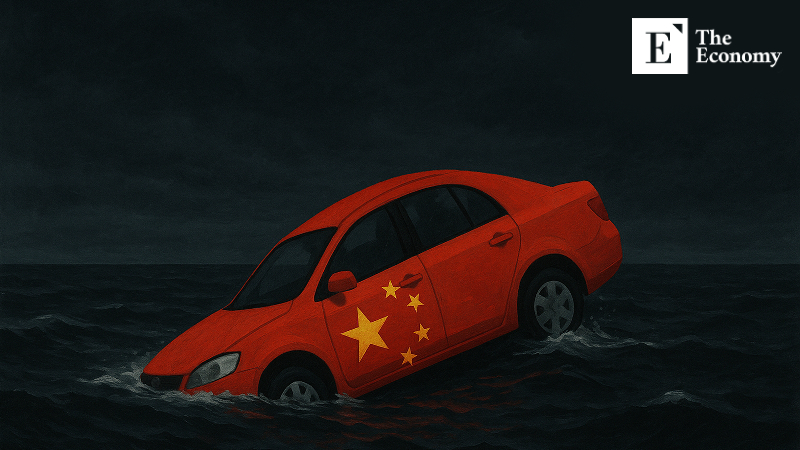
A wave of Chinese-made gasoline cars is expected to rattle the global auto market this year. As Beijing has poured aggressive support into the EV industry to upgrade the structure of its auto sector, gasoline-powered vehicles left without a home amid upheaval in the domestic market are increasingly being pushed out into overseas markets. Even Chinese EVs, now a new centerpiece of the market, are being driven into crisis as the backlash from heavy-handed subsidy policies—oversupply and a brutal price war—intensifies.
China’s gasoline cars lose ground amid EV surge
On January 8 (local time), Reuters projected that China’s vehicle exports could exceed 6.5 million units this year, with gasoline cars excluding EVs accounting for about two-thirds of the total. As China’s domestic market rapidly shifts, internal-combustion vehicles that have become unwanted inventory are increasingly being pushed into overseas markets. China’s auto market has been reshaped in just a few years around EVs and plug-in hybrids (PHEVs), leaving conventional assembly lines—built for annual capacity of 30 million vehicles—falling idle one after another. China’s unused gasoline-car capacity is estimated at roughly 20 million vehicles a year.
The driver of this shift is the Chinese government. In 2018, the National Development and Reform Commission released the “Regulations on the Administration of Investment in the Automobile Industry,” effectively banning automakers that produce vehicles powered by fossil-fuel engines from building new plants for the domestic market. Expansions by existing automakers aimed at increasing internal-combustion production capacity were also restricted. The move was widely seen as a strategy to upgrade the industrial structure by reorienting the market toward green vehicles, while cutting pollution from exhaust emissions.
Instead of supporting internal-combustion vehicles, the government poured massive resources into the EV industry. A 2024 report by the Korea Energy Economics Institute titled “China’s Government Support for the EV Industry and Responses by Major Countries” estimated that China’s government support for its domestic EV sector totaled about $230.9 billion over 2009–2023. Including harder-to-quantify measures such as low-interest loans, discounted land, and cooperation by local governments, the actual scale of support is likely far larger. Under this hardline policy stance, internal-combustion vehicles have effectively lost their place in the market.
The flip side of EV support policies
The problem is that China’s aggressive government backing has triggered a proliferation of EV makers. According to China Industry Information Network, more than 30,000 new EV-related companies were registered in China between 2016 and 2022, with around 500 firms actually receiving licenses to manufacture complete vehicles. Many lacked meaningful technology or production capability and entered the market as so-called “fake unicorns,” relying on capital and marketing rather than substance. Some rushed out prototypes primarily to secure subsidies rather than invest in research and development, while others later devolved into “ghost brands” unable to provide even basic after-sales service. As a result, criticism has mounted that many Chinese EV startups are not businesses that sell cars, but businesses that sell subsidies.
Intoxicated by headline growth, EV makers pressed ahead with indiscriminate capacity expansion despite mounting concerns, quickly leading to oversupply. A report titled “The Paradox of China’s Auto Industry: Neijuan (Involution),” published last November by the Korea Automobile Research Institute, showed that China’s vehicle production capacity in 2024 reached 55.07 million units a year—more than double domestic sales of 26.9 million. The industry’s average utilization rate, measured for companies above a certain size, stood at 72.2% in 2024, but when expanded to all registered manufacturers, effective utilization was estimated at around 50%. In general, utilization below 75% is considered a sign of excess capacity. As supply-demand balance collapsed, indiscriminate discounting spread across China’s EV market, and profitability deteriorated across the board.
Industries warped by excessive subsidies extend well beyond autos. China’s solar and steel sectors—both emblematic of chronic oversupply—posted massive losses last year of about $8.7 billion and $4.3 billion, respectively. The outcome reflects local governments continuing to subsidize zombie firms that should have exited the market, further fueling excess supply. One industry source said that when supply outstrips demand, restructuring is needed to weed out uncompetitive players, but Chinese local governments have instead used subsidies to prevent bankruptcies, fearing economic contraction and rising unemployment. As zombie firms keep churning out volumes the market cannot absorb, price wars intensify, profitability erodes, and dependence on government support deepens—creating a vicious cycle that has rapidly hollowed out China’s manufacturing sector.
China’s local government fiscal crisis deepens
The fiscal health of local governments—one of the core pillars behind industrial support—has also deteriorated sharply. According to China’s Ministry of Finance, outstanding local government debt stood at about $8.3 trillion as of the end of September 2025. While aggressive support policies have kept spending elevated, a prolonged property downturn has sharply reduced land-sale revenue, pushing local finances into increasingly fragile territory. The central government has pledged to inject about $1.4 trillion over the next five years to address local debt risks, but there is growing doubt over whether large-scale funding alone can resolve the problem.
The situation looks even more severe once debt tied to Local Government Financing Vehicles (LGFVs) is included. LGFVs are special-purpose entities set up by local governments to fund infrastructure projects and are often referred to as “shadow debt” because they are not formally counted as government liabilities. The IMF estimates China’s LGFV debt at around $8.4 trillion. Viewing LGFVs as a potential economic flashpoint, Beijing has recently instructed local governments to rein in such liabilities, prompting a rush to issue local bonds to secure repayment funds.
As local governments shift their focus toward deleveraging, industries that expanded on the back of excessive subsidies could face a risk of collapse, while spending capacity for healthcare, social welfare, and genuine infrastructure investment is also likely to weaken materially. Experts describe the situation as a paradox born of indiscriminate subsidy policies. One market analyst said blanket industrial subsidies may initially boost output and create the appearance of economic recovery, but ultimately leave companies—and the broader economy—poorer. Once artificially inflated growth unravels, the government that financed the subsidies is left to shoulder the full burden.
As one of the youngest members of the team, Tyler Hansbrough is a rising star in financial journalism. His fresh perspective and analytical approach bring a modern edge to business reporting. Whether he’s covering stock market trends or dissecting corporate earnings, his sharp insights resonate with the new generation of investors.
Similar Post