AI Awakens Nuclear Power as India Unlocks a 60-Year Monopoly, Drawing Big Tech Capital

Authored On
Modified
Big Tech bets on India’s nuclear sector to secure data center power
Indian government targets tenfold expansion of nuclear capacity led by SMRs
Surging AI-driven power demand marks a global inflection point for nuclear energy
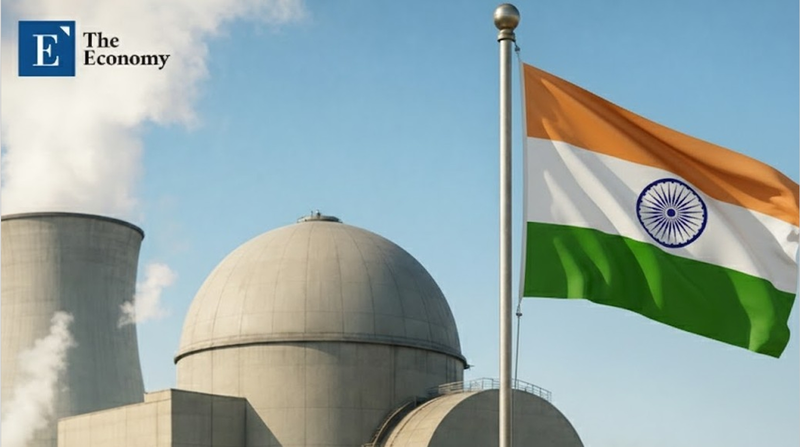
India has moved to dismantle long-standing barriers in its nuclear power industry, launching an aggressive expansion strategy. As electricity demand surges alongside the rapid growth of artificial intelligence (AI) and cloud computing, the Indian government has embarked on a sweeping policy shift that places small modular reactors (SMRs) at the center of a plan to dramatically expand nuclear generation capacity, while ending the state monopoly and allowing private-sector participation. Global Big Tech companies are likewise accelerating investments in nuclear power to secure stable baseload electricity for AI data centers. Industry observers note that the AI-driven spike in power demand is creating a long-awaited rebound opportunity for the global nuclear sector, which has endured decades of stagnation.
India Passes Legislation Allowing Private Participation in Nuclear Power
According to Indian media outlet Eurasian Times on the 8th (local time), the Indian government recently announced the “India Nuclear Energy Mission,” which aims to expand nuclear power capacity more than tenfold, from the current 8.8 gigawatts (GW) to 100 GW, by 2047, marking the country’s centenary of independence. The plan positions SMRs as a core technology to supply clean energy for industrial use and advance decarbonization. To this end, the government will immediately invest $2.23 billion in SMR research and development, and estimates that a total of $214 billion in investment will be required to achieve the 2047 target.
This initiative aligns with the government’s broader push to expand nuclear power generation, particularly its effort to dismantle the state monopoly over nuclear projects. Prime Minister Narendra Modi submitted a bill last month to the federal parliament permitting private companies to enter the nuclear power sector. The bill cleared the lower and upper houses on the 17th and 18th, respectively, and received final assent from President Droupadi Murmu on the 20th, completing an unusually swift legislative process in just one week. With this, the legal framework that has underpinned India’s nuclear industry for more than six decades has entered a new phase.
India had long maintained state control over the nuclear sector following the catastrophic gas leak in Bhopal, Madhya Pradesh, in 1984. The disaster, which killed thousands, prompted the government to significantly tighten industrial and environmental regulations and establish a rare legal regime that imposed liability on both equipment suppliers and operators in the event of accidents. Over time, however, these stringent regulations and the state monopoly became structural and strategic constraints, blocking the inflow of private capital and advanced technology and limiting broader investment and technological advancement across the nuclear industry.
Since activating its first reactor in 1969, India has built and operated a total of 25 reactors nationwide, all constructed and run by the state-owned Nuclear Power Corporation of India Limited (NPCIL). With private participation effectively excluded, nuclear power accounts for only about 2% of the country’s total installed capacity and roughly 3% of electricity generation. Modi described the passage of the bill as “a transformative event that will change India’s technological landscape,” emphasizing that it would create jobs for young people and open new investment opportunities for businesses.
Microsoft Commits Largest-Ever Asia Investment in India
Underlying this policy shift is the structural rise in data center power demand. As global Big Tech companies designate India as a key hub for AI and cloud operations, a wave of large-scale data center construction plans has followed. Experts estimate that a single hyperscale data center can require several hundred megawatts (MW) of electricity, comparable to the power consumption of an entire mid-sized city. Given the limitations of solar and wind power in providing stable, round-the-clock supply, nuclear energy is increasingly viewed as a viable baseload solution to support data centers.
India has emerged as a major growth market where Microsoft (MS), Amazon Web Services (AWS), and Google have each committed investments exceeding $10 billion. Within the global cloud industry, India is widely regarded as the “next hyperscale battleground.” Last month, Microsoft CEO Satya Nadella visited India and met with Prime Minister Modi, announcing plans to invest $17.5 billion in the country over four years starting in 2026. This represents Microsoft’s largest-ever investment in Asia and follows an earlier $3 billion commitment announced at the beginning of last year.
AWS, after investing $3.7 billion between 2016 and 2022, has unveiled plans to inject an additional $12.7 billion by 2030 to expand cloud and AI infrastructure in regions including Telangana and Maharashtra. Google, for its part, announced last October that it would invest $15 billion to build its first “gigawatt-scale AI hub” in Visakhapatnam, Andhra Pradesh. Combining massive data centers, fiber-optic networks, and power infrastructure, the project is considered Google’s largest AI infrastructure investment outside the United States.

U.S. Big Tech Accelerates New Power Generation Projects
As global Big Tech companies intensify their investments in nuclear energy, industry analysts are increasingly describing the moment as the dawn of a new renaissance for nuclear power worldwide, extending well beyond India. Bloomberg Intelligence projects that U.S. nuclear generation capacity will increase by 63% by 2050, while the International Energy Agency (IEA) forecasts that global data center electricity consumption will double within the next decade. Against this backdrop of structurally expanding power demand, nuclear energy is re-emerging as a practical solution that can simultaneously support carbon neutrality goals and energy security, signaling a decisive turning point for an industry long hampered by high costs and public opposition.
In practice, major technology companies including Google, Amazon, and Meta are moving aggressively to secure nuclear power and develop new generation projects. Meta signed a long-term power purchase agreement (PPA) with the Clinton Clean Energy Center in Illinois, supporting a 20-year extension of a plant that had faced closure. Joe Dominguez, CEO of Constellation, indicated that similar contracts with large customers like Meta could spread nationwide, raising the prospect of restarting previously shuttered reactors. Google has partnered with NextEra Energy to revive the Duane Arnold Energy Center in Iowa, which was closed in 2020. Scheduled to resume operations by 2029, the facility will supply electricity to Google under a 25-year purchase agreement.
Amazon has purchased four SMRs from X-Energy in Washington State and secured options for eight additional units. Global data center operator Equinix has pre-ordered 20 mobile microreactors produced by California-based startup Radiant Nuclear. Meta is also soliciting proposals from developers to secure 1 to 4 GW of new nuclear capacity by the early 2030s. Experts observe that AI-driven power demand is becoming a tangible catalyst for nuclear investment, adding that if the AI boom persists, nuclear energy is poised to become one of the biggest beneficiaries of the 21st-century energy transition.
Similar Post