Trump Administration Initiates ‘Military Intervention in Iran,’ Laying Groundwork for Pro-U.S. Regime Realignment

Siobhán Delaney is a Dublin-based writer for The Economy, focusing on culture, education, and international affairs. With a background in media and communication from University College Dublin, she contributes to cross-regional coverage and translation-based commentary. Her work emphasizes clarity and balance, especially in contexts shaped by cultural difference and policy translation.
Authored On
Modified
Fourteenth consecutive day of anti-government protests across Iran
Iran crosses Trump’s warned ‘red line’
“With its support base collapsing, the Iranian regime has no option left but a hardline crackdown”
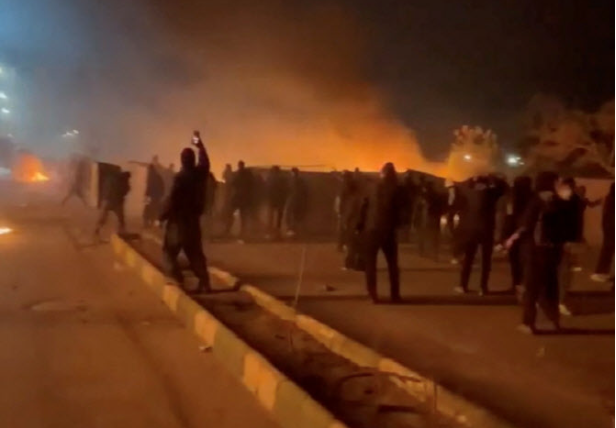
Anti-government protests triggered by economic hardship have entered their fourteenth day, pushing Iran’s situation toward its worst crisis yet. Casualties are mounting as authorities resort to bloody crackdowns, overwhelming the medical system to the point of near collapse, with morgues reportedly running out of space and bodies left unattended. Against this backdrop, U.S. President Donald Trump has openly signaled the possibility of military intervention, holding Iran’s leadership responsible for the bloodshed. As the regime faces an existential threat amid the erosion of its support base, analysts suggest Washington may be weighing a strategy aimed at ousting the supreme leader and installing a new leadership aligned with the West.
Trump: “Ready to Help Iran”
According to a compilation of foreign media reports on the 11th (local time), hospitals in Tehran and other cities are inundated with the dead and wounded to such an extent that Iran’s healthcare system is effectively paralyzed. Staff at three hospitals inside Iran, contacted by the BBC, said the escalation of protests has left facilities overflowing with injured and deceased patients. BBC Persian reported that on the night of the 9th alone, 70 bodies were transported to a hospital in Rasht, but had to be moved elsewhere due to a lack of capacity. Some global media outlets estimate that casualties have exceeded several hundred, with even larger numbers detained.
As the situation inside Iran deteriorates rapidly, the U.S. government has begun formulating military intervention scenarios. According to The Wall Street Journal, President Trump is scheduled to receive briefings on the 13th from senior administration officials outlining options that include military, cyber, and economic responses. The meeting is expected to focus on whether to implement measures Trump has long warned of in response to the regime’s violent suppression of protesters. Trump has repeatedly declared a “red line,” warning that the United States would intervene militarily if the Iranian government killed demonstrators. Options under discussion reportedly include supporting the online dissemination of anti-government information, deploying covert cyber weapons against Iranian military and civilian infrastructure, imposing additional sanctions, and even conducting military strikes.
The meeting is expected to include Secretary of State Marco Rubio, Defense Secretary Pete Hegseth, and Chairman of the Joint Chiefs of Staff Dan Caine. However, discussions remain at an early stage, and Trump is not expected to make a final decision at this gathering. At present, the U.S. Department of Defense has not moved troops in preparation for an attack on Iran. The aircraft carrier strike group USS Gerald R. Ford recently departed the Mediterranean for Latin America, leaving no U.S. aircraft carriers currently deployed in the Middle East or Europe.
Within the administration, internal documents are reportedly circulating that request input from various agencies to flesh out potential military targets and economic response measures. One option under review is providing Starlink satellite internet terminals to protesters to help them bypass government-imposed internet shutdowns. The Trump administration is also weighing the risk that taking only symbolic measures that fail to significantly weaken the regime could instead demoralize protesters who expect tangible U.S. support.
President Trump has steadily escalated his rhetoric since the protests began. On the 2nd, he warned protesters not to be killed, saying the United States was “on alert.” On the 9th, he declared that if Iranian forces opened fire on demonstrators, “we will open fire too.” On the 10th, he posted on social media that “Iran is looking at freedom like never before. The United States is ready to help.” Vice President J.D. Vance, meanwhile, signaled last week that diplomatic options have not been entirely ruled out, noting that Iran could still return to negotiations with the United States over its nuclear program.
Economic Collapse and Systemic Distrust as the Spark
Despite the worsening crisis, the Iranian government is maintaining a hardline stance, blaming Israel and the United States for inciting unrest. In a state television interview on the 11th, Iranian President Masoud Pezeshkian said, “We are working to address public dissatisfaction caused by economic hardship,” but added, “The people must not allow hooligans to disrupt society. They must trust that we, the government, seek to establish justice.” He also accused the United States and Israel of orchestrating riots in Iran to sow chaos and disorder.
Iranian Prosecutor General Mohammad Kazem Movahedi Azad went further, issuing an official statement labeling all protesters as “moharebeh,” or enemies of God—a charge that under Iranian law can carry the death penalty. On the same day, Parliament Speaker Mohammad Bagher Ghalibaf warned the United States against miscalculation during a parliamentary address, stating that if Iran were attacked, “the occupied territories—namely Israel—as well as all U.S. bases and vessels would become legitimate targets.” AFP reported that although verification is difficult due to a nationwide internet blackout lasting more than 60 hours, multiple accounts indicate security forces are engaging in brutal repression, including deliberately targeting protesters’ eyes.
Experts point to a key distinction between the current unrest and past episodes of turmoil: the defection of the bazaaris, the traditional merchant class that had long served as a core pillar of regime support. During the 1979 Islamic Revolution, bazaaris financed the clerical establishment that overthrew the monarchy. Their decision now to shutter shops and join protests is widely interpreted as a sign that the regime’s legitimacy has reached a breaking point.
Authorities appear intent on distinguishing between economic protests and movements calling for regime change. CNN reported that officials are separating economic demonstrators from those demanding the overthrow of the system, branding the latter as “hooligans” or foreign-backed “mercenaries” and pledging harsher repression against them. Reuters similarly noted that while authorities portray economic grievances as legitimate, they are deploying security forces to crush those they classify as violent agitators.
At the root of Iran’s economic protests lies the weight of U.S.-led sanctions. In 2011, the United States passed the National Defense Authorization Act, barring foreign banks that transact with Iran’s central bank from accessing the U.S. financial system. At the time, both chambers of Congress reportedly concluded that Iran’s provocations had reached an intolerable threshold, prompting a decision to impose direct economic pressure. The sanctions effectively isolated Iran from the global economy. Added to this are vulnerabilities within the current power structure, which help explain the significance of the present unrest. Iran has weathered major upheavals before, including the 1999 student protests, the 2009 demonstrations over disputed election results, the 2019 protests against economic hardship, and the 2022 “Women, Life, Freedom” movement. During the 2022 protests, sparked by the death of a young woman in the custody of the morality police, hundreds were killed and thousands imprisoned.
Iran’s Collapse Could Trigger a Second All-Out Middle East War
At this juncture, analysts broadly outline three scenarios that could determine the fate of the Iranian regime. The first is a large-scale, bloody crackdown, as signaled by Iran’s Supreme National Security Council, framing protesters as “agents of the enemy” and employing lethal force. The second envisions fractures and defections within the security forces as protests spread even to religious strongholds such as Mashhad, the hometown of Supreme Leader Ayatollah Seyed Ali Khamenei. The third is a so-called “Bonapartist” solution, in which elements of the military or pragmatic figures step in to restore order and implement reforms to avert total collapse.
Iran’s disintegration would almost certainly create a massive geopolitical vacuum, abruptly shattering the regional balance of power and posing serious risks even for the United States. For decades, Iran has served as the standard-bearer of the Shiite bloc, maintaining a tense equilibrium with the Sunni camp led by Saudi Arabia. A loss of central control in Iran could ignite a scramble among regional powers for dominance, plunging the Middle East into an uncontrollable vortex of conflict.
Jonathan Panikoff, a former senior U.S. intelligence official and current fellow at the Atlantic Council, warned that “the collapse of the Iranian regime could spiral into an uncontrollable situation,” adding that it “could escalate into a second full-scale Middle East war.” Such an outcome, analysts say, would trigger sweeping economic shockwaves, including oil supply disruptions, blocked trade routes, financial market panic, and a global economic downturn. From an economic perspective, rapid deterioration in Iran could deal a catastrophic blow to global energy markets. In particular, the possibility of a blockade of the Strait of Hormuz and disruptions to oil production could send prices soaring, dramatically amplifying downside risks to the global economy. While the United States has been exploring ways to offset potential supply shocks by boosting oil output from Venezuela, uncertainties remain over whether this could fully neutralize the impact, given shifts in influence within the Organization of the Petroleum Exporting Countries and constraints on production capacity.
Siobhán Delaney is a Dublin-based writer for The Economy, focusing on culture, education, and international affairs. With a background in media and communication from University College Dublin, she contributes to cross-regional coverage and translation-based commentary. Her work emphasizes clarity and balance, especially in contexts shaped by cultural difference and policy translation.
Similar Post