Prosecutorial Probe Shaking Fed Independence Raises Alarm Over Dollar Hegemony Amid Trump’s Escalation

Matthew Reuter is a senior economic correspondent at The Economy, where he covers global financial markets, emerging technologies, and cross-border trade dynamics. With over a decade of experience reporting from major financial hubs—including London, New York, and Hong Kong—Matthew has developed a reputation for breaking complex economic stories into sharp, accessible narratives. Before joining The Economy, he worked at a leading European financial daily, where his investigative reporting on post-crisis banking reforms earned him recognition from the European Press Association. A graduate of the London School of Economics, Matthew holds dual degrees in economics and international relations. He is particularly interested in how data science and AI are reshaping market analysis and policymaking, often blending quantitative insights into his articles. Outside journalism, Matthew frequently moderates panels at global finance summits and guest lectures on financial journalism at top universities.
Authored On
Modified
Summons of Fed Chair Jerome Powell by U.S. prosecutors
Clash with Trump escalates into a legal confrontation
Renewed controversy over policy independence amid rate pressure
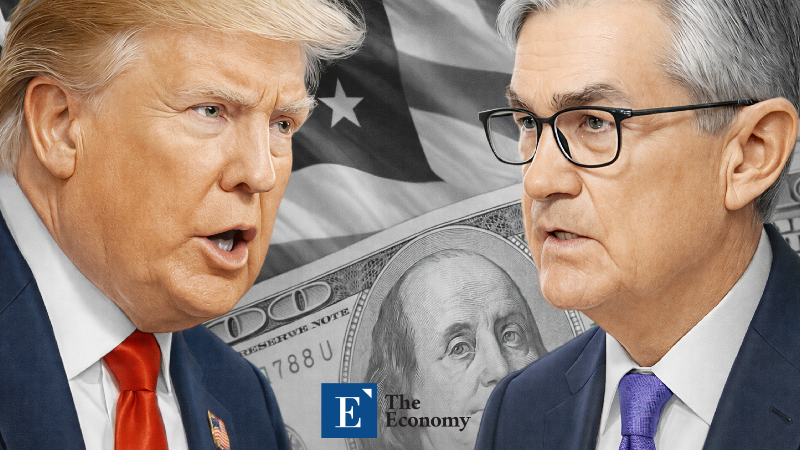
U.S. federal prosecutors have summoned Jerome Powell, Chair of the Federal Reserve. The long-running conflict between Powell and U.S. President Donald Trump, who has repeatedly applied public pressure on the Fed chair to cut interest rates, has now spilled into the legal arena, further intensifying the confrontation. As tensions over monetary policy escalate into a full-blown clash between the White House and the Federal Reserve, critics warn that the Trump administration is undermining confidence in the U.S. financial system itself.
U.S. Prosecutors Issue Subpoena to Fed Chair, Alleged Retaliation for Defying Rate Cuts
According to The New York Times (NYT) on the 11th (local time), the U.S. Attorney’s Office for the District of Columbia has launched an investigation into Powell over alleged mismanagement in the renovation of the Fed’s headquarters building and possible perjury before Congress. The probe was reportedly given final approval in November last year by U.S. Attorney Jeanine Pirro, a close Trump ally appointed by the president. Prosecutors are focusing on how the budget for the headquarters renovation project ballooned to $2.5 billion and whether Powell understated key details of the project during a congressional hearing in June last year.
The NYT noted that the investigation signals a new phase in the protracted feud between Trump and Powell. Trump has repeatedly urged Powell to resign, publicly pressing for faster rate cuts to stimulate the economy regardless of the Fed’s dual mandate of price stability and maximum employment. In an interview last December, Trump said that whether Powell’s successor would “immediately implement rate cuts” would be a decisive criterion in his selection, a stance widely seen as dismissive of the Fed’s monetary policy independence. More recently, Trump told the NYT that he had “already decided” on Powell’s successor, hinting at Kevin Hassett, Director of the White House National Economic Council, as a leading candidate.
While the U.S. president has the authority to nominate the Fed chair, he lacks the power to dismiss one. Under the Federal Reserve Act, Fed governors may only be removed “for cause.” In 1935, the U.S. Supreme Court ruled that President Franklin D. Roosevelt could not dismiss a commissioner of the Federal Trade Commission merely over policy disagreements, affirming the independence of federal agencies. Still, the outcome of a criminal investigation could potentially furnish Trump with grounds to justify removal. Powell’s term as Fed chair ends this May, though his term as a Fed governor runs until January 2018. Trump has previously attempted to remove Fed Governor Lisa Cook, citing allegations of fraud.
Powell, for his part, maintains that the allegations against him are merely a pretext. He argues that the investigation is retaliatory, triggered by the Fed’s refusal to comply with Trump’s overt demands for rate cuts. In a post on the Fed’s official X account on the 11th, Powell stated, “This is not about my testimony last June or about a building renovation,” adding that it is “the result of the Fed making its best judgment about what serves the public interest, even when that differs from the president’s preferences.” He continued, “This is about whether the Fed can continue to set interest rates based on evidence and economic conditions, or whether monetary policy will be dictated by political intimidation,” reaffirming his commitment to maintaining policy independence.
Markets Likely to Question Independence Regardless of Who Becomes Next Chair
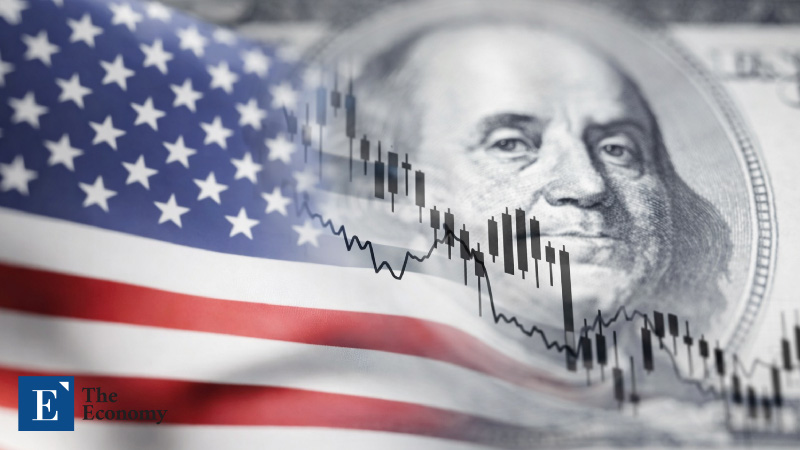
Trump’s relentless pressure on the Fed is rooted in the ballooning fiscal deficit. As of the end of last year, U.S. federal government debt stood at $38.57 trillion. According to the Congressional Budget Office (CBO), the debt-to-GDP ratio is projected to rise from around 100% to more than 150% over the next 30 years, while net interest costs borne by the federal government are expected to climb from 3.2% of GDP to 5.4%. Sustained fiscal deficits approaching 6% of GDP in the absence of war or a severe recession are virtually unprecedented.
Should monetary policy fall under fiscal dominance—where it becomes subordinated to fiscal needs—government financing pressures may ease temporarily, but at the cost of heightened inflation volatility and rising borrowing costs over time. If markets lose faith in the government’s ability to rein in deficits, higher risk premiums could set off a vicious cycle of mounting debt, ultimately exerting downward pressure on the U.S. dollar.
The Federal Reserve serves as an anchor of the global financial system. As such, attacks on its independence encourage countries to consider diversifying into alternative currencies. Roger Ferguson, former Vice Chair of the Federal Reserve Board and honorary fellow in international economics at the Council on Foreign Relations, warned that “presidential pressure on the Fed risks weakening its independence and undermining confidence in the dollar as the world’s reserve currency,” adding that such uncertainty could prompt investors to demand higher yields on U.S. Treasuries amid expectations of ever-larger federal deficits. Some market participants argue that last year’s surge in Treasury yield volatility and recent U.S. sovereign credit rating downgrades already reflect these concerns.
Economists Sound Alarms Over Erosion of Central Bank Independence
Concerns are also mounting that political interference could fundamentally destabilize the U.S. monetary policy framework. In a recent note to investors, global investment bank Piper Sandler stated, “Regardless of who succeeds Powell, markets will question the Fed’s independence,” stressing that “the politicization of the Federal Reserve is an extremely serious matter.”
History offers cautionary lessons. The Wall Street Journal pointed to the 1970s, when political pressure led the Fed to pursue misguided policies, culminating in punishingly high interest rates and a severe recession in the early 1980s. “As political pressure intensifies, suspicions grow that the Fed is responding to political interests rather than data, eroding market trust,” the paper noted.
Leading economists worldwide share these concerns. According to a recent Financial Times survey of 94 economists across the United States, the United Kingdom, and Europe, 89 respondents said Trump’s pressure on the Fed has “already damaged” its credibility. Among them, 42% identified “severe inflationary pressure” as the greatest risk stemming from weakened Fed independence, while 35% cited the potential loss of investor confidence in U.S. Treasuries. Only one respondent said Trump’s attacks posed “no meaningful risk” to the Fed’s independence.
Rüdiger Bachmann, a professor of economics at the University of Michigan, said that “most economists agree that Trump’s attacks on the Fed will harm the U.S. economy.” Christiane Baumeister of the University of Notre Dame warned that “the Fed will become a puppet of the Trump administration,” while several other respondents described the outlook for U.S. monetary policy as “terrible,” “chaotic,” and “nothing short of a disaster.”
Moritz Kraemer, chief economist at Germany’s LBBW, remarked, “To understand the risks the White House is taking by trying to subordinate the Fed, one need only look at Turkey,” adding that “the U.S. dollar could ultimately lose even more credibility than the Turkish lira.” Turkey suffered a collapse of its currency and runaway inflation after President Recep Tayyip Erdoğan replaced central bank governors with loyalists and enforced artificially low interest rates starting in 2019. Karsten Junius of J. Safra Sarasin in Zurich also cautioned that “if the Fed does not fight for its survival, the U.S. dollar itself will face a crisis.”
Matthew Reuter is a senior economic correspondent at The Economy, where he covers global financial markets, emerging technologies, and cross-border trade dynamics. With over a decade of experience reporting from major financial hubs—including London, New York, and Hong Kong—Matthew has developed a reputation for breaking complex economic stories into sharp, accessible narratives. Before joining The Economy, he worked at a leading European financial daily, where his investigative reporting on post-crisis banking reforms earned him recognition from the European Press Association. A graduate of the London School of Economics, Matthew holds dual degrees in economics and international relations. He is particularly interested in how data science and AI are reshaping market analysis and policymaking, often blending quantitative insights into his articles. Outside journalism, Matthew frequently moderates panels at global finance summits and guest lectures on financial journalism at top universities.
Similar Post