Japan begins deep-sea rare-earth extraction to speed supply-chain self-reliance, but faces refining hurdles under China pressure

Aoife Brennan is a contributing writer for The Economy, with a focus on education, youth, and societal change. Based in Limerick, she holds a degree in political communication from Queen’s University Belfast. Aoife’s work draws connections between cultural narratives and public discourse in Europe and Asia.
Authored On
Modified
Japan begins deep-sea rare-earth test extraction near Minamitorishima
Supply-chain self-reliance drive accelerates amid China’s rare-earth weaponization, but tech and processing limits remain a variable
China raises the intensity of rare-earth export controls, stoking fears of economic blowback for Japan
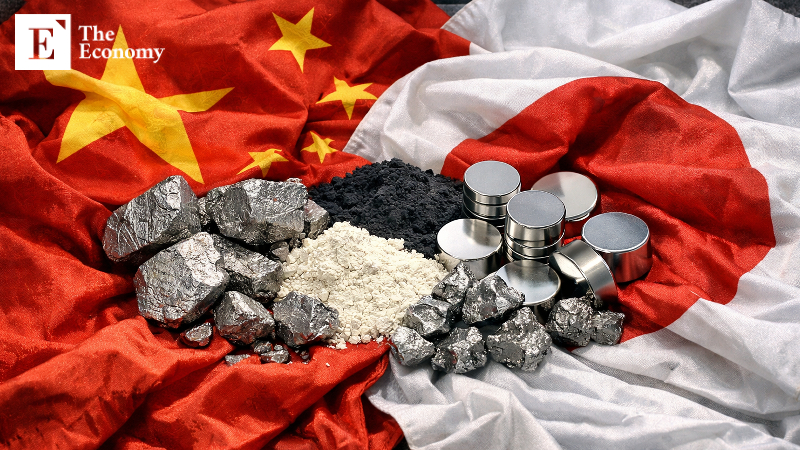
Japan has begun deep-sea rare-earth extraction work in waters near Minamitorishima. With China’s weaponization of rare earths flaring again after Prime Minister Sanae Takaichi’s recent remarks suggesting possible intervention in a Taiwan contingency, Tokyo is accelerating moves to secure its own supply chain. However, China is pointing to Japan’s limited refining and processing capacity and continues to raise the intensity of its restrictions.
Minamitorishima deep-sea “mud” drilling begins
According to Nikkei Asia on January 12 (local time), JAMSTEC’s deep-sea drilling vessel Chikyu departed for waters near Minamitorishima, about 1,950 km southeast of Tokyo. Japan previously discovered mud containing high concentrations of rare earths on the seabed at a depth of around 6,000 meters within its exclusive economic zone (EEZ) near Minamitorishima in 2012. Analysis by the University of Tokyo and other institutions estimates rare-earth reserves in the area at roughly 6.8 million tons.
The vessel will conduct trial work to lift deep-sea mud containing rare earths from an area about 150 km southeast of Minamitorishima. The test drilling is scheduled to run through February 14. If the initial test concludes successfully, Japan plans to increase daily mud collection to up to 350 tons starting in February 2027 to verify commercial viability. If sufficient development potential is confirmed, Japan will dewater the mud at Minamitorishima, transport it to the mainland, and attempt rare-earth extraction and refining.
The move is widely seen as part of Japan’s supply-chain overhaul in response to China’s weaponization of resources. China previously restricted rare-earth exports last April in retaliation for U.S. tariffs. More recently, after Prime Minister Sanae Takaichi suggested possible Japanese involvement in a Taiwan contingency, Beijing further increased pressure by tightening export controls on dual-use items bound for Japan. On January 6, China’s Ministry of Commerce announced a ban on exports of all dual-use materials destined for Japanese military users, military purposes, or other end uses that could contribute to enhancing Japan’s military capabilities.
China scoffs at Japan’s self-reliance push
China responded skeptically to news of Japan’s attempt to mine rare earths from the deep sea. On January 11, Da Zhigang, head of the Northeast Asia Research Institute at the Heilongjiang Academy of Social Sciences, told state-run Global Times that deep-sea rare-earth development faces technical constraints, massive costs, and limited odds of success. He said operations at depths beyond 6,000 meters must withstand extreme pressure and complex currents, and that key processes such as seabed mining and lifting are not yet technologically mature. He added that global rare-earth refining and processing capacity is highly concentrated in China, meaning Japan would remain heavily dependent on external processing systems even if it succeeds in extracting raw materials.
China does hold overwhelming strength in rare-earth refining. Rare earths are widely seen as requiring substantial technological capability in downstream stages after extraction. Because the chemical properties of the 17 rare-earth elements are highly similar, separation and refining demand advanced precision chemistry. Solvent extraction, a representative separation method, can require at least 200 steps to isolate a desired element. The process relies on a range of chemicals including ammonium chloride and oxalic acid, and without a stable supply chain for such reagents, refining capacity can be effectively crippled. In practice, market dominance depends on both process know-how and the ability to secure inputs for those processes.
China expanded its rare-earth ecosystem after studying U.S. rare-earth extraction and refining operations in the 1960s, building out its supply chain and technical base on the back of cheap electricity and looser environmental regulation. In the 2000s, it consolidated a fragmented industry through nationalization into the so-called “Big Six,” then further streamlined the structure around China Northern Rare Earth and China Rare Earth—creating a system capable of managing supply and prices. This laid the foundation for China to evolve from a resource holder into a processing powerhouse. Today, China accounts for about 90% of the global market for rare-earth smelting and separation (oxide production) and about 93% of permanent magnet manufacturing, the key end product.
If Japan fails to find a way out, the economic shock will follow
Markets are increasingly warning that Japan could face significant blowback if it fails to reshape its rare-earth supply chain. China’s export controls are already tightening the vise on Japanese industry. Kyodo News reported on January 10, citing an anonymous source, that some Chinese state-owned firms exporting rare earths decided immediately after Beijing’s January 6 announcement not to sign new contracts with Japanese companies and are even considering terminating existing agreements. It marked the first confirmed case of Japanese firms being turned away when trying to purchase rare earths after China announced tighter dual-use export controls.
On January 11, the Yomiuri Shimbun and Asahi Shimbun reported noticeable delays in China’s approval process for civilian rare-earth exports to Japanese companies. That runs counter to China’s Ministry of Commerce, which has maintained that civilian-use rare earths are not affected by the latest measures. Asahi warned the move could have broad ripple effects across Japan’s manufacturing sector. Yomiuri, however, noted that export-approval delays had been occurring even before January 6 and said a direct link to the latest controls remains unclear.
Japan sought to diversify sourcing after being jolted by China’s rare-earth controls in 2010, but it still relies on China for more than 60% of its rare-earth metal imports (as of 2024). Dependence is especially acute for dysprosium and terbium—key inputs for EVs—which Japan must import almost entirely from China. Nomura Research Institute estimates that if China restricts rare-earth exports for three months, Japan’s GDP could fall by 0.11%, and if controls persist for a year, the decline could widen to 0.43%. For an economy already posting near-zero annual growth, the risk is hard to dismiss—and it would be particularly damaging for the Takaichi administration, which has made economic growth a central goal.
Aoife Brennan is a contributing writer for The Economy, with a focus on education, youth, and societal change. Based in Limerick, she holds a degree in political communication from Queen’s University Belfast. Aoife’s work draws connections between cultural narratives and public discourse in Europe and Asia.
Similar Post
















