Trump’s ‘Powell Offensive’ Triggers Broad New York Market Weakness, Risks Spreading ‘Sell America’ Trade

Siobhán Delaney is a Dublin-based writer for The Economy, focusing on culture, education, and international affairs. With a background in media and communication from University College Dublin, she contributes to cross-regional coverage and translation-based commentary. Her work emphasizes clarity and balance, especially in contexts shaped by cultural difference and policy translation.
Authored On
Modified
U.S. Federal Prosecutors Launch Criminal Probe Into Fed Chair Powell
Powell Issues Unprecedented Statement, Directly Confronts Trump
Risk Aversion Spreads Across Wall Street as Fed Independence Wavers
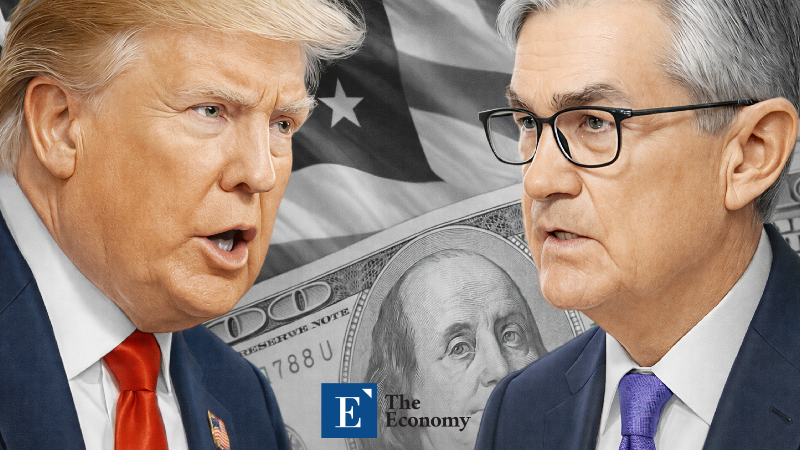
As the administration of U.S. President Donald Trump moves forward with a full-fledged investigation into Jerome Powell, Chair of the Federal Reserve, U.S. stock index futures have turned broadly lower. As Trump intensifies pressure on the central bank, concerns that the Fed’s independence may be undermined are rippling across capital markets. Some in the market are now warning that a full-scale “Sell America” trade—marked by broad avoidance of dollar-denominated assets—may be taking hold.
U.S. Futures, Dollar, and Treasuries Decline in Tandem
According to CNBC on the 12th (local time), as of 6 p.m., the blue-chip Dow Jones Industrial Average was down 205.86 points, or 0.42%, from the previous session, at 49,298.21. The large-cap Standard & Poor’s 500 Index slipped 9.18 points, or 0.13%, to 6,957.1, while the tech-heavy Nasdaq Composite fell 29.813 points, or 0.13%, to 23,641.534.
The dollar also weakened sharply. In the New York foreign exchange market, the dollar index (DXY), which tracks the U.S. currency against six major peers, fell 0.337 points, or 0.340%, to 98.799 from the previous close of 99.136. In London trading, it briefly slid as low as 98.705. The Bloomberg Dollar Spot Index also declined 0.3%, marking its largest drop since December 23 of last year. U.S. Treasuries came under pressure as well. The yield on the 10-year Treasury note rose 4 basis points to as high as 4.211%, while the 30-year yield climbed more than 5 basis points at one point to 4.86%. Bond yields move inversely to prices.
At the heart of the market turmoil are concerns over the independence of the U.S. central bank. On the 11th, Powell revealed that the Fed had been notified by the U.S. Department of Justice on the 9th of a grand jury subpoena and the possibility of criminal charges. The legal action is reportedly tied to Powell’s testimony before the Senate Banking Committee in June of last year regarding the renovation project of the Fed’s headquarters.
Since taking office, President Trump has openly rejected the principles of central bank independence and monetary policy neutrality, applying overt pressure for rate cuts. While Trump has argued that the benchmark rate should be lowered to 1%, Powell has maintained his course undeterred. During Trump’s second term, the Fed has cut rates three times by a total of 0.75 percentage points, bringing the current target range to 3.50–3.75%. Frustrated by Powell’s refusal to comply with his demands, Trump has repeatedly signaled his desire to remove the Fed chair. Beginning last summer, he shifted his focus to the Fed building renovation project, criticizing it for exceeding the original budget by 700 million dollars and even visiting the construction site in person. The investigation has ultimately been launched on this basis.
Former Economic Chiefs Publicly Condemn ‘Powell Probe’
Powell has strongly pushed back, arguing that the investigation is merely an attempt to legitimize Trump’s sustained pressure for rate cuts. On the 11th, Powell stated, “This new threat has nothing to do with my June testimony last year or the Fed building renovation—it is simply a pretext,” adding, “The real reason is that the Federal Reserve set interest rates based on the public interest rather than the president’s preferences.”
He continued, “This unprecedented action must be viewed in the broader context of threats and persistent pressure from the administration,” and said it raises the question of “whether monetary policy will be dictated by political pressure or intimidation.” Powell also remarked, “Public service sometimes requires standing firm in the face of threats. I will faithfully carry out my duties and remain committed to serving the American people,” signaling his intention to complete his term. Powell’s term as Fed chair expires in May, while his term as a Fed governor runs through January 2028.
Former and current Fed officials, along with several former Treasury secretaries, issued statements publicly supporting Powell and criticizing the Trump administration. In a joint statement released on the 12th, they denounced the move as an “unprecedented attempt to weaponize prosecutorial authority to weaken central bank independence,” calling it a style of monetary policymaking “typically seen in emerging markets with fragile institutional foundations.” The statement warned that “the Federal Reserve’s independence and public trust in it are essential to achieving price stability, maximum employment, and appropriate long-term interest rates,” and cautioned that erosion of that independence could pose serious risks to the U.S. economy. Signatories included former Fed chairs Alan Greenspan, Ben Bernanke, and Janet Yellen, as well as former Treasury secretaries Henry Paulson, Timothy Geithner, and Robert Rubin.
‘Sell America’ Fears Mount on Fed Independence Concerns
As recently as last year, U.S. equity markets appeared relatively resilient despite Trump’s pressure on the Fed, as the central bank independently delivered three rate cuts in line with easing inflation. However, as the use of investigative authority becomes a tangible tool of pressure ahead of the announcement of a new Fed chair nominee, market anxiety is intensifying. Jay Woods, Chief Global Strategist at Freedom Capital Markets, said, “The issue right now is not Powell as an individual, but the independence of the Federal Reserve itself,” adding, “When news like this breaks, markets tend to react with immediate selling.”
Trump’s persistent pressure on the Fed is widely interpreted as an effort to weaken the dollar. In July last year, Trump said, “I would never say I like a weak currency,” while also noting, “I am a strong-dollar person. But a weak dollar makes you a lot more money.” He went on to argue, “A strong dollar sounds good, but it hurts tourism, factories, trucks—nothing sells,” adding that while it helps curb inflation, “we have already eliminated inflation.” Analysts say the dollar’s weakness reflects global investors’ unease over Trump’s protectionist stance and high-tariff policies. Generally, a weaker dollar lowers the price of U.S. exports, boosting overseas demand and improving the current account balance.
Still, it remains uncertain whether the United States can maintain its reserve-currency status under Trump’s weak-dollar doctrine. As the U.S. expands its trade surplus, global dollar liquidity would shrink, potentially pushing the dollar higher and undermining its own position. At the same time, the U.S. has no desire to relinquish its reserve-currency privilege, which has allowed it to effectively borrow vast pools of idle global capital at interest rates close to Treasury yields.
If dollar weakness escapes market control and morphs into a broader “Sell America” trend, however, the United States could find itself at a severe disadvantage in the global competition for investment. Early warning signs are already emerging. The sharp turbulence in U.S. financial markets following Trump’s intensified pressure on the Fed underscores the risk. Krishna Guha, Vice Chairman at Evercore ISI, said, “This is an unmistakable risk-off environment,” adding, “There is a real possibility that a sustained Sell America pattern—marked by simultaneous declines in the dollar, bonds, and equities—could take hold going forward.”
Siobhán Delaney is a Dublin-based writer for The Economy, focusing on culture, education, and international affairs. With a background in media and communication from University College Dublin, she contributes to cross-regional coverage and translation-based commentary. Her work emphasizes clarity and balance, especially in contexts shaped by cultural difference and policy translation.
Similar Post
















