Korea Fair Trade Commission Considers ‘Business Suspension’ as Hardline Sanction Against Coupang, Raising Fears of Cascading Impact on Jobs and the Retail Ecosystem

Matthew Reuter is a senior economic correspondent at The Economy, where he covers global financial markets, emerging technologies, and cross-border trade dynamics. With over a decade of experience reporting from major financial hubs—including London, New York, and Hong Kong—Matthew has developed a reputation for breaking complex economic stories into sharp, accessible narratives. Before joining The Economy, he worked at a leading European financial daily, where his investigative reporting on post-crisis banking reforms earned him recognition from the European Press Association. A graduate of the London School of Economics, Matthew holds dual degrees in economics and international relations. He is particularly interested in how data science and AI are reshaping market analysis and policymaking, often blending quantitative insights into his articles. Outside journalism, Matthew frequently moderates panels at global finance summits and guest lectures on financial journalism at top universities.
Authored On
Modified
The Korea Fair Trade Commission’s blade turns squarely toward Coupang, with even a business suspension now under discussion
For platform operators, the damage could far exceed fines
Livelihoods of 230,000 small merchants at stake
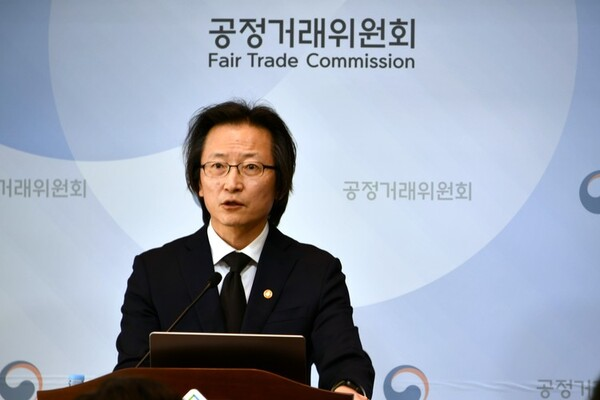
The Korea Fair Trade Commission (FTC) has initiated procedural discussions on whether to impose a business suspension on Coupang. Under FTC investigations, if corrective orders alone are deemed insufficient to remedy consumer harm, the authority may move to suspend business operations. The decision ultimately hinges on the extent to which the company undertakes consumer redress efforts. However, given Coupang’s market dominance and the potential spillover effects across employment and the broader distribution ecosystem, analysts note that it would be far from straightforward to impose a business suspension solely on the basis of a personal data breach.
Chair Joo: Sanctions Possible If Orders Are Ignored or Consumer Redress Fails
According to distribution and legal industry sources on the 13th, Chair Joo appeared the previous day on the YouTube program Kim Eo-jun’s News Factory and stated that the FTC would issue corrective orders after assessing consumer redress related to damages stemming from the data breach, referencing the progress of the joint public-private investigation with the Ministry of Science and ICT and the Personal Information Protection Commission. Chair Joo said, “After identifying what kinds of damage consumers may suffer due to the data leak, we will order Coupang to take appropriate remedial measures,” adding, “If the company fails to implement those orders or if consumer redress is deemed inadequate, a business suspension is also possible.”
Chair Joo also delivered unusually sharp criticism of Coupang’s unfair trade practices. “Passing on losses incurred during lowest-price sales to suppliers constitutes a serious unfair practice,” he said, adding that the results of the related deliberations would be announced soon. He went further, characterizing Coupang’s practice of shifting losses arising from unmet profit targets onto marketplace sellers as “predatory business conduct.”
At present, the FTC is deliberating multiple cases involving Coupang, including deceptive advertising of its Wow Membership, coercion of most-favored-nation clauses in food delivery apps, and tying practices involving Coupang Eats and Coupang Play. Chair Joo stated that “sanctions, including business suspension, are under review” for these violations as well. Separately, the FTC is closely examining whether Coupang qualifies as a “market-dominant enterprise,” which could warrant harsher penalties, and is also reviewing whether to shift the designation of the controlling shareholder (“same person”) from a corporate entity to an individual by scrutinizing the involvement of relatives of Coupang Inc. Chairman Bom Kim in management.
Multiple Precedents for Business Suspension Under the E-Commerce Act
This is not the first time Chair Joo has personally signaled the possibility of suspending Coupang’s operations following the personal data breach. On December 19 last year, he also stated in an interview with KBS News that “the possibility of a business suspension remains open,” adding that authorities would need to determine whether to impose suspension or monetary penalties after the investigation.
Those remarks came amid mounting political criticism after Chairman Kim failed to appear at a National Assembly hearing on the Coupang data breach held on December 17, lending weight to interpretations that the comments were a deliberate warning. Chair Joo added, “We are mobilizing all available means, including dispute mediation and litigation support, to remedy consumer harm,” and emphasized that “if Coupang fails to take appropriate recovery measures when consumers suffer financial losses, a business suspension can be ordered.”
The legal basis for such a sanction is explicitly stipulated in the E-Commerce Act. Article 11 of the Act requires businesses to take measures prescribed by presidential decree—such as identity verification and damage recovery—when consumer information is misused in transactions, resulting in or posing a risk of financial loss. If a company fails to comply, the FTC may issue corrective orders, and where such measures are deemed insufficient to prevent harm, it may suspend all or part of the business for up to one year.
There are precedents in which business suspensions were imposed based on the adequacy of consumer redress. In 2017, the FTC ordered a watch retailer that sold random boxes through deceptive practices to pay an administrative fine of approximately $14,600 and imposed a three-month business suspension. This marked the first case of a suspension under the E-Commerce Act, with the FTC citing the insufficiency of corrective measures to prevent and compensate consumer harm. In 2023, the authority also imposed a 135-day business suspension on an online apparel retailer that continued operations while refusing refunds and failing to comply with corrective orders, again citing the inability of corrective measures alone to prevent harm or secure consumer redress.
Ripple Effects Extending to Private-Brand Suppliers
Should the FTC ultimately impose a business suspension on Coupang, the impact is expected to be more severe than a monetary fine. Platform businesses derive value from network effects, meaning that a halt in operations could prompt users to migrate rapidly to rival platforms such as Naver or Shinsegae. Meanwhile, fixed costs—including delivery fleets and logistics center maintenance—would continue to accrue during any suspension period, further intensifying financial strain.
Nonetheless, many observers view the likelihood of an actual suspension as limited, citing the difficulty of applying the E-Commerce Act to a personal data breach. The Act primarily targets false or exaggerated advertising and obstruction of subscription withdrawals, leading some to argue that its application in this case would be legally contentious. Practical considerations also loom large, including the broader impact on consumers, marketplace sellers, and delivery workers.
Coupang accounts for 22.3% of South Korea’s online shopping transaction value as of 2024, underscoring its outsized market influence. The company employs approximately 80,000 people (2024), while the number of small merchants operating on its platform approaches 230,000 (2023). An estimated 23,000 workers are employed by suppliers producing Coupang’s private-brand products as of 2024. Including delivery workers, the number of individuals directly and indirectly tied to Coupang reaches into the hundreds of thousands, fueling concerns that suspending its operations could destabilize the market itself.
These concerns have also surfaced within the ruling Democratic Party. Min Byung-duk, a member of the party’s Euljiro Committee, said during an appearance on an SBS radio program on the 22nd of last month that while a business suspension is legally possible if consumer harm occurs or is likely and adequate recovery or preventive measures are not taken, “a blanket suspension would have far-reaching repercussions for consumers, merchants, and delivery workers,” suggesting that conditional suspension or partial operational restrictions may be more realistic alternatives.
Matthew Reuter is a senior economic correspondent at The Economy, where he covers global financial markets, emerging technologies, and cross-border trade dynamics. With over a decade of experience reporting from major financial hubs—including London, New York, and Hong Kong—Matthew has developed a reputation for breaking complex economic stories into sharp, accessible narratives. Before joining The Economy, he worked at a leading European financial daily, where his investigative reporting on post-crisis banking reforms earned him recognition from the European Press Association. A graduate of the London School of Economics, Matthew holds dual degrees in economics and international relations. He is particularly interested in how data science and AI are reshaping market analysis and policymaking, often blending quantitative insights into his articles. Outside journalism, Matthew frequently moderates panels at global finance summits and guest lectures on financial journalism at top universities.
Similar Post