EU–China EV Tariff War Reaches Compromise Through “Minimum Price” Formula Amid Divergent Calculations

Oliver Griffin is a policy and tech reporter at The Economy, focusing on the intersection of artificial intelligence, government regulation, and macroeconomic strategy. Based in Dublin, Oliver has reported extensively on European Union policy shifts and their ripple effects across global markets. Prior to joining The Economy, he covered technology policy for an international think tank, producing research cited by major institutions, including the OECD and IMF. Oliver studied political economy at Trinity College Dublin and later completed a master’s in data journalism at Columbia University. His reporting blends field interviews with rigorous statistical analysis, offering readers a nuanced understanding of how policy decisions shape industries and everyday lives. Beyond his newsroom work, Oliver contributes op-eds on ethics in AI and has been a guest commentator on BBC World and CNBC Europe.
Authored On
Modified
China looks abroad as EU moves to shield domestic industry
Tariff clash ongoing since 2024 enters a phase of de-escalation
EU formalizes procedures to introduce minimum prices on Chinese EVs
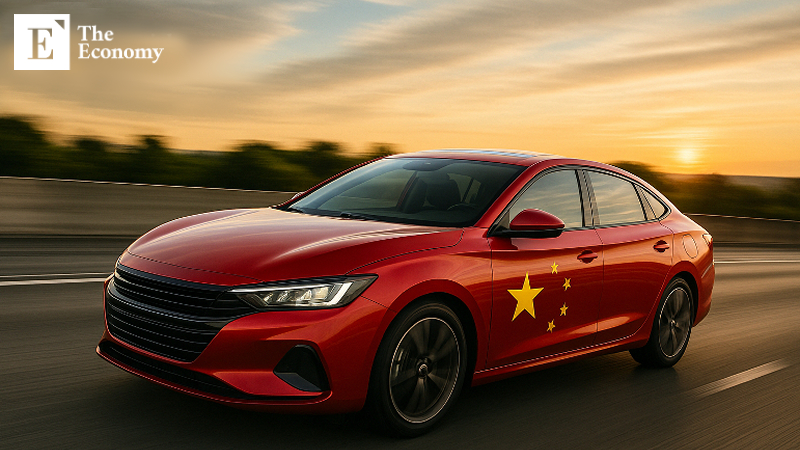
The European Union has formally initiated procedures that would allow the replacement of the high tariffs imposed on Chinese electric vehicles with a minimum sales price mechanism. The protracted tariff conflict between the two sides, which has persisted since 2024 over the EV sector, appears to be shifting from confrontation toward a managed stabilization phase. The move reflects a convergence of interests between the EU, which seeks to protect its automotive industry while avoiding a spiral of retaliatory measures, and China, which aims to preserve access to the European market while alleviating tariff burdens.
EU to Assess Local Investment Plans by Chinese Firms
On the 12th (local time), the European Commission released written guidelines outlining how the existing high tariffs on Chinese EV manufacturers could be replaced with a so-called “price undertaking,” under which exporters commit to a minimum sales price. Under the guidelines, Chinese exporters may submit proposals to the Commission seeking to apply minimum prices in lieu of tariffs, with the Commission evaluating whether the proposed pricing framework meets the required criteria. The Commission stated that, in this process, it would also take into account the scale of EV investments made by Chinese firms within the EU.
The guidelines specify that the minimum prices proposed by Chinese EV manufacturers must eliminate the effects of Chinese government subsidies, deliver a level of protection equivalent to existing tariffs, be practically enforceable, and minimize cross-compensation. They also require minimum prices to be set by model and configuration, with the benchmark defined as the point of sale to the first independent consumer within the EU. In addition, exporters are encouraged to include measures for regulating annual shipment volumes to Europe, as well as plans for local investment, in their submissions.
Bloomberg analyzed the approach by noting that “the EU can reduce the burden of a tariff war while defending its automotive industry, while Chinese manufacturers such as BYD can maintain access to the European market without surrendering profits to tariffs.” As a result, assessments have emerged that the long-running bilateral tariff dispute over EVs is entering a soft-landing phase. China’s Ministry of Commerce also welcomed the development in a statement, saying it “fully reflects the spirit of dialogue and consultation between both sides.”
From Retaliatory Tariffs to a Managed Framework
In July 2024, the EU implemented provisional measures raising tariffs on Chinese EVs exported to Europe to as high as 30%, citing unfair state subsidies. This was followed in October of the same year by the imposition of definitive countervailing duties of up to 45.3%, added on top of the existing 10% base tariff. In response, China launched anti-dumping investigations in August against European dairy products, pork, brandy, and other agricultural and food products, imposing provisional duties on those items. The scope of investigations was later expanded to include plastic raw materials, gradually broadening the trade dispute.
However, the EU’s tariff measures complicated the strategies of European automakers that had leveraged China’s low manufacturing costs and competitive EV technology. BMW, for example, faced the burden of elevated tariffs on the iX3 produced in China, while Volvo Cars shifted production of the tariff-exposed EX30 to Ghent, Belgium, incurring higher costs and triggering supply-chain adjustments. Against this backdrop, the Commission last month began reviewing minimum price and import quota proposals submitted by Volkswagen to replace tariffs on electric SUVs produced in China.
The latest arrangement is viewed as a policy inflection point in that both sides have moved beyond a single blunt instrument—tariffs—toward a framework that absorbs friction through firm-by-firm applications and reviews. With global trade uncertainty still elevated, analysts note that the approach creates room to avoid a full-scale economic and trade war while calibrating technological competition and market access in the EV sector. At the same time, some warn that introducing minimum prices without fully resolving underlying trust deficits could deepen Europe’s dependence on Chinese manufacturers.
Chinese EV Makers Prioritize Market Diversification Beyond Europe
Structural pressures facing China’s auto industry also underpin the compromise. A surge in EV supply has intensified price wars within China, with manufacturers engaging in aggressive discounting. Even BYD, the country’s top EV seller, has rolled out discounts of around 30%, squeezing profitability for smaller and newer entrants. As losses mount, the Chinese government has announced plans to rationalize the industry by phasing out weaker players and restructuring the market around roughly 10 leading manufacturers that together account for about 95% of sales.
Confronted with slowing domestic demand and constrained margins, Chinese automakers have increasingly turned overseas to secure sustainable revenue growth. BYD has already built factories in Brazil and Thailand and is pursuing additional production facilities in Hungary, Türkiye, and Indonesia. The company has set a target of selling 1.5 million vehicles overseas this year, an increase of more than 50% from the previous year. Geely is expanding local production and assembly hubs across Eastern Europe and the Middle East, while Chery is exploring joint manufacturing ventures in Spain and Latin America.
The acceleration of China’s overseas push is also evident in the data. As of November last year, China’s cumulative automobile exports reached 6.343 million units, up 18.7% from a year earlier. Annual exports are expected to surpass 7 million units for the first time. The China Automotive Technology and Research Center projects that overseas sales of Chinese automobiles will reach 10 million units by 2030. Market diversification is already yielding tangible results, with the top 10 export destinations last year spanning the United Arab Emirates, Mexico, Russia, Belgium, the United Kingdom, Brazil, Saudi Arabia, Australia, the Philippines, and Kazakhstan.
Oliver Griffin is a policy and tech reporter at The Economy, focusing on the intersection of artificial intelligence, government regulation, and macroeconomic strategy. Based in Dublin, Oliver has reported extensively on European Union policy shifts and their ripple effects across global markets. Prior to joining The Economy, he covered technology policy for an international think tank, producing research cited by major institutions, including the OECD and IMF. Oliver studied political economy at Trinity College Dublin and later completed a master’s in data journalism at Columbia University. His reporting blends field interviews with rigorous statistical analysis, offering readers a nuanced understanding of how policy decisions shape industries and everyday lives. Beyond his newsroom work, Oliver contributes op-eds on ethics in AI and has been a guest commentator on BBC World and CNBC Europe.
Similar Post