TSMC Pledges Additional U.S. Investment, Expanding Supply Chain Leverage Amid Tariff Negotiations

Matthew Reuter is a senior economic correspondent at The Economy, where he covers global financial markets, emerging technologies, and cross-border trade dynamics. With over a decade of experience reporting from major financial hubs—including London, New York, and Hong Kong—Matthew has developed a reputation for breaking complex economic stories into sharp, accessible narratives. Before joining The Economy, he worked at a leading European financial daily, where his investigative reporting on post-crisis banking reforms earned him recognition from the European Press Association. A graduate of the London School of Economics, Matthew holds dual degrees in economics and international relations. He is particularly interested in how data science and AI are reshaping market analysis and policymaking, often blending quantitative insights into his articles. Outside journalism, Matthew frequently moderates panels at global finance summits and guest lectures on financial journalism at top universities.
Authored On
Modified
U.S.–Taiwan tariff negotiations are nearing a conclusion, with tariffs set to be lowered to 15%.
TSMC accepts U.S. demands for expanded investment, plans additional fabs.
Focus shifts to strengthening influence within the global supply chain through U.S.-based investment.
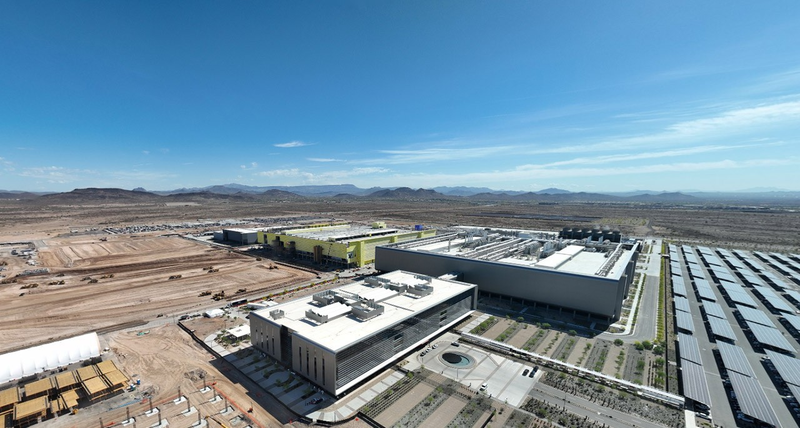
As tariff negotiations between the United States and Taiwan approach a final agreement, Taiwan Semiconductor Manufacturing Co. (TSMC), the world’s largest contract chipmaker, has decided to build more than five additional semiconductor fabs in Arizona. By accepting Washington’s demand to link tariff concessions to incremental investment, TSMC’s U.S. manufacturing footprint is expected to expand to at least 11 facilities. Industry observers interpret TSMC’s aggressive expansion in the U.S. as a strategic move to transplant Taiwan’s semiconductor ecosystem onto American soil and thereby reinforce its influence across the global supply chain.
TSMC Acquires Land for New Facilities in Arizona
On the 12th (local time), The New York Times reported that the U.S. administration is likely to announce within the month an agreement to lower reciprocal tariffs on Taiwan from 20% to 15%, aligning them with those applied to South Korea and Japan. In conjunction with the deal, TSMC is said to be planning the construction of more than five additional semiconductor plants in Arizona. To that end, on the 7th TSMC purchased approximately 3.64 million square meters of land near its existing Arizona site for $197 million. The land is intended for future manufacturing facilities.
Previously, President Donald Trump announced plans in April last year to impose tariffs of up to 32% on Taiwan, later revising the figure to 20%. Controversy followed when it emerged that the tariff structure would add 20% on top of existing rates. In response, Taiwan pushed for negotiations to bring tariffs down to levels comparable with South Korea and Japan. During the process, controversy intensified after claims surfaced that U.S. negotiators had proposed eight conditions, including a requirement that Taiwanese companies with annual revenues exceeding $1.7 billion prioritize investment in the United States within specified limits.
In practice, the true target of the tariff negotiations was TSMC. According to The Wall Street Journal, the U.S. made tariff relief conditional on TSMC committing to further U.S. investment and local fab construction. TSMC began building fabs in Arizona in 2020, completed its first plant last year, and plans to bring a second facility online in 2028. The company has already pledged to build four additional fabs, and when combined with commitments tied to the latest negotiations, TSMC is set to operate at least 11 facilities in the United States.
U.S. Pressures TSMC on Investment Over DEI Compliance
This is not the first instance in which the Trump administration has pressured TSMC to expand its U.S. investment. According to the All-In Podcast released on the 11th, the U.S. government last year leveraged alleged violations of diversity, equity, and inclusion (DEI) provisions under the CHIPS Act to extract an additional $100 billion investment commitment from TSMC. In March last year, TSMC formally announced plans to invest $100 billion to build three advanced-node wafer fabs, two packaging plants, and a research and development center in the United States. This investment was additive to the $65 billion allocated for its Arizona fabs, bringing TSMC’s total U.S. investment to $165 billion.
U.S. Commerce Secretary Howard Lutnick stated that TSMC had signed a 20-page contract under the previous Joe Biden administration that included DEI provisions but failed to comply. He noted that the contract required the hiring of visually impaired contractors and transgender and lesbian engineers, yet TSMC’s Taiwan fabs employed few women lithography equipment engineers and were overwhelmingly male. Lutnick added that while many expected Republicans to dismantle DEI provisions, the administration instead cited violations such as the absence of on-site childcare facilities and proposed waiving all DEI requirements in exchange for more than $100 billion in new fab construction investment.
Lutnick further suggested that TSMC’s investment commitment could increase further. He noted that while TSMC had been slated to receive $6.6 billion from the previous administration for U.S. fab construction, its initial investment stood at just $65 billion. He emphasized that TSMC would announce additional investment details in due course and projected that total U.S. investment could exceed $200 billion, generating roughly 30,000 new jobs. The Wall Street Journal forecast that, as U.S. investment pressure converges with tariff negotiations, Taiwan’s total direct investment in the United States could expand beyond $300 billion.
Deepening Collaboration With Big Tech Through Expanded U.S. Investment
TSMC’s effort to broaden its supply chain presence in the United States may undermine short-term profitability. According to an analysis by semiconductor research firm SemiAnalysis comparing 5-nanometer production costs, TSMC’s Taiwan fabs recorded a total cost of $6,681 per wafer, while its Arizona facility posted a significantly higher cost of $16,123 per wafer, roughly 2.4 times higher. Elevated labor costs, materials pricing, and equipment depreciation were cited as the primary drivers, with U.S. labor and materials costs approximately double those in Taiwan and depreciation costs nearly four times higher.
Nevertheless, TSMC’s aggressive U.S. expansion cannot be explained solely by pressure from the Trump administration or national considerations. The company has secured core U.S. big tech clients such as Apple and Nvidia while accelerating its transition to mass production at the 2-nanometer node. Nvidia CEO Jensen Huang has repeatedly underscored the unmatched strength of Taiwan’s semiconductor ecosystem and publicly endorsed a TSMC-centered supply chain strategy. As Samsung Electronics and Intel intensify competition by targeting next-generation process leadership and early mass production, the battle for supremacy in advanced semiconductors is escalating.
Despite challenges from rivals, Huang asserted that TSMC’s ecosystem dominance will remain intact for the foreseeable future. He stated that Taiwan’s unparalleled manufacturing, packaging, and specialized talent ecosystem cannot be replicated in the short term, characterizing U.S. production expansion as an insurance policy for supply chain resilience. Analysts view TSMC’s massive U.S. investment not merely as a capacity expansion, but as a long-term strategic move to build an advanced ecosystem in the United States with efficiency comparable to Taiwan, thereby securing enduring leverage within the global semiconductor supply chain.
Matthew Reuter is a senior economic correspondent at The Economy, where he covers global financial markets, emerging technologies, and cross-border trade dynamics. With over a decade of experience reporting from major financial hubs—including London, New York, and Hong Kong—Matthew has developed a reputation for breaking complex economic stories into sharp, accessible narratives. Before joining The Economy, he worked at a leading European financial daily, where his investigative reporting on post-crisis banking reforms earned him recognition from the European Press Association. A graduate of the London School of Economics, Matthew holds dual degrees in economics and international relations. He is particularly interested in how data science and AI are reshaping market analysis and policymaking, often blending quantitative insights into his articles. Outside journalism, Matthew frequently moderates panels at global finance summits and guest lectures on financial journalism at top universities.
Similar Post