Samsung Electronics and SK Hynix ramp up DRAM output amid memory boom, China in hot pursuit of the big three

As one of the youngest members of the team, Tyler Hansbrough is a rising star in financial journalism. His fresh perspective and analytical approach bring a modern edge to business reporting. Whether he’s covering stock market trends or dissecting corporate earnings, his sharp insights resonate with the new generation of investors.
Authored On
Modified
Samsung Electronics and SK Hynix ramp up DRAM output amid a memory supply crunch
Memory prices expected to keep surging, pushing up PC and smartphone prices
China’s CXMT accelerates in scale and capability, emerging as a key market wildcard

Major memory makers including Samsung Electronics and SK Hynix are set to increase DRAM output this year. With the global DRAM supply shortage expected to persist, they are reshuffling capacity that had been concentrated on products such as high-bandwidth memory (HBM) to better match market demand. As the memory upcycle and rising prices are seen lasting for some time, China’s CXMT is also accelerating capacity expansion and technological upgrades, emerging as a new market wildcard alongside the Korean chipmakers.
“Must keep up with demand” DRAM supply to expand modestly
According to data from market research firm Omdia released on the 14th, Samsung Electronics’ DRAM wafer output this year is estimated at 7.93 million units, up about 5% from 7.59 million a year earlier. SK Hynix is also expected to raise DRAM production by roughly 8%, from 5.97 million units last year to about 6.48 million this year. The increase is seen as larger than Samsung’s as volumes from the Cheongju M15X plant, which underwent expansion investment earlier, begin to be added in the second half. Micron, the third member of the “big three” memory makers alongside Samsung and SK Hynix, is projected to post annual output similar to last year at around 3.6 million units.
The DRAM output increase is viewed as a strategy to respond to the recent, persistent memory supply crunch. In recent years, memory makers have prioritized advanced process nodes and new production facilities for server and high-bandwidth memory (HBM) products, reflecting strong AI server demand. This has been a key factor behind DRAM supply failing to keep pace with market demand despite steady expansion in production capacity among the top three players. According to an analysis by KB Securities, the industry’s DRAM demand fulfillment rate for customers currently stands at about 60%, with server DRAM fulfillment falling below 50%.
As supply-demand imbalances push prices higher, memory makers’ earnings have been improving across the board. Samsung Electronics, in particular, has posted rapid growth, reshaping the competitive landscape. Data from Counterpoint Research show that in the fourth quarter of last year, Samsung’s memory revenue reached $25.9 billion, accounting for 40% of total sales. Of that, DRAM revenue stood at $19.2 billion and NAND flash at $6.7 billion. Over the same period, SK Hynix recorded memory revenue of $22.4 billion, including $17.1 billion from DRAM and $5.3 billion from NAND. Samsung thus reclaimed the top spot simultaneously in both major memory segments.
“Sky-high” DRAM prices hit downstream markets
The price surge is expected to continue this year as well. Market research firm TrendForce forecast that average DRAM prices in the first quarter will rise 50% to 55% from the previous quarter, calling it an “unprecedented rise in memory prices.” According to DRAMeXchange, the average fixed contract price for mainstream PC DRAM (DDR4 8Gb) in November was about $8.1.
With memory product prices soaring, downstream markets including PCs have been jolted. Mainstream DRAM and NAND flash are key components that currently account for about 10% to 18% of laptop manufacturing costs. Some analysts expect consumer PC prices to jump sharply. In a recent report, IDC said memory supply-demand imbalances are delivering a multifaceted shock to the PC industry, projecting that PC shipments could fall by about 5% to 9% through 2026 while average selling prices could rise by 4% to 8%. AI PCs, which manufacturers have been focusing on since last year, may face an even heavier cost burden because they require more memory.
The smartphone market is also on edge. DRAM accounts for around 20% of smartphone component costs, making it one of the parts most sensitive to price swings. Another variable is that long-term supply agreements (LTAs) between Apple and DRAM suppliers such as Samsung Electronics and SK Hynix are set to expire this month. Typically, DRAM LTAs are signed for one year or longer to secure supply stability, but when supply fails to keep up with demand as it does now, negotiations tend to tilt in suppliers’ favor. The industry expects memory makers to seek higher DRAM prices from major smartphone manufacturers including Apple during the renewal process, raising the likelihood of further increases in retail prices for consumers.
CXMT’s memory push
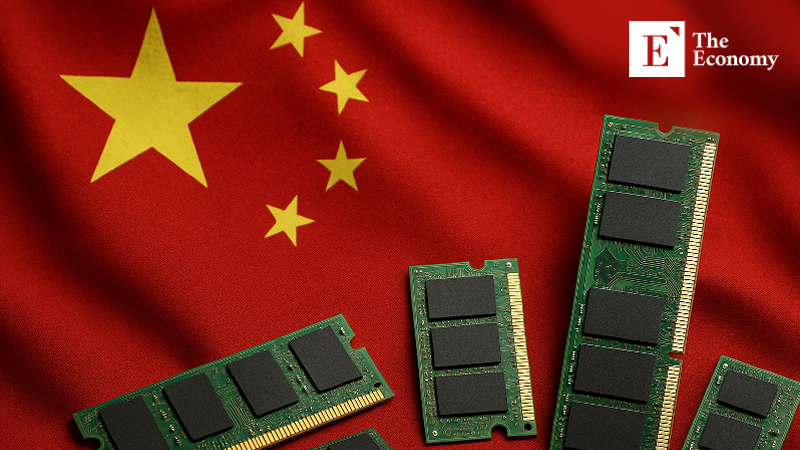
As the memory boom brings upheaval across the market, China is moving to challenge a DRAM industry long dominated by the top three global players. ChangXin Memory Technologies (CXMT), China’s leading memory chipmaker, is stepping up its pursuit after securing substantial funding. The Wall Street Journal reported on the 11th (local time) that CXMT recently raised funds that lifted its valuation to more than $20 billion, and plans to list this year on Shanghai’s STAR Market, often dubbed China’s Nasdaq, to raise about $4 billion. The capital will be used to expand DRAM output (in wafer terms) from about 200,000 wafers per month to 300,000 by the end of this year, and to more than 400,000 in the longer run.
Its latest DRAM lineup has already been unveiled. At the “IC China 2025” event that opened in Beijing last November, CXMT showcased physical samples of seven self-developed products, including DDR5 and LPDDR5X. DDR5 is the latest DRAM standard used in PCs and servers, while LPDDR5X is used in smartphones and tablets. After struggling with DDR5 development and focusing on supplying older-generation products such as DDR4 at lower prices, China’s memory industry is signaling its intent to join the race in the latest-generation memory segment.
CXMT said its DDR5 reaches speeds of up to 8,000 Mbps, a significant improvement from the previous generation’s 6,400 Mbps, and that its LPDDR5X runs at 10,667 Mbps, claiming it can compete with products already on the market. A semiconductor industry source said that while it is unclear how competitive CXMT is in leading-edge process technology, it appears to have caught up to a level fairly close to today’s mainstream products. The source added, however, that factors such as yield rates have not been disclosed, so CXMT’s real-world competitiveness will need to be watched further.
As one of the youngest members of the team, Tyler Hansbrough is a rising star in financial journalism. His fresh perspective and analytical approach bring a modern edge to business reporting. Whether he’s covering stock market trends or dissecting corporate earnings, his sharp insights resonate with the new generation of investors.
Similar Post