U.S. Supreme Court Ruling on Reciprocal Tariffs Imminent, Trump Warns of “Catastrophe” if Defeated vs Treasury Says “Fiscal Capacity Is Sufficient”

Oliver Griffin is a policy and tech reporter at The Economy, focusing on the intersection of artificial intelligence, government regulation, and macroeconomic strategy. Based in Dublin, Oliver has reported extensively on European Union policy shifts and their ripple effects across global markets. Prior to joining The Economy, he covered technology policy for an international think tank, producing research cited by major institutions, including the OECD and IMF. Oliver studied political economy at Trinity College Dublin and later completed a master’s in data journalism at Columbia University. His reporting blends field interviews with rigorous statistical analysis, offering readers a nuanced understanding of how policy decisions shape industries and everyday lives. Beyond his newsroom work, Oliver contributes op-eds on ethics in AI and has been a guest commentator on BBC World and CNBC Europe.
Authored On
Modified
Supreme Court decision approaching, conservative justices skeptical that “taxation is Congress’s authority”
Trump warns “U.S. finances will collapse,” Treasury counters “ample cash on hand”
Companies file successive injunctions, tariff liquidation irrelevant to refunds even if duties are finalized
As the U.S. Supreme Court prepares to issue its final ruling on the legality of the Trump administration’s reciprocal tariffs imposed under the International Emergency Economic Powers Act (IEEPA), President Donald Trump and the Treasury Department are sharply divided over the potential fallout of a defeat. Trump has warned of a fiscal crisis driven by massive refunds, while the Treasury has dismissed such concerns, stressing that available resources are more than sufficient. Amid this uncertainty, U.S. companies have moved preemptively by seeking injunctions to halt tariff liquidation procedures and, crucially, by securing the application of the doctrine of estoppel, preventing the government from reversing its position in the future and establishing tangible legal safeguards for refunds.
U.S. Supreme Court Decision Imminent, Final Verdict on Legality of Trump’s IEEPA-Based Reciprocal Tariffs
According to Reuters on the 13th (local time), the U.S. Supreme Court is expected to deliver its final judgment on the legality of the Trump administration’s IEEPA-based reciprocal tariffs as early as a conference scheduled for the 14th. The central issue is whether the president is empowered under IEEPA to impose sweeping tariffs. While the law grants the president authority to regulate trade and imports during a national emergency, it does not explicitly state whether this authority extends to tariffs, which constitute a form of taxation.
Shortly after returning to office last April, Trump declared the U.S. trade deficit and fentanyl inflows a national emergency and issued an executive order imposing reciprocal tariffs on countries worldwide without congressional approval, citing IEEPA as the legal basis. Additional tariffs were applied to Canada, Mexico, and China under the pretext of curbing fentanyl trafficking. In response, U.S. importers and 12 state governments filed suit, arguing that tariffs fall under Congress’s exclusive constitutional authority and that the president’s use of emergency powers to levy them amounted to an abuse of power.
Both lower courts—the U.S. Court of International Trade and the Federal Circuit Court of Appeals—ruled in favor of the plaintiffs, holding that across-the-board tariffs imposed under IEEPA were unlawful. Despite the Supreme Court’s 6–3 conservative majority, skepticism has been evident, with even conservative Chief Justice John Roberts remarking during initial oral arguments last November that “the power to impose taxes has always been at the core of Congress’s authority.” Questions have also been raised over whether a structural, long-term trade imbalance can legitimately be addressed through an emergency statute designed for temporary crises.
If the Supreme Court upholds the tariffs, short-term legal uncertainty would subside, but concerns would intensify that the judiciary had effectively sanctioned the weaponization of tariffs by the presidency. The Economist warned that while invalidating the tariffs would cause short-term disruption, failing to constrain Trump could produce even worse outcomes, as it would entrench a precedent allowing future presidents to deploy tariffs freely for political, diplomatic, or fiscal objectives.
Trump Warns of U.S. Fiscal Collapse, Treasury Secretary Says “There Is Capacity”
Trump has maintained a hardline protectionist stance regardless of the Court’s ruling. The White House has openly signaled that it could swiftly activate alternative tariff authorities under Section 232 of the Trade Expansion Act or Section 301 of the Trade Act should it lose the case. Tariffs currently applied to automobiles at 15% and to steel and aluminum at 50% could be extended to additional industries. Legal experts, however, argue that a Supreme Court ruling against the administration would significantly narrow Trump’s options and erode the administration’s policy momentum.
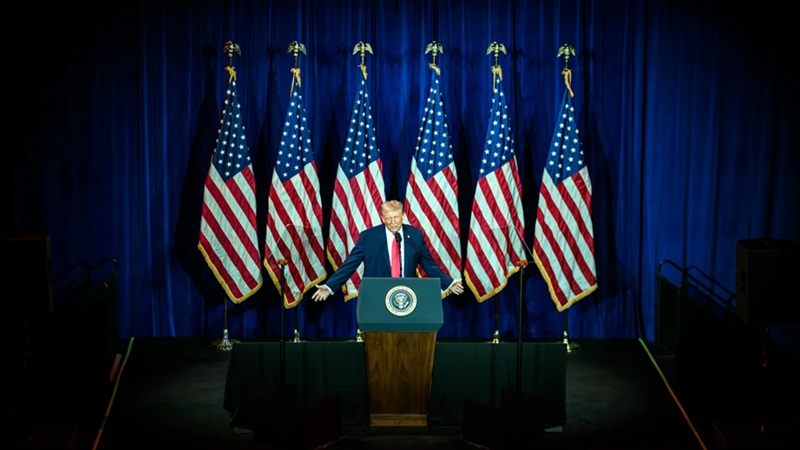
Against this backdrop, Trump took to the stage at the Detroit Economic Club on the 13th, launching a public campaign. He framed tariffs as a cornerstone of national security, insisted that feared side effects had not materialized, and claimed tariff costs had not been passed on to consumers. He went further by asserting that the lawsuit had been brought by forces representing China, branding opponents of tariffs as pro-China and sharpening his rhetoric. He also highlighted progress on inflation and economic growth over the past year, a move widely interpreted as a bid to neutralize voter discontent over high prices ahead of the November midterm elections.
Trump escalated pressure on the judiciary by emphasizing the economic repercussions of a defeat. In a post on Truth Social on the 13th, he claimed that an adverse ruling would immediately require refunds amounting to hundreds of billions of dollars, and that when combined with factory and equipment investments undertaken by governments and companies to avoid tariffs, the total could reach trillions of dollars. He warned that dismantling tariffs, which he likened to a core national security asset, would ultimately lead the United States to catastrophe. Observers note, however, that Trump’s “trillions of dollars” figure far exceeds estimates by the media and expert institutions and appears intended to exaggerate the economic burden of a loss. Reuters estimates potential refunds at approximately $150 billion if the government were to lose at the Supreme Court.
The U.S. Treasury has pushed back, downplaying the risk of a fiscal crisis. Treasury Secretary Scott Bessent told Reuters that as of the 8th, the Treasury held cash reserves of $774 billion, a level sufficient to absorb refunds even if they are ordered. He added that refunds would likely be paid in installments over weeks, months, or longer, rather than as a lump sum, dismissing Trump’s warnings of an imminent fiscal breakdown.
Bessent argued that the more consequential issue lies not in fiscal capacity but in the potential curtailment of presidential trade authority. “The bigger issue than the finances is the reduction in the president’s flexibility to use tariffs as a national security and negotiating tool,” he said. The Trump administration has consistently deployed tariffs as leverage to extract concessions from trading partners, making the Court’s decision pivotal not in terms of tariff rates themselves, but in whether presidential negotiating power is preserved. The ruling also bears directly on the legal stability of existing trade agreements.
Refund Process Fraught With Obstacles, U.S. Companies File Successive Injunctions to Halt Tariff Liquidation
Meanwhile, U.S. administrative authorities have begun preparing for the possibility of large-scale refunds following the Supreme Court’s ruling. According to the Federal Register, U.S. Customs and Border Protection (CBP) has announced that starting February 6, tariff refunds will shift from paper checks to electronic transfers via the Automated Clearing House (ACH). While framed as a routine efficiency upgrade, the move is widely viewed as a preemptive measure to handle a potential surge in refund claims.
Despite these preparations, significant hurdles remain before refunds can actually be disbursed. As Bessent noted, if the Supreme Court does not clearly specify the scope and timing of refunds, administrative procedures and litigation could drag on. The Congressional Research Service (CRS) has identified two critical requirements for refunds: tariff liquidation and the timely filing of a protest. Under standard rules, importers must file a protest within 180 days of liquidation to preserve refund rights, setting the stage for intense legal battles between companies and the government. Questions also loom over whether existing market access and investment commitments made by South Korea, the European Union, the United Kingdom, and Japan would remain valid if the legal basis for the tariffs were invalidated.
As uncertainty over refunds mounted, U.S. companies moved to secure their rights in advance. Costco, AGS, and other businesses filed injunctions with the U.S. Court of International Trade (CIT) to halt tariff liquidation, fearing that once duties were administratively finalized, refunds could be blocked even after a constitutional ruling against the tariffs. In response, the Department of Justice formally stated that it would comply with any future court order to issue refunds regardless of liquidation status. The court dismissed AGS’s injunction request on the grounds that the criteria of “immediate, irreparable harm” had not been met, but crucially applied the doctrine of estoppel, explicitly preventing the government from reversing its position in the future. As a result, companies effectively secured a concrete legal safeguard ensuring that the government cannot later deny refunds by citing tariff liquidation.
Oliver Griffin is a policy and tech reporter at The Economy, focusing on the intersection of artificial intelligence, government regulation, and macroeconomic strategy. Based in Dublin, Oliver has reported extensively on European Union policy shifts and their ripple effects across global markets. Prior to joining The Economy, he covered technology policy for an international think tank, producing research cited by major institutions, including the OECD and IMF. Oliver studied political economy at Trinity College Dublin and later completed a master’s in data journalism at Columbia University. His reporting blends field interviews with rigorous statistical analysis, offering readers a nuanced understanding of how policy decisions shape industries and everyday lives. Beyond his newsroom work, Oliver contributes op-eds on ethics in AI and has been a guest commentator on BBC World and CNBC Europe.
Similar Post