Trump Signals Possible Military Intervention in Iran as Escalating Anti-Government Protests Raise Regime Collapse Risks

Siobhán Delaney is a Dublin-based writer for The Economy, focusing on culture, education, and international affairs. With a background in media and communication from University College Dublin, she contributes to cross-regional coverage and translation-based commentary. Her work emphasizes clarity and balance, especially in contexts shaped by cultural difference and policy translation.
Authored On
Modified
Trump “If the killing does not stop, we will take very strong action”
Fears of Iranian regime collapse heighten volatility in energy markets
Russia, Israel and others closely watch cascading regional repercussions
As anti-government protests continue across Iran for more than two weeks, U.S. President Donald Trump has issued an exceptionally hardline warning to the Iranian regime, including the possibility of military action, sharply intensifying instability across the Middle East. With Washington signaling a potential shift away from its prior emphasis on diplomatic negotiations and economic sanctions toward the prospect of surprise military operations, parts of the international community are now openly discussing the possibility of regime collapse in Iran. Russia, Israel, and other regional stakeholders are closely monitoring the situation and recalibrating their response strategies in anticipation of broader geopolitical fallout.
Trump “There Will Be a Helping Hand for Iranian Protesters”
On the 13th (local time), President Trump said in an interview with CBS News that if the Iranian government proceeds with executing anti-government protesters by hanging, “we will take very strong action.” While he did not specify what form such “strong action” would take, he referenced the recent military operation that removed Venezuela’s President Nicolás Maduro from power, as well as the assassination of Qassem Soleimani, the former commander of the Islamic Revolutionary Guard Corps’ elite Quds Force, during his first term. The remarks were widely interpreted as signaling the possibility of a surprise military strike targeting Iran’s leadership, marking a sharp departure from Washington’s previously restrained posture.
Until just days earlier, President Trump’s focus had remained centered on economic pressure rather than direct military involvement. On the 11th, he warned that “the killing must stop first” before any negotiations could proceed, noting that Iran had proposed talks the previous day. At the time, he described potential airstrikes on Iran as “one of many options available to a commander-in-chief” and stressed that “President Trump always prioritizes diplomacy as the first option.” The White House also announced that it would immediately impose a 25% tariff on countries conducting business with Iran as part of an expanded sanctions regime.
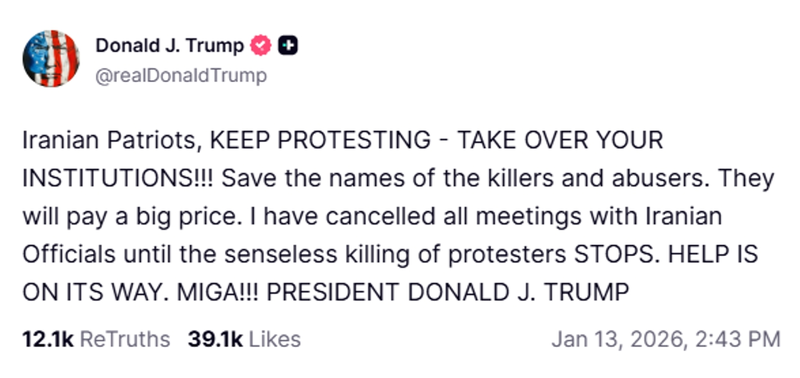
However, on the morning of the 13th, President Trump abruptly escalated his rhetoric. In a post on Truth Social, he urged “patriots of Iran” to “keep protesting” and to “take over your institutions,” adding, “Record the names of those who kill and abuse. They will pay a heavy price.” He further declared that all meetings with Iranian officials had been canceled “until the indiscriminate killing of protesters stops,” and emphasized that “help is on the way.” Trump also referenced the slogan “Make Iran Great Again (MIGA),” which has been adopted by some protesters, further intensifying pressure on Tehran.
Iran responded swiftly and angrily. According to the Associated Press, Ali Larijani, secretary of Iran’s Supreme National Security Council, posted on X on the 13th that “a list of those responsible for killing the Iranian people will be published,” adding, “Number one is Trump, followed by Benjamin Netanyahu.” Iranian Foreign Minister Abbas Araghchi told Al Jazeera that Iran was prepared to resume nuclear negotiations “as long as there are no threats or orders from the United States.”
Bloomberg “Iran Unlikely to Reassert Control”
As tensions between Washington and Tehran escalate amid the expanding protests, the international community is increasingly focused on the potential impact on global geopolitics and energy markets. Some analysts argue that if the unrest spirals into widespread violence, the current system centered on Supreme Leader Ayatollah Ali Khamenei could face a serious challenge. Bloomberg reported that “Iran is facing its most critical moment since 1979,” adding that “the regime’s opportunities and tools to regain control are becoming increasingly limited.” Following the 1979 Iranian Revolution, the pro-U.S., pro-Western Pahlavi monarchy collapsed, giving way to the Islamic Republic and a sharp pivot toward anti-U.S. and anti-Western foreign policy.
Energy markets are also closely watching developments in Iran. As the fourth-largest oil producer within OPEC, Iran’s crude supply disruptions could have significant consequences. With speculation growing that the United States may resort to military options, Brent crude has risen more than 5% since the 8th, surpassing 63 dollars per barrel. While there are no clear signs yet that protests have reduced oil exports, market anxiety has intensified after Reza Pahlavi, son of Iran’s last monarch and a key opposition figure, called on oil workers to strike. In 1978, a nationwide oil workers’ strike crippled Iran’s economy and served as a decisive catalyst for the collapse of the Pahlavi dynasty.
A potential regime collapse in Iran would also pose a major setback for Russian President Vladimir Putin. With pro-Russian governments in Syria and Venezuela already undergoing leadership changes, losing Iran as a core Middle Eastern ally would significantly undermine Moscow’s broader foreign strategy. Since the Cold War, Russia and Iran have rapidly deepened ties based on shared opposition to the United States and the West. Iran has served as a crucial geopolitical bridgehead for Russia’s influence across the Middle East, South Asia, and the Caucasus, and more recently has emerged as a key military partner by supplying drones and ballistic missiles during the war in Ukraine.
Nonetheless, assessments of how the crisis may unfold remain divided. Dina Esfandiary, a Middle East analyst at Bloomberg Economics, said that while “it will be difficult for the Islamic Republic to survive in its current form,” the situation may culminate in leadership replacement rather than full-scale revolution. “A coup by the IRGC is more likely than a popular revolution,” she said, warning that such a scenario could lead to reduced political freedoms and a more hardline foreign policy. William Usher, a former senior Middle East analyst at the CIA, also suggested that in the short term, some ethnic groups and regions could seek autonomy or secession, potentially triggering fragmentation of the state.
U.S. Middle East Envoy Holds Secret Meeting With Former Crown Prince Pahlavi
Signs suggesting preparations for a worst-case scenario are reportedly emerging within Iran. Tom Tugendhat, a British Conservative Party lawmaker, cited intelligence sources claiming that Russian cargo aircraft have landed in Tehran to deliver military supplies while simultaneously transporting large quantities of gold out of the country. While Western media and experts caution that it is unclear whether the gold transfers are linked to arms trafficking or an escape plan by the regime, many interpret the developments as evidence that Iran’s leadership is bracing for escalating unrest.
Meanwhile, U.S. officials are reported to have held secret talks with Reza Pahlavi, the symbolic figurehead of Iran’s opposition. Axios reported on the 13th that Steve Witkoff, President Trump’s Middle East envoy, had made covert contact with Pahlavi, marking the first high-level engagement between the Trump administration and an Iranian opposition leader. Exiled to the United States since 1979, Pahlavi said in a CBS interview on the 12th that “the best way to minimize casualties in Iran is for the United States to intervene more quickly,” directly urging President Trump to pursue regime change.
Israeli Prime Minister Benjamin Netanyahu, who has long maintained an adversarial stance toward the Khamenei government, also issued remarks that appeared to look beyond the current crisis toward a post-regime scenario. In opening remarks at a cabinet meeting on the 11th, Netanyahu expressed support for the “heroic and courageous Iranian people,” adding that “when the Iranian regime falls, we will work together for the benefit of both our nations.” He concluded by saying, “We hope the Persian people will soon be freed from the yoke of tyranny, and when that day comes, Israel and Iran will once again build a future of prosperity and peace as faithful partners.”
Siobhán Delaney is a Dublin-based writer for The Economy, focusing on culture, education, and international affairs. With a background in media and communication from University College Dublin, she contributes to cross-regional coverage and translation-based commentary. Her work emphasizes clarity and balance, especially in contexts shaped by cultural difference and policy translation.
Similar Post
















