Trump’s ‘Greenland Obsession’: The Real Ambition Hidden Behind the Security Rationale

Authored On
Modified
White House hosts trilateral talks among the United States, Denmark, and Greenland
Trump: “If the United States doesn’t take it, Russia or China will”
Is there a long-term strategic calculus beyond the security argument?
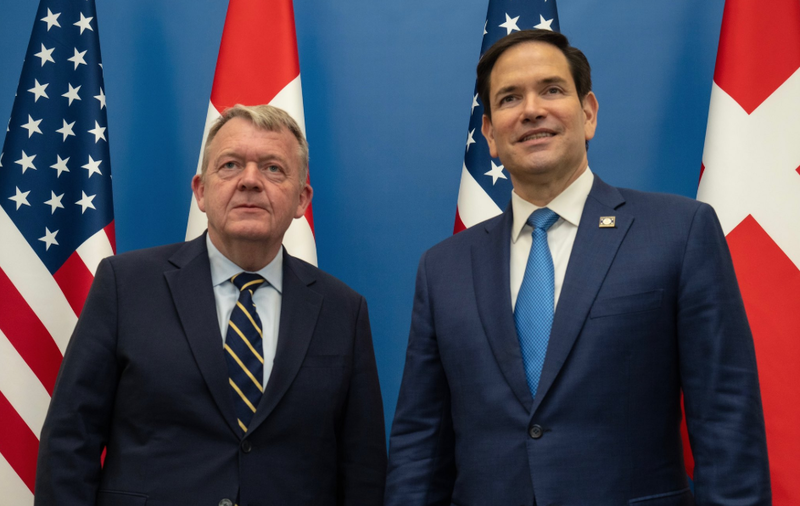
Senior officials from the United States, Denmark, and Greenland met in Washington, D.C., to discuss the issue of Greenland’s potential incorporation into U.S. territory, but failed to narrow their differences, according to sources. As U.S. President Donald Trump continues to signal his intent to annex Greenland under the banner of national security and Arctic order management, Denmark and Greenland have responded head-on by reaffirming the inviolability of sovereignty. While military bases, missile defense, and checks on China and Russia were placed at the forefront of the discussions, analysts note that existing agreements already satisfy a substantial portion of U.S. security requirements, suggesting the presence of other underlying drivers.
U.S. Vice President and Secretary of State Hold One-Hour Talks With Danish and Greenlandic Foreign Ministers
According to Reuters on the 14th (local time), Danish Foreign Minister Lars Løkke Rasmussen met at the White House with U.S. Vice President JD Vance, Secretary of State Marco Rubio, and Greenlandic Foreign Minister Vivian Motzfeldt, holding talks for about an hour. Afterward, Rasmussen said, “We failed to change the U.S. position,” adding, “There remains a fundamental difference of views. It is clear that President Trump wants to conquer Greenland.”
Rasmussen stressed that while Denmark must address U.S. security concerns, the United States must also respect Denmark’s “red line”—the principle that Greenland’s sovereignty cannot be transferred. Motzfeldt likewise stated, “Strengthening cooperation with the United States is important,” but added, “That does not mean we want to be owned by the United States.” This high-level meeting marked the first trilateral talks among the United States, Denmark, and Greenland since President Trump openly expressed his intention to annex Greenland. The three sides plan to hold their first working-level meeting within the next two weeks in an effort to find a compromise.
President Trump, who revealed his interest in purchasing Greenland during his first term, has continued to raise the possibility of annexation since returning for a second term. Ahead of the meeting, Trump wrote on his social media platform Truth Social that “Greenland is needed for national security purposes” and that “NATO should step up and help us get it.” He further warned that if the United States failed to secure Greenland, Russia or China would, stressing, “That will never happen.”
Even after the talks concluded, Trump reiterated his stance, saying, “The United States needs Greenland, and we cannot trust Denmark to properly protect it.” He added, “Greenland is critically important to the security of many countries, including Denmark,” arguing that “if Russia or China were to move in on Greenland, there is nothing Denmark could do.” He continued, “We, on the other hand, can do everything,” adding, “You would have seen that in the Venezuela situation.” As Trump and his aides openly floated the possibility of a Greenland invasion following U.S. military action in Venezuela, Denmark, Greenland, and even Europe at large have been thrown into a state of heightened tension.
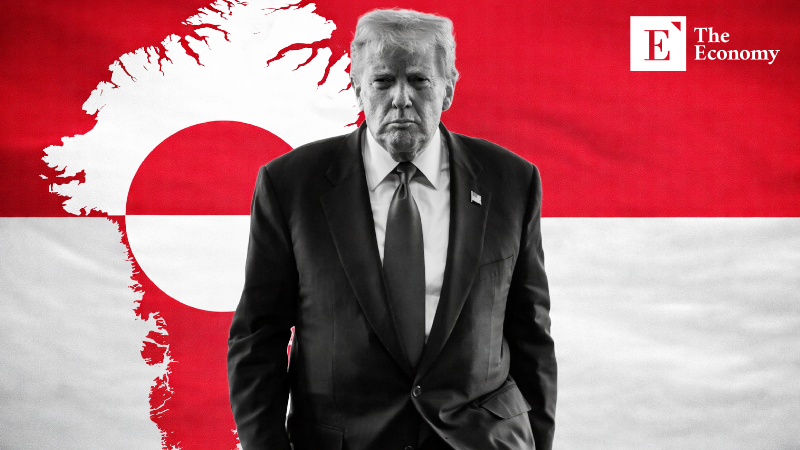
Trump Highlights Greenland’s Value by Invoking Russia–China Containment and Security Concerns
President Trump’s interest in Greenland is multifaceted. He has framed national security as the primary justification for acquiring the territory. On the 9th, he claimed that Russian and Chinese destroyers and submarines were operating around Greenland, stating, “We will not have Russia or China as our neighbors.” Trump has also emphasized that Greenland is a critical area for the U.S.-led Golden Dome project, America’s next-generation missile defense system modeled after Israel’s Iron Dome. Designed to defend the entire U.S. mainland against potential threats from China, Russia, and other adversaries, the plan envisions operating 400 to 1,000 surveillance and tracking satellites along with about 200 interceptor satellites.
Above all, the waters surrounding Greenland are emerging as the shortest maritime routes linking Europe, Asia, and North America. These Arctic sea lanes are divided into the Northern Sea Route (NSR) and the Northwest Passage (NWP). The NSR runs through the Bering Sea between Russia and Alaska, across the Russian Arctic Ocean, connecting Europe and Asia. The NWP also passes through the Bering Sea but cuts across Alaska and the Canadian Arctic coast to reach Europe; it is characterized by less ice melt, shallow depths, and a complex network of large and small islands. Located near the western terminus of these routes, Greenland holds the potential to serve as a logistics hub linking North America and Europe and is considered well suited for operating missile early-warning systems. Controlling Greenland would therefore allow dominance over Arctic maritime traffic and logistics.
China and Russia have likewise shown keen interest in Greenland. In 2023, the two countries formed a working group to develop Arctic shipping routes and have recently agreed to coordinate Arctic maritime law enforcement, beginning with joint patrols. Trump has repeatedly voiced strong concerns over these moves, insisting that influence over the Arctic Ocean must not fall into the hands of “hostile states.”
Some analysts interpret this as an example of what Trump has dubbed the “Donroe Doctrine”—an aggressively reinterpreted version of the 19th-century Monroe Doctrine aimed at asserting U.S. dominance over the Western Hemisphere. Whereas the Monroe Doctrine sought to exclude external powers, Trump’s doctrine envisions direct U.S. management and control of hemispheric order. Ryan Berg of the Center for Strategic and International Studies (CSIS) noted, “Trump views the Western Hemisphere as an extension of ‘America First,’” adding, “Following Venezuela, Greenland is a case where the same logic is being applied along the northern axis.”
The Strategic Precedent Set by the Alaska Purchase
That said, some experts argue that the Trump administration’s publicly stated rationale alone fails to fully explain the push for acquisition. Under existing defense agreements, the United States already enjoys broad freedom to conduct military activities in Greenland, and Arctic shipping routes can be secured through investment partnerships and commercial contracts without territorial ownership. As a result, some observers suggest that, as with the U.S. purchase of Alaska in 1867, there may be other strategic motivations concealed beneath the surface.
The Alaska purchase itself was an example of the United States exploiting Russia’s weakening control to expand its territory, and it initially faced widespread domestic criticism. Through negotiations with the Russian Empire, the United States acquired Alaska for 7.2 million dollars—equivalent to roughly five cents per hectare—a large sum for the U.S. government at the time. When the news broke, many mocked the deal, asking, “Why does America need such a giant ice box?” and deriding it as “Seward’s Folly” or merely a “Polar Bear Garden.”
However, some 20 years after the purchase, the discovery of gold during the 1897 Klondike Gold Rush triggered a surge in mining, followed by the exploitation of oil, coal, natural gas, iron, and other resources, transforming Alaska into what became known as a “great land.” Over the 20th century, its economic value soared as it proved rich in oil, natural gas, and fisheries. Alaska also emerged as a strategic chokepoint linking the Pacific Ocean and the Arctic, serving as a critical military base during World War II and the Cold War amid tensions with the Soviet Union. In 1959, Alaska was admitted as the 49th U.S. state, becoming fully integrated into U.S. territory.
Experts believe that the true reason behind the Trump administration’s ambitions toward Greenland may likewise lie in resources. Climate change and melting ice have made access to rare earth elements, uranium, and iron increasingly feasible. The U.S. Geological Survey (USGS) has previously assessed that Greenland may contain uranium, graphite, and other critical minerals, along with petroleum resources equivalent to about 31.4 billion barrels of oil and 148 trillion cubic feet of natural gas. As U.S.–China strategic competition intensifies, analysts argue that the convergence of resource potential and geographic significance is elevating Greenland’s strategic profile.
Similar Post