China’s surprise trade rebound, powered by export diversification and FX, faces subsidy overhang and tariff risks

Aoife Brennan is a contributing writer for The Economy, with a focus on education, youth, and societal change. Based in Limerick, she holds a degree in political communication from Queen’s University Belfast. Aoife’s work draws connections between cultural narratives and public discourse in Europe and Asia.
Authored On
Modified
China’s December 2025 exports and imports rebound sharply, beating expectations
Annual trade surplus jumps 20%, driven by partner diversification and an undervalued yuan
Subsidy-led export growth fuels global push for higher tariff barriers on China
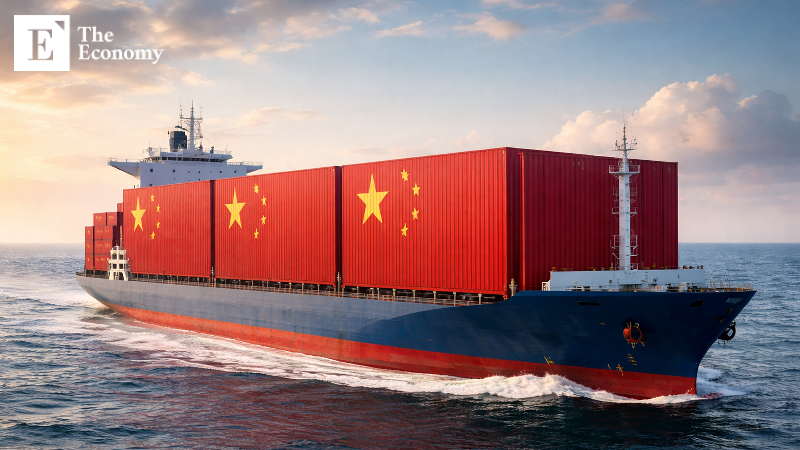
China’s export and import growth rates in December 2025 far exceeded market expectations. With the yuan undervalued, China diversified its trading partners and still delivered solid results despite U.S. tariff pressure. At the same time, some analysts argue that massive subsidies and the resulting oversupply are the structural drivers behind the expanding trade surplus. As countries raise tariff barriers to curb a flood of low-priced Chinese goods, doubts are also growing over the long-term sustainability of this export-led model.
China posts strong trade numbers for 2025
According to China’s General Administration of Customs (GACC) on the 15th, China’s exports in December 2025 rose 6.6% year on year, beating both market expectations (3.1%) and the previous month’s growth (5.9%). Imports also increased 5.7% over the same period, far exceeding expectations (0.9%) and the prior month’s growth (1.9%). It was the biggest rise since September 2025 (up 7.4%). As a result, China’s full-year 2025 trade surplus is expected to reach $1.19 trillion, up 20% from a year earlier.
The Chinese government cited diversification of trading partners as a key driver. At a press briefing, GACC Vice Minister Wang Jun said that while the global trade environment remains complex and challenging, a broader mix of trade partners has significantly strengthened China’s ability to manage risks. By destination in 2025, exports to Africa jumped 26%, the largest increase, while exports to Southeast Asia rose 13%. Exports to the European Union (EU) and South America increased 8% and 7%, respectively. By contrast, exports to the United States fell 20% after Washington sharply tightened trade barriers against China.
Autos were cited as a major engine of export growth. China’s vehicle exports in 2025 rose 19.4% year on year to 5.79 million units, with pure electric-vehicle (EV) exports surging 48.8%. The auto industry expects China, which overtook Japan in 2023 to become the world’s largest vehicle exporter, to have a strong chance of holding the top spot for a third consecutive year.
Where the massive trade surplus comes from
Some in the market argue that China’s huge trade surplus cannot be explained solely by export market diversification. Analysts at Goldman Sachs point to an undervalued yuan as the core driver of China’s export competitiveness. The yuan’s real effective exchange rate (REER), which adjusts for relative inflation, has fallen by about 20% over the past several years, leaving the currency roughly 25% undervalued against the dollar. While the United States and Europe have grappled with inflation, China has faced deflation, eroding the yuan’s real purchasing power relative to its trading partners. This has created a favorable environment for exports.
There is also a view that Western consumption has propped up China’s export strength. Xu Tianchen, senior economist at the Economist Intelligence Unit (EIU), said years of stimulus in the United States generated strong consumer demand, while China’s domestic demand weakened amid a property downturn, reinforcing a classic trade pattern in which excess Chinese production flows to the U.S. China’s economy remains heavily tilted toward hardware manufacturing exports, supported by Western consumption. In fact, China’s goods trade posted a massive surplus even as services trade ran a large deficit of $115.6 billion in the January–November period last year.
Others argue that enormous government subsidies are a central pillar of China’s export-led economy. Beijing has long pursued a strategy of nurturing selected industries through large-scale financial support. A prime example is electric vehicles. According to a 2024 report by the Korea Energy Economics Institute on China’s EV subsidies and global responses, the Chinese government provided about $230.9 billion in support to its EV industry between 2009 and 2023. Other sectors plagued by overcapacity, such as solar and steel, are also being kept afloat by state subsidies. Local governments have continued to support so-called zombie firms that should have exited the market, accelerating oversupply. Backed by subsidies, these industries produce far more than domestic demand can absorb and push excess output into overseas markets, driving the expansion of China’s trade surplus.
Rising trade barriers expected to deepen pressure on China
Countries are moving to erect trade barriers to rein in a flood of low-priced Chinese goods, with many beginning to emulate the tariff strategy once pursued by U.S. President Donald Trump to protect domestic industries. Vietnam has already imposed tariffs on Chinese steel since July, while countries such as Indonesia are reviewing similar measures. Mexico, meanwhile, implemented revisions to its General Import and Export Tax Law (LIGIE) on January 1, imposing tariffs of up to 50% on 1,463 products, including goods from China.
French President Emmanuel Macron also flagged China’s massive trade surplus last month, warning that “if they do not respond, Europeans will have no choice but to follow the U.S. example in the coming months and take strong measures such as imposing tariffs on Chinese products.” According to French business daily Les Echos, the EU’s trade deficit with China reached about $324 billion in 2024.
This trend could deal a serious blow to China’s industrial sector. Government subsidies in China have effectively lowered production costs by covering expenses that companies would otherwise have had to bear themselves, forming the backbone of Chinese firms’ ability to compete aggressively on price. But if heavy tariffs are imposed on Chinese products across global markets, companies will face additional cost burdens that go beyond existing government support. In that case, firms would be forced either to sacrifice margins or raise prices, eroding the cost advantage that subsidies have helped to create.
Aoife Brennan is a contributing writer for The Economy, with a focus on education, youth, and societal change. Based in Limerick, she holds a degree in political communication from Queen’s University Belfast. Aoife’s work draws connections between cultural narratives and public discourse in Europe and Asia.
Similar Post
















