U.S. semiconductor tariffs take effect, Trump-style trade tactics shake markets and erode global trust

Aoife Brennan is a contributing writer for The Economy, with a focus on education, youth, and societal change. Based in Limerick, she holds a degree in political communication from Queen’s University Belfast. Aoife’s work draws connections between cultural narratives and public discourse in Europe and Asia.
Authored On
Modified
U.S. imposes tariffs on semiconductors and equipment, while exempting chips for domestic data centers
Trump once threatened “100% tariffs,” but the actual rate is just 25%
Tariffs repeatedly used as a bargaining lever, shaking global trust
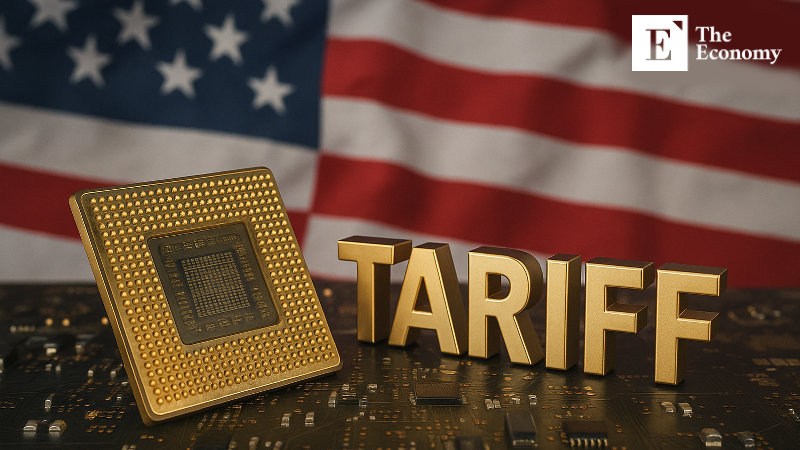
The administration of U.S. President Donald Trump said it would impose tariffs on semiconductors and related products. Under the plan, a 25% tariff would apply to imports of semiconductors, semiconductor manufacturing equipment, and other related items, while products deemed to support U.S. data centers and efforts to strengthen domestic chipmaking capacity would be exempt. With a semiconductor tariff long floated since last year now materializing at a lower level than previously signaled, the market is increasingly viewing Trump’s tariff-first trade posture—repeatedly using duties as a negotiating lever—as undermining international trust.
Trump plays the “semiconductor tariff” card
On the 14th (local time), President Trump signed an executive order imposing a 25% tariff on semiconductors, semiconductor manufacturing equipment, and related imports. According to the order, the U.S. Department of Commerce, citing the findings of a semiconductor import investigation conducted under Section 232 of the Trade Expansion Act on December 22 last year, said semiconductors are essential to America’s economic, industrial, and military capabilities, but the country’s reliance on overseas chip production has been steadily increasing. The department warned that failing to address this trend could undermine U.S. national security.
At the same time, Commerce concluded that current U.S. chipmaking capacity is insufficient to meet projected defense needs or keep pace with demand from growth industries, and recommended a two-phase approach within bounds that would not pose a national-security risk. Trump said Commerce recommended, as a first phase, continuing existing trade negotiations with foreign countries that could help strengthen the U.S. semiconductor industry, and immediately imposing a 25% ad valorem tariff on a very limited category of semiconductors considered critical to the administration’s AI and technology policy.
Trump also directed the commerce secretary and the U.S. Trade Representative (USTR) to conclude semiconductor-related trade agreements with foreign countries and report negotiation outcomes within 90 days. He added that after negotiations conclude, a second phase would impose substantial tariffs more broadly, meaning higher rates and an expanded list of covered items. The first-phase tariff will apply to goods entered for consumption or withdrawn from warehouse for consumption after 12:01 a.m. Eastern Time on the 15th. Chips for U.S. use, including those for data centers, repair and replacement, R&D, startups, consumer devices, and the public sector, will be exempt.
Repeated threats since last year, little follow-through
Markets are focusing on the fact that the long-discussed semiconductor tariff has materialized at a level different from what had been signaled. Trump said on August 6 last year that he would impose “about 100%” tariffs on semiconductors, adding that all integrated circuits and chips entering the United States would be covered—except for companies already building, or pledging to build, semiconductor plants in the U.S. On August 15, he again pressured the industry, saying he would set semiconductor tariffs “next week,” but no duties were ultimately imposed.
On September 6 the same year, Trump declared he would levy “fairly substantial” tariffs on semiconductor imports from companies that do not relocate production to the United States. Reuters reported that he told reporters ahead of an IT-industry dinner at the White House that tariffs would be imposed on companies that “don’t come into the United States,” without specifying timing or rates, while reiterating that firms already in the U.S., building plants, or planning to do so would be exempt.
Later that month, on September 26, reports surfaced that the Trump administration was considering a “1:1” policy that would require domestic production to match the volume of semiconductors imported from other countries. The Wall Street Journal, citing people familiar with the matter, said the administration was reviewing a plan to impose tariffs on chipmakers that fail to increase U.S. production. Under the concept, customers importing chips would need to secure an equivalent amount of U.S.-made semiconductors, or face tariffs if they failed to maintain the ratio. None of those ideas were implemented, and the tariff rate once floated at 100% ultimately slid to 25%. The shift is seen as reflecting the fact that, as tariff implementation was delayed and more companies committed to invest locally, Trump achieved his goal of boosting domestic production and adjusted his approach.
Growing distrust of President Trump
As President Trump wields tariffs as a tool to sway global markets, trust in him is visibly eroding. According to an Axios report last August citing a Pew Research Center survey, only 34% of respondents across 24 countries said they believed Trump would make the right decisions on international issues. In many countries, favorability dropped by more than 10 percentage points compared with the previous survey conducted in 2018. Notable declines were seen in South Korea (–16%), Mexico (–32%), Sweden (–28%), Poland (–22%), Canada (–20%), Germany (–16%), and Japan (–15%).
In a large number of countries, a majority said they do not trust Trump. The share of respondents expressing distrust was particularly high in Canada (77%), the Netherlands (77%), France (78%), Germany (81%), Sweden (85%), Turkey (80%), and Mexico (91%). His handling of international affairs was cited as the main reason for this skepticism. Countries where trust in Trump was relatively higher were limited to a few with authoritarian-leaning governments, such as Hungary (53%), India (52%), and Israel (69%).
Common perceptions of Trump across countries included “arrogant” (80%), “a strong leader” (67%), and “dangerous” (65%). His hard-line policy stance—marked by cuts to foreign aid, tariffs on allies, restrictions on international students, and a firm embrace of “America First”—is seen as shaping these views. Axios noted that even in countries such as South Korea and Japan, where distrust of Trump is widespread, he is still often regarded as a “strong” leader.
Aoife Brennan is a contributing writer for The Economy, with a focus on education, youth, and societal change. Based in Limerick, she holds a degree in political communication from Queen’s University Belfast. Aoife’s work draws connections between cultural narratives and public discourse in Europe and Asia.
Similar Post