[Rare Earth Supply Chain] India bets on rare earths to cut reliance on China, but faces hurdles in technology gaps and resource concentration

Aoife Brennan is a contributing writer for The Economy, with a focus on education, youth, and societal change. Based in Limerick, she holds a degree in political communication from Queen’s University Belfast. Aoife’s work draws connections between cultural narratives and public discourse in Europe and Asia.
Authored On
Modified
India approves massive rare-earth subsidies to curb reliance on China
World’s third-largest reserves provide a solid raw-material base
But gaps remain in processing technology and high-performance magnet materials
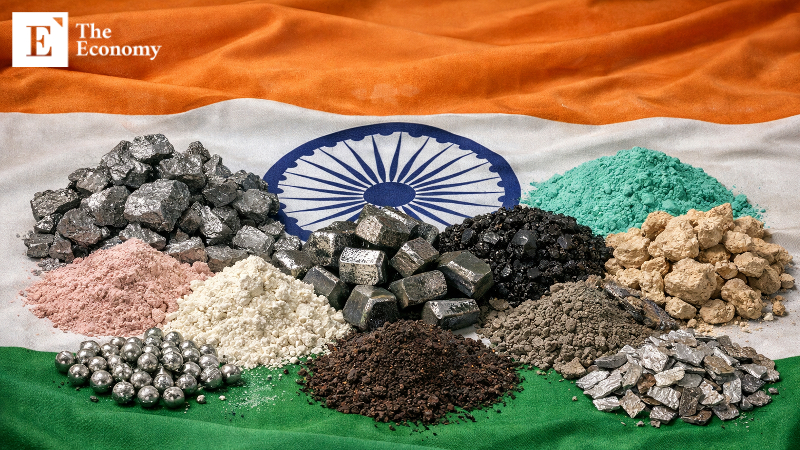
The Indian government has finalized a subsidy plan to strengthen its domestic rare-earth ecosystem. With China—effectively dominating the global rare-earth market—continuing to use resources as a strategic lever, India is moving to make large-scale investments to secure a stable foundation for advanced industries. However, the market is also warning that clear constraints, including gaps in refining and separation technology and limited reserves of heavy rare earths, could make it difficult for India to drive meaningful supply-chain shifts in the near term.
India approves rare-earth subsidy plan
According to a Bloomberg report on the 16th (local time), India has approved a self-reliance program to build a domestic ecosystem for manufacturing rare-earth magnets, combining funding support and sales incentives totaling about $880 million. The program will be rolled out in phases over seven years. Of the total, roughly $780 million will be used as sales incentives for rare-earth magnets, and about $90 million will go toward subsidies for new and expanded production facilities. The government aims to use the plan to establish annual production capacity of 6,000 tons of rare-earth magnets.
The decision is widely seen as aimed at China. India’s goal is to produce rare-earth magnets—critical components for advanced industries—at home and reduce dependence on Chinese products. China controls more than 90% of the global rare-earth processing market, while India currently imports 80% to 90% of its rare-earth magnets and related raw materials from China. Indian government data show India spent $221 million in 2025 on importing magnets and related materials.
That dependence poses a growing risk for India as demand for rare earths surges alongside the expansion of strategic industries such as EVs, wind power, and defense—especially as China continues to weaponize its resource advantage. In April last year, China added seven heavy rare earths and permanent magnets to its export-control list in response to steep U.S. tariffs. Shipments of related products plunged in April and May, triggering significant production disruptions across India’s auto and home-appliance sectors. Maruti Suzuki, India’s largest automaker, reportedly cut production of its electric e-Vitara to less than one-third of its original plan due to supply constraints.
India’s rare-earth competitiveness
Going forward, India is expected to lean on a strategy that highlights its strength in raw materials, as it ranks among the world’s top five rare-earth holders. India’s rare-earth resources are concentrated largely along coastal regions such as Odisha and Kerala. Exploration and mining are currently dominated by the state-run miner IREL, but since 2023 India has begun legislative and regulatory work to expand private-sector participation in exploration and refining—signaling a gradual easing of the state monopoly.
India also reported the discovery of new deposits last year. In July 2025, Union Minister for Coal and Mines Kishan Reddy told the upper house that the government had identified roughly 8.5 million tons of rare-earth element reserves, well above the previous estimate of 6.99 million tons. He added that an additional 1.29 million tons of rare-earth oxide were confirmed in hard-rock deposits in Gujarat and Rajasthan, strengthening India’s resource base.
Still, resource endowment alone does not complete a supply chain. Rare earths are widely seen as requiring substantial technological capability after extraction, not at the mining stage itself. Because the 17 rare-earth elements have very similar chemical properties, separating and refining them demands highly sophisticated precision chemistry. Solvent extraction, a main separation method, can require at least 200 stages to isolate the desired element. The process also depends on a steady supply of chemicals such as ammonium chloride and oxalic acid; without reliable access to these reagents, refining capacity can be crippled. In other words, market dominance ultimately hinges on both process know-how and procurement capabilities for key inputs.
India lags China’s industry-leading capabilities
China is the dominant force in the rare-earth refining and separation market. It built its industrial base in the 1960s by learning from U.S. rare-earth mining and processing operations, then rapidly expanded its domestic industry on the back of cheap electricity and looser environmental regulation, developing both a supply chain and technical know-how. In the 2000s, China further reshaped the market through state-led consolidation, merging a fragmented industry into the so-called “Big Six.” The result was a shift from being merely resource-rich to becoming a process and supply-chain powerhouse.
India, by contrast, faces clear constraints in refining technology and processing capacity, and remains underdeveloped in downstream industrialization and applications. A state-centric, relatively closed structure has limited technology adoption and private-sector innovation, while the lack of a robust downstream ecosystem has prevented scale-up into end-use industries. Weak infrastructure and shortages of skilled labor are also cited as headwinds. These structural limitations are reflected in India’s current rare-earth output, which accounts for about 1% of global production.
Another challenge is India’s limited availability of heavy rare earths such as dysprosium and terbium, which are critical inputs for high-performance magnets. In May, Hindustan Zinc won a mining block for monazite—a neodymium-bearing mineral—in the northern state of Uttar Pradesh, but exploration and extraction are expected to take around three to four years. High-performance magnets are used in strategic sectors including EV motors, wind turbines, industrial robots, and aerospace and defense equipment. Without a stable supply of heavy rare-earth inputs, India’s push for genuine supply-chain self-reliance could face major setbacks.
Aoife Brennan is a contributing writer for The Economy, with a focus on education, youth, and societal change. Based in Limerick, she holds a degree in political communication from Queen’s University Belfast. Aoife’s work draws connections between cultural narratives and public discourse in Europe and Asia.
Similar Post