EU embraces protectionism amid Russia- and China-driven headwinds ahead of “Made in Europe” bill draft release

As one of the youngest members of the team, Tyler Hansbrough is a rising star in financial journalism. His fresh perspective and analytical approach bring a modern edge to business reporting. Whether he’s covering stock market trends or dissecting corporate earnings, his sharp insights resonate with the new generation of investors.
Authored On
Modified
EU pushes “Made in Europe” legislation, doubling down on protectionist trade stance
Moves to shield industrial competitiveness amid fiscal strain and slowing growth
Energy supply risks and trade tensions with China add pressure across the bloc
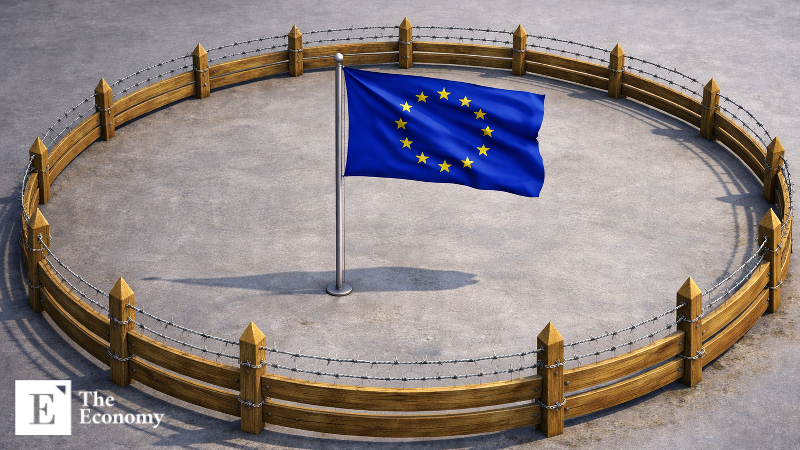
The European Union (EU) is moving to advance so-called “Made in Europe” legislation, reinforcing a more protectionist trade stance to limit the erosion of industrial competitiveness within the bloc. The shift comes as mounting internal and external uncertainties—including the cutoff of Russian energy supplies and growing trade frictions with China—have accelerated economic slowing and fiscal stress across major member states.
EU steps up push for Industrial Accelerator Act
According to Bloomberg on the 17th (local time), the European Commission is set to unveil a draft of the “Industrial Accelerator Act” later this month. The proposal includes provisions that would require major foreign investments exceeding €100 million to meet conditions such as technology transfer, local hiring, and the establishment of joint ventures with European companies. Some exemptions would apply to countries that have signed free trade agreements (FTAs) with the EU.
The bill also includes measures to set up stockpiling hubs to prepare for shocks to supplies of critical raw materials, along with fast-track procedures to speed approvals for strategic projects in areas such as batteries, semiconductors, and green hydrogen. In addition, the EU plans to mobilize €100 billion in funding through channels such as the Innovation Fund, and to grant “green labels” and “Made in Europe” certification to products produced in an environmentally friendly manner, giving them priority in public procurement. Given that public procurement in Europe accounts for about 14% of the EU’s GDP, the move would represent a clear advantage for European-made products.
The steps come as signs of slowing industrial output across Europe have become more pronounced. The Commission said high energy prices, the need for large-scale decarbonization investment, and unfair global competition are combining to put energy-intensive industries at a competitive disadvantage and heighten the risk of industrial decline. It added that strengthening supply-chain resilience and protecting the single market and industrial capacity are necessary for the EU’s economic security.
Fiscal and economic warning lights flash across major EU economies
The crisis facing the EU becomes clearer when looking at the fiscal positions of its major member states. France is a prime example. French public debt has ballooned rapidly through the global financial crisis, the war in Ukraine, and the Covid-19 pandemic. During the pandemic, the French government maintained an open-ended spending stance to fund stimulus measures and unemployment support, and this period of what critics describe as “fiscal addiction” has left lasting damage to the economy.
France’s public debt, which stood at around 50% of GDP in the early 2000s, has surged to well above 115% of GDP as of 2025. That is the third-highest level in the euro zone, after Greece and Italy. In September last year, Fitch cut France’s sovereign credit rating from AA- to A+, below that of South Korea. In October, Moody’s also revised France’s outlook from “stable” to “negative.” Around the same time, then Finance Minister Bruno Le Maire warned upon stepping down that France could eventually require intervention from the International Monetary Fund.
Germany is also struggling to emerge from a prolonged economic slump. The economy contracted by 0.9% in 2023 and 0.5% in 2024, marking two consecutive years of negative growth. As the downturn deepened, companies were pushed to the brink. According to the ZEW economic research institute, the number of business closures in Germany rose 16% in 2024 from the previous year to 196,100, the highest level in 13 years since the euro zone debt crisis in 2011. By sector, closures among energy-related firms jumped 26% year on year, followed by IT companies at 24% and construction firms at 20%.
Although Germany’s growth rate finally returned to positive territory at 0.2% last year, the recovery was driven largely by government spending. Private-sector activity remains mired in stagnation. Manufacturing output—led by autos and machinery, the backbone of the German economy—fell 1.3%, extending its decline for a third straight year, while exports also shrank 0.3%, marking a third consecutive annual contraction.
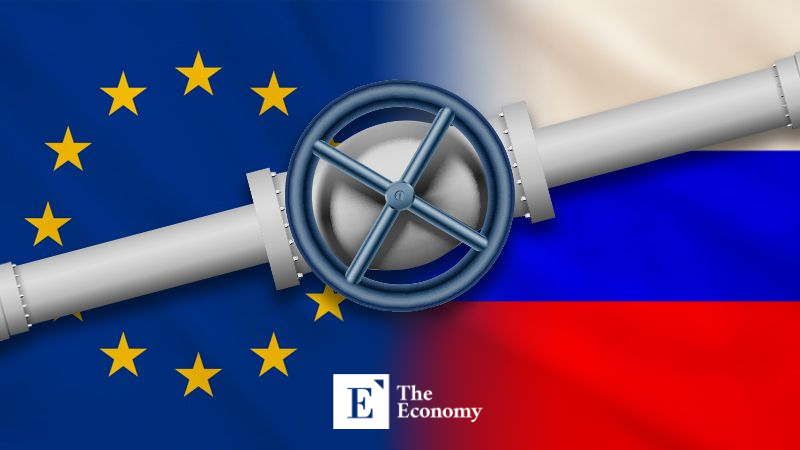
Tensions between the EU, Russia, and China
Experts say rising energy prices are accelerating the EU’s economic strains. The cutoff of cheap Russian energy supplies has sharply increased costs across member states. Since Russia’s invasion of Ukraine in February 2022, the EU has steadily reduced its dependence on Russian energy. Imports of Russian gas fell from about 150 billion cubic meters in 2021 to 52 billion cubic meters in 2024, while Russia’s share of EU gas imports dropped from 45% to 19%. Imports of Russian coal have been fully banned, and oil imports have plunged from 27% in early 2022 to just 3%.
At the same time, China—wielding significant influence in global manufacturing—has moved in the opposite direction, sharply increasing imports of Russian energy to bolster its competitiveness. According to China’s General Administration of Customs, China’s imports of Russian LNG in November last year surged 142.6% year on year to 1.6 million tons, accounting for 23.5% of its total LNG imports. As China cuts energy costs and disrupts global manufacturing with aggressive low-price strategies, the EU is instead facing a backlash from sanctions on Russia, weakening its industrial base.
Trade friction with China is another risk the EU cannot ignore. In October 2024, the bloc imposed tariffs of up to 45.3% on Chinese-made electric vehicles following an anti-subsidy investigation. China retaliated with anti-dumping duties of up to 34.9% on European brandy in July and up to 19.8% on pork in September, followed last month by tariffs of up to 42.7% on EU dairy products. The tit-for-tat measures have steadily escalated trade tensions over several months. Although the EU and China continued economic and trade talks amid heightened strain, they have only recently managed to reach a tentative understanding.
On the 12th, China’s Ministry of Commerce said on its website that both sides agreed Chinese exporters of pure electric vehicles to the EU would need to provide general guidance on price commitments. In effect, Chinese EV makers will adopt a pricing-undertaking mechanism that sets minimum export prices. Detailed criteria are expected to be outlined soon in guidance documents to be released by the EU on applications for price undertakings.
As one of the youngest members of the team, Tyler Hansbrough is a rising star in financial journalism. His fresh perspective and analytical approach bring a modern edge to business reporting. Whether he’s covering stock market trends or dissecting corporate earnings, his sharp insights resonate with the new generation of investors.
Similar Post