U.S. Threatens “100% Tariffs Without Investment,” Potentially Accelerating a Deepening Semiconductor Shortage

Anne-Marie Nicholson is a fearless reporter covering international markets and global economic shifts. With a background in international relations, she provides a nuanced perspective on trade policies, foreign investments, and macroeconomic developments. Quick-witted and always on the move, she delivers hard-hitting stories that connect the dots in an ever-changing global economy.
Authored On
Modified
U.S. Commerce Secretary Lutnick Reiterates “100% Tariff” Warning
Washington Seen Pressuring South Korea via U.S.–Taiwan Trade Talks
U.S. Secures Production Facilities but Manufacturing Constraints Remain Urgent
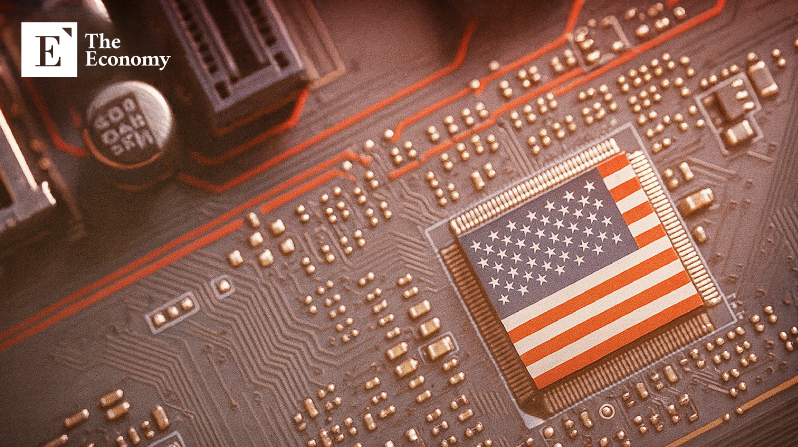
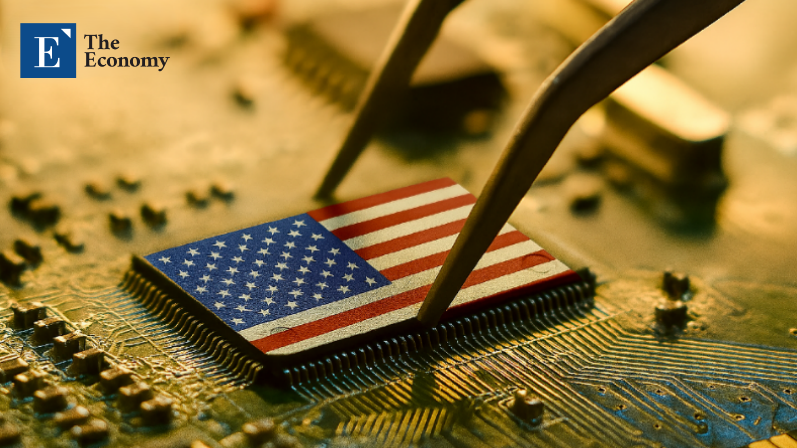
After concluding tariff negotiations with Taiwan, the United States has once again warned that it could impose tariffs of up to 100% on imported semiconductors if companies fail to invest in domestic production, reigniting tariff-related uncertainty across the semiconductor industry. The move is widely interpreted as an attempt to force the onshore production of high-bandwidth memory (HBM), which has been in chronic short supply amid the artificial intelligence boom. However, the effectiveness of the policy is increasingly questioned, as America’s weak manufacturing ecosystem, high cost structure, and persistent policy uncertainty threaten to further distort global supply chains.
U.S. Commerce Secretary: “Invest in the U.S. or Pay 100% Tariffs”
According to Bloomberg on January 18 (local time), U.S. Commerce Secretary Howard Lutnick told reporters at a groundbreaking ceremony for Micron’s new facility in New York on January 16 that “every memory producer has only two choices,” adding that they must either “pay a 100% tariff or manufacture products in the United States.” Earlier, on January 14, the White House had signaled through a fact sheet that President Donald Trump intended to expand tariffs on semiconductor and derivative product imports while introducing a tariff-offset program to encourage domestic manufacturing.
Semiconductor tariffs have followed a familiar cycle. The Trump administration first floated the idea in August last year, before pivoting toward tariff waivers and bilateral negotiations as the AI-driven semiconductor shortage became increasingly apparent. The looming January 20 Supreme Court ruling on the legality of reciprocal tariffs also appears to have influenced the administration’s stance. Should the court strike down the policy, the Trump administration could face refund pressures totaling $150 billion, along with significant political fallout.
What stands out this time, however, is the explicit targeting of “memory” and the ultimatum of “investment or tariffs.” Bloomberg described the move as a “warning shot aimed at South Korean memory makers.” With memory production concentrated among Micron, Samsung Electronics, and SK hynix, the pressure effectively zeroes in on “K-semiconductors.” At present, South Korea has no memory manufacturing plants in the United States. Samsung operates a foundry in Austin, Texas, and is preparing to bring online its Taylor, Texas foundry after investing $37 billion, while SK hynix’s $3.87 billion Indiana project focuses on HBM packaging, not wafer-level memory fabrication. Lutnick’s pointed demand for memory investment is therefore widely seen as an attempt to force new capital commitments.
TSMC Secures Tariff Exemptions by Building U.S. Plants
Until now, Washington had exercised caution on memory tariffs. With South Korean firms commanding over 60% of the global market, higher tariffs risked triggering sharp price increases across everything from iPhones to AI data centers. The decision to play the memory card nonetheless appears driven by mounting anxiety over HBM shortages. The administration seems to believe that a complete “U.S. AI chip ecosystem” requires both Korean HBM and Taiwanese foundry capacity to be relocated to American soil.
Taiwan has already pledged a staggering $500 billion investment and guarantee package to the United States, securing tariff exemptions on semiconductor products in return. On January 15, the Trump administration disclosed details of its trade agreement with Taiwan, explicitly linking tariff preferences to the construction of new U.S. production facilities. According to the Commerce Department, Taiwanese semiconductor firms building new plants in the United States can import up to 2.5 times their installed capacity tariff-free while construction is underway. A facility with an annual capacity of one million wafers, for example, would be allowed to ship up to 2.5 million wafers into the U.S. without tariffs during the buildout period.
Preferential treatment extends even beyond that threshold. Once a new U.S. facility is completed, firms can import up to 1.5 times their production capacity tariff-free. The policy clearly reflects the Trump administration’s strategy of using tariffs as leverage to pull semiconductor manufacturing into the United States.
TSMC is already constructing or expanding six semiconductor plants in Arizona and, under the new agreement, plans to add five more facilities. Lutnick said the package includes the $100 billion investment previously pledged by TSMC, with additional spending expected. He also noted that TSMC has acquired millions of acres of land near its Arizona sites, adding that U.S.-based production capacity would double as a result.
Forced Investment Strategy Fuels Price Inflation and Uncertainty
From Washington’s perspective, the structure appears advantageous. If South Korean firms follow TSMC and expand U.S. manufacturing under tariff pressure, the United States would effectively absorb East Asia’s semiconductor production infrastructure. Either outcome, the administration argues, maximizes U.S. interests.
Industry experts, however, remain deeply skeptical. Structural weaknesses in America’s semiconductor manufacturing environment are likely to derail the plan. Among South Korean firms, it is increasingly said that “paying the tariff may be cheaper than building in the U.S.” Labor costs are dramatically higher than in Korea, yet skilled workers are scarce. One industry source noted that semiconductor plants are often built in low-income rural areas, where many workers have never seen a cleanroom and few have experience with large-scale advanced facilities. Despite this, wages remain high, and companies must shoulder the burden of training workers, meeting construction timelines, and building an entire ecosystem in partnership with local universities.
The cost gap is stark. According to the Semiconductor Industry Association, operating an advanced logic chip plant in the United States for ten years costs 28% more than in South Korea. With U.S. operating costs indexed at 100, comparable costs stand at 78 in South Korea, Taiwan, and Japan, and 63 in China. Currency fluctuations and rising inflation have further driven up raw material costs. Reuters reports that Samsung’s Taylor, Texas fab, initially projected to cost $17 billion, is now expected to exceed $25 billion, a surge of nearly 47%, with costs continuing to climb. The Trump administration’s decision to impose a 50% tariff on imported steel has added further inflationary pressure, pushing construction expenses even higher.
The greater concern, however, is uncertainty. The Biden administration sought to offset America’s high-cost structure through the CHIPS Act, offering generous subsidies to attract manufacturing investment. Those commitments were abruptly reversed after President Trump returned to office in January last year. The new administration moved beyond subsidy cuts to proposals involving equity stakes in investing companies. Critics argue that these policy reversals have worsened semiconductor supply imbalances and fueled distorted price spikes, as investment proceeded in the absence of adequate power, water, and skilled labor infrastructure, driving production costs higher.
Immigration policy has compounded the uncertainty. The Biden administration halted large-scale workplace raids in 2021 as part of its investment attraction strategy, benefiting states such as Georgia, where Hyundai Motor and South Korean battery makers established major facilities. Under the second Trump administration, however, pressure on foreign investors has intensified while visa requirements have tightened and immigration enforcement has hardened. The widely reported large-scale raid at a Hyundai–LG facility last year underscored the risks. A senior executive at a South Korean conglomerate said companies fear uncertainty even more than losses, adding that America’s volatile policy and regulatory environment makes long-term investment planning increasingly difficult.
Anne-Marie Nicholson is a fearless reporter covering international markets and global economic shifts. With a background in international relations, she provides a nuanced perspective on trade policies, foreign investments, and macroeconomic developments. Quick-witted and always on the move, she delivers hard-hitting stories that connect the dots in an ever-changing global economy.
Similar Post