EU Fires Back With Hardline Response to Trump’s ‘Tariff Bomb,’ Accelerates Push for Strategic Autonomy

Matthew Reuter is a senior economic correspondent at The Economy, where he covers global financial markets, emerging technologies, and cross-border trade dynamics. With over a decade of experience reporting from major financial hubs—including London, New York, and Hong Kong—Matthew has developed a reputation for breaking complex economic stories into sharp, accessible narratives. Before joining The Economy, he worked at a leading European financial daily, where his investigative reporting on post-crisis banking reforms earned him recognition from the European Press Association. A graduate of the London School of Economics, Matthew holds dual degrees in economics and international relations. He is particularly interested in how data science and AI are reshaping market analysis and policymaking, often blending quantitative insights into his articles. Outside journalism, Matthew frequently moderates panels at global finance summits and guest lectures on financial journalism at top universities.
Authored On
Modified
Trump’s Greenland-linked tariff threat escalates; Bessent defends pressure tariffs
EU weighs ‘trade bazooka,’ retaliatory duties as confrontation hardens
‘Greenland tariffs’ ignite flashpoint, signaling fractures in transatlantic relations
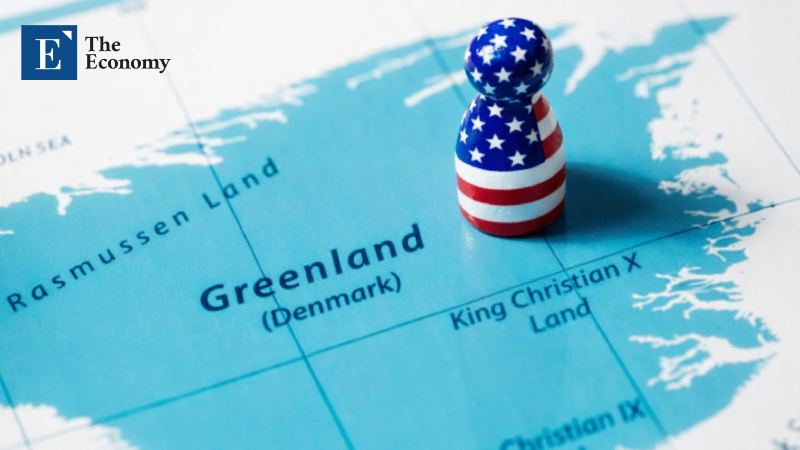
Tensions between the United States and Europe over Greenland are escalating into a full-blown trade confrontation. After U.S. President Donald Trump threatened additional tariffs against European countries opposing his plan to annex Greenland, the European Union (EU) has moved toward a hardline response, openly weighing retaliatory tariffs against the United States. What began as a geopolitical dispute triggered by Trump’s “America First” doctrine is increasingly morphing into a geoeconomic clash between Washington and Brussels.
U.S. Treasury Reaffirms ‘Greenland Annexation,’ Says “Europe Is Weak, America Projects Strength”
According to Bloomberg on the 18th (local time), U.S. Treasury Secretary Scott Bessent said in an interview with NBC that Trump’s Greenland initiative reflects Washington’s determination to strengthen security in regions it already has a defense obligation to protect. “Europe is exposing weakness, while the United States is projecting strength,” Bessent said, adding that Trump believes enhanced security is impossible unless Greenland becomes part of the United States. Addressing Trump’s warning of tariffs on the EU, Bessent described the move as “a geopolitical judgment and a strategic decision,” arguing that Washington is using its economic power to prevent an actual war. He added that Europeans would ultimately come to understand that Greenland’s annexation would serve the interests of Greenland, Europe, and the United States alike.
Bessent went on to warn that European leaders would eventually realize they must remain under the U.S. security umbrella, asking rhetorically what would happen to Ukraine if American support were withdrawn. “Everything would collapse,” he said. Noting that U.S. presidents have sought to acquire Greenland for more than a century, Bessent said Washington is currently building the “Golden Dome,” a next-generation missile defense system, and that Trump is looking beyond this year and next to potential conflicts in the Arctic.
Earlier, on the 17th, Trump announced that starting next month he would impose a 10% tariff on goods imported from eight European countries, including Denmark, which exercises de facto control over Greenland, with the rate set to rise to 25% in June. The eight countries named by Trump are those that have either deployed troops to Greenland or expressed an intention to do so after Washington raised the possibility of military action to acquire the territory. Trump accused these countries of heading to Greenland “without any clear purpose,” saying they had created “unsustainable and intolerable levels of risk.” He stressed that the tariffs would remain in place until a deal is reached on the “complete and total acquisition” of Greenland.
EU Weighs $100 Billion in Retaliatory Tariffs and Trade Sanctions
Trump’s willingness to wield tariffs to advance his Greenland agenda has hardened sentiment across Europe, where patience appears to be wearing thin. Since Trump’s return to office in January last year, European governments have faced repeated friction with Washington over the Ukraine war and trade disputes, yet largely refrained from open confrontation in an effort to manage the relationship. With U.S. support still critical in NATO defense and the conflict in Ukraine, European leaders had judged that a full-scale trade war could easily spill over into the diplomatic and security arenas.
That calculus now appears to be shifting. As dialogue and compromise with Trump grow increasingly elusive, calls for a “hard-against-hard” response are gaining traction. On the 17th, French President Emmanuel Macron declared that “intimidation and threats, whether in Ukraine or Greenland, will not influence us,” adding that tariff threats are unacceptable and that Europe will respond in a united and coordinated manner. The same day, European Commission President Ursula von der Leyen warned that the tariff move would damage transatlantic relations and trigger a dangerous vicious cycle, stressing that Europe would stand together to defend its sovereignty. Other leaders echoed the criticism, with UK Prime Minister Keir Starmer calling tariffs on NATO allies “completely wrong,” and Swedish Prime Minister Ulf Kristersson vowing not to yield to intimidation.
EU ambassadors convened an emergency meeting in Brussels on the 18th to discuss a joint response. According to the Financial Times, the EU’s 27 member states debated whether to impose retaliatory tariffs of up to about $100 billion on U.S. goods or to deploy the bloc’s “anti-coercion instrument” (ACI), which would restrict U.S. companies’ access to the EU market. Introduced in 2023 but never used, the ACI allows the EU to limit trade in services, foreign direct investment, financial markets, public procurement, and intellectual property with countries deemed to be exerting economic pressure. The EU had already prepared a list of U.S. products for potential retaliation during previous trade talks but shelved the measures to avoid a full-scale trade war.
Rising Momentum for Autonomous Defense, Inevitable Surge in Military Spending
The possible closure of U.S. military bases in Europe is also being floated as a retaliatory option. According to Politico Europe, a European diplomat said discussions have emerged about reclaiming control over U.S. bases and potentially suspending support for American forces stationed on the continent. As of 2024, the United States operates 31 permanent bases and 19 additional military facilities in Europe, with a total of 67,500 troops deployed. Germany’s Ramstein Air Base, NATO’s largest, plays a pivotal role in enabling U.S. military operations across the Middle East and Africa.
In practice, Washington continues to rely heavily on its European footprint. Last June, during airstrikes on Iranian nuclear facilities, the United States requested European air support from NATO bases near the Black Sea in Romania, and just last week used British bases in operations to seize Russian “shadow fleet” oil tankers. European officials say these episodes underscore Trump’s continued dependence on European military infrastructure. Europe also represents a major market for U.S. arms exports. In 2024 alone, European countries approved $76 billion in purchases of U.S. weapons, accounting for more than half of total U.S. arms exports that year.
At the same time, awareness is spreading within the EU that member states must strengthen their own defense capabilities to bolster deterrence against Washington itself. The underlying judgment is that reliance on the United States as a security guarantor has become increasingly untenable. Europe’s long-standing reluctance to confront Washington head-on has been rooted in deep-seated security dependence. NATO data show that of the alliance’s total defense spending of $1.4515 trillion in 2024, the United States accounted for $935 billion, or about 64%, exceeding the combined spending of Europe and Canada by a factor of 1.81. In 2025 estimates, U.S. defense outlays are projected at $980 billion out of a total $1.588 trillion, described as about 627%, compared with $607.9 billion for all other members combined, a ratio of 1.61. Trump underscored this imbalance on the 12th in a post on Truth Social, writing, “I am the one who saved NATO.”
Building autonomous European defense capabilities, however, would require staggering financial commitments. According to estimates by the International Institute for Strategic Studies (IISS), replacing U.S. conventional forces in Europe with equivalent capabilities would require $226 billion to $344.4 billion in procurement spending on new weapons systems and platforms over the next 25 years, with total costs approaching $1 trillion. For European economies grappling with chronic low growth and tight public finances, such a burden would be immense.
Matthew Reuter is a senior economic correspondent at The Economy, where he covers global financial markets, emerging technologies, and cross-border trade dynamics. With over a decade of experience reporting from major financial hubs—including London, New York, and Hong Kong—Matthew has developed a reputation for breaking complex economic stories into sharp, accessible narratives. Before joining The Economy, he worked at a leading European financial daily, where his investigative reporting on post-crisis banking reforms earned him recognition from the European Press Association. A graduate of the London School of Economics, Matthew holds dual degrees in economics and international relations. He is particularly interested in how data science and AI are reshaping market analysis and policymaking, often blending quantitative insights into his articles. Outside journalism, Matthew frequently moderates panels at global finance summits and guest lectures on financial journalism at top universities.
Similar Post