[AI Hegemony War] China Enters the 10 Trillion kWh Era, Where the Decisive Battleground of the AI Race Is Not Technology but Power

Matthew Reuter is a senior economic correspondent at The Economy, where he covers global financial markets, emerging technologies, and cross-border trade dynamics. With over a decade of experience reporting from major financial hubs—including London, New York, and Hong Kong—Matthew has developed a reputation for breaking complex economic stories into sharp, accessible narratives. Before joining The Economy, he worked at a leading European financial daily, where his investigative reporting on post-crisis banking reforms earned him recognition from the European Press Association. A graduate of the London School of Economics, Matthew holds dual degrees in economics and international relations. He is particularly interested in how data science and AI are reshaping market analysis and policymaking, often blending quantitative insights into his articles. Outside journalism, Matthew frequently moderates panels at global finance summits and guest lectures on financial journalism at top universities.
Authored On
Modified
China Accounts for One-Third of Global Electricity Consumption
Structural Advantage Secured Through Parallel Investment in Power Grids and Equipment
Low-Cost Supply Chain Built Amid Intensifying AI Leadership Competition
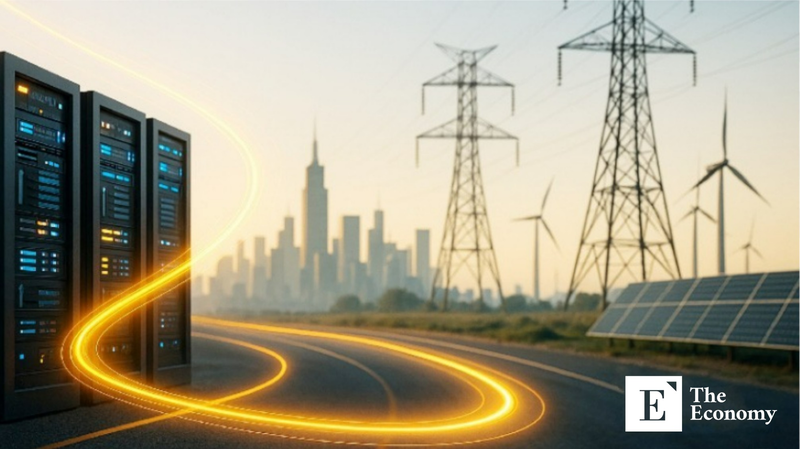
China’s electricity consumption has surpassed 10 trillion kilowatt-hours (kWh) annually for the first time as a single country, reshaping the global energy landscape. As investment simultaneously expands across power grids, batteries, and power equipment to accommodate the rapid proliferation of artificial intelligence (AI) data centers, China is entering a phase of overwhelming cost superiority in power-intensive industries. As competition over electricity and energy costs intensifies beneath the surface of advanced technology rivalry, analysts increasingly argue that China is preemptively securing leadership in AI and next-generation industries at the infrastructure level.
Surging Power Demand Driven by AI Cloud and Tertiary Industries
On the 18th, China’s National Energy Administration announced that the country’s electricity consumption last year rose 5% year-on-year to 10.3682 trillion kWh. This marked the first time any single country has exceeded 10 trillion kWh in annual power consumption, cementing China’s position as the world’s largest electricity consumer since the early 2010s. The figure represents roughly one-third of total global electricity consumption, double that of the United States, and exceeds the combined annual consumption of the European Union, Russia, India, and Japan.
By year, growth has accelerated markedly since the 2020s. China’s annual electricity consumption increased 2.8% year-on-year in 2020 to 7.51 trillion kWh, followed by 8.31 trillion kWh in 2021, 8.84 trillion kWh in 2022, 9.2 trillion kWh in 2023, and 9.9 trillion kWh in 2024, sustaining a steady upward trajectory. Xinhua News Agency assessed that “this trend in electricity consumption, often regarded as a barometer of economic activity, offers an intuitive demonstration of the Chinese economy’s resilience and solid underlying strength.”
The primary driver of rising power demand has been AI and the digital economy. By sector, electricity consumption in tertiary industries, including AI cloud services, rose 8.2% year-on-year to 1.99 trillion kWh. Power usage in IT services surged 17% due to soaring demand for data centers and AI, while electricity demand from electric vehicle charging and battery swapping jumped 48.8%. Electricity consumption in secondary industries, which account for 60% of total usage, also increased by more than 5%, while residential power consumption rose 6.3% over the same period.
USD 560 Billion Power Infrastructure Investment Through 2030
To respond to the surge in electricity demand, the Chinese government has unveiled the largest power infrastructure investment plan in its history, committing a total of USD 560 billion through 2030. State Grid Corporation of China announced on the 16th in its mid- to long-term investment plan that it would “build a more intelligent and environmentally friendly power grid system to drive the transition to a new-type power system and promote broad-based industrial growth.” The plan also sets targets to expand average annual new installations of renewable energy capacity to 200 gigawatts and raise the share of non-fossil energy consumption to 25%.
The core of the plan lies in reinforcing transmission and distribution infrastructure that has lagged behind the rapid expansion of renewable generation. As of the end of last year, renewable energy installations accounted for more than 50% of China’s total power capacity, with solar and wind continuing to grow at world-leading rates and overtaking fossil fuels. However, repeated bottlenecks have emerged as grid investment failed to keep pace with generation capacity. China aims to eliminate constraints across the entire cycle—from generation to transmission, distribution, and final consumption—to enhance the stability of renewable power integration.
Specifically, China will accelerate the construction of ultra-high-voltage direct current (HVDC) transmission networks. With energy resources concentrated in the west and demand clustered in the east, high-capacity long-distance transmission is essential. By the end of 2025, nationwide transmission capacity is set to increase by more than 30%. Investment in distribution networks will also expand. While transmission serves as the arteries that move electricity over long distances, distribution functions as capillaries delivering power to end users. State Grid plans to advance microgrid pilot projects to improve supply stability in remote and island regions.
Efforts to strengthen power balancing capabilities will proceed in parallel. Pumped-storage hydropower facilities will be strategically expanded, and next-generation energy storage systems (ESS) will be fostered as a new growth engine. By cultivating an industrial ecosystem encompassing battery cells, power conversion equipment, and system integration, China aims to secure both grid stability and industrial competitiveness. Reflecting rising demand from electric vehicle adoption, plans are also in place to build 35 million charging facilities. This strategy of simultaneously expanding generation, storage, and consumption infrastructure is widely interpreted as a comprehensive effort to structurally enhance the resilience of China’s power sector.
In tandem, China plans to strengthen the “East Data, West Computing” initiative by building data centers in western regions with abundant power resources and transmitting computing capacity to eastern coastal demand centers. Leveraging ample electricity supply and land availability, AI and cloud infrastructure will be concentrated in the west and connected via high-speed communications networks to serve eastern markets. Analysts view this as the full-scale launch of infrastructure investment to support large-scale AI model training and cloud service expansion. Alibaba and Huawei are expected to emerge as major beneficiaries of this AI infrastructure buildout.
Electricity Cost Gap Reshapes AI Competitiveness
Markets widely expect China to secure a low-cost, high-efficiency structure across electricity-intensive industries, underpinned by a robust power supply chain. As investment proceeds simultaneously in batteries, power equipment, and grids, costs across the full cycle—from generation and storage to consumption—are falling rapidly. With domestic firms capable of mass-producing core equipment such as ESS, transformers, and power conversion devices, China is creating a cost environment increasingly favorable to power-dependent industries.
This cost gap directly translates into AI competitiveness. Large-scale data centers and AI model training require vast amounts of electricity and stable energy storage, and China is rapidly internalizing this infrastructure. Chinese companies that command both power and battery supply chains are securing clear advantages in cost and delivery timelines for AI infrastructure, inevitably widening the gap with competing nations in service pricing and expansion speed. This underpins growing warnings that China may reshape the AI leadership race not merely through technological catch-up, but by tilting the playing field at the infrastructure level.
Moreover, once established, such structural advantages are difficult to reverse in the short term. While the United States and Europe are pursuing tariff hikes and supply chain restructuring, fields that require massive capital investment and long-term industrial accumulation—such as power equipment and batteries—will take considerable time to replicate. In the interim, China is likely to further reinforce economies of scale through its vast domestic market, expanding its global influence. As competition in AI and green industries increasingly extends into the realm of power access and energy costs, China’s impact on global industry is poised to grow even more pronounced.
Matthew Reuter is a senior economic correspondent at The Economy, where he covers global financial markets, emerging technologies, and cross-border trade dynamics. With over a decade of experience reporting from major financial hubs—including London, New York, and Hong Kong—Matthew has developed a reputation for breaking complex economic stories into sharp, accessible narratives. Before joining The Economy, he worked at a leading European financial daily, where his investigative reporting on post-crisis banking reforms earned him recognition from the European Press Association. A graduate of the London School of Economics, Matthew holds dual degrees in economics and international relations. He is particularly interested in how data science and AI are reshaping market analysis and policymaking, often blending quantitative insights into his articles. Outside journalism, Matthew frequently moderates panels at global finance summits and guest lectures on financial journalism at top universities.
Similar Post