Micron, Long a Perennial Third Player, Steps Up Pursuit of SK Hynix With Full Takeover of Taiwan Fab

Siobhán Delaney is a Dublin-based writer for The Economy, focusing on culture, education, and international affairs. With a background in media and communication from University College Dublin, she contributes to cross-regional coverage and translation-based commentary. Her work emphasizes clarity and balance, especially in contexts shaped by cultural difference and policy translation.
Authored On
Modified
Intensifying capacity race amid surging AI server demand
Micron acquires Taiwan fab for $1.8 billion
Full-scale DRAM mass production expected from the second half of next year
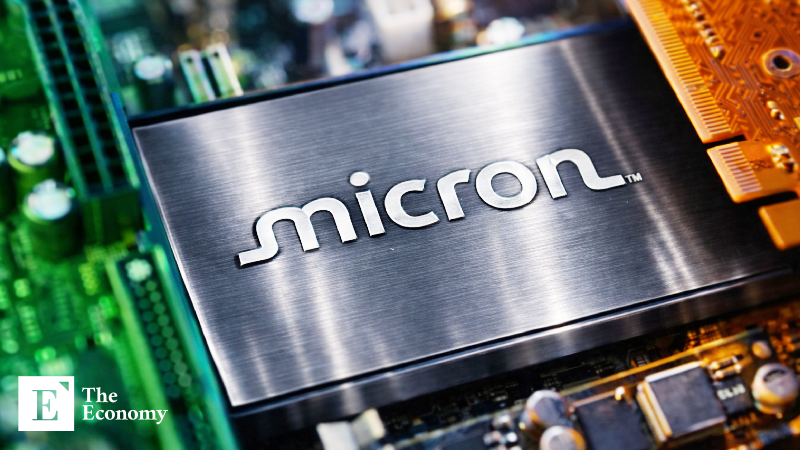
U.S. memory chipmaker Micron Technology has made a decisive move to expand its artificial intelligence (AI) memory production capacity by acquiring manufacturing facilities from Taiwan-based foundry Powerchip Semiconductor Manufacturing Corp. (PSMC). The bold acquisition underscores Micron’s intent to accelerate its pursuit of Samsung Electronics and SK Hynix amid an unprecedented surge in memory demand driven by AI workloads. While building a new fab typically requires five to seven years from site acquisition to mass production, leveraging an existing cleanroom enables Micron to establish stable production within roughly two years. With global memory demand rapidly intensifying, Micron is opting for speed to close the gap with the Korean memory leaders.
Micron Chooses Acquisition Over Greenfield Fab to Cut Time
On the 19th, Micron announced that it had signed a letter of intent to acquire PSMC’s P5 fabrication plant, located in Miaoli County, Taiwan, for $1.8 billion in cash. The assets included in the transaction comprise a 300mm wafer fab with approximately 300,000 square feet of cleanroom space. Micron expects the facility to enhance its ability to respond more reliably to expanding global memory demand. Manish Bhatia, Micron’s Executive Vice President of Global Operations, stated that in a market environment where demand continues to outstrip supply, the acquisition will allow Micron to increase output and deliver improved service to customers, adding that the proximity of the acquired facility to Micron’s existing plants would generate significant operational synergies.
Micron’s DRAM operations are understood to be split between research and development and partial production in Hiroshima, Japan, while large-scale mass production has been centered in Taiwan. The company began investing in Inotera Memories in 2008 to expand its front-end manufacturing base in Taiwan and acquired full ownership in 2016, turning the company into a wholly owned subsidiary. In 2013, Micron also secured full ownership of Elpida Memory through its bankruptcy restructuring, along with Elpida’s subsidiary Rexchip Electronics. Building on these production hubs, Micron has continued capacity expansion, including the opening of its Taichung Fab 4 in 2023.
The cooperative relationship between PSMC and Micron dates back to a period when Micron purchased output volumes held by Powerchip Technology, now PSMC. Late last year, the two companies reviewed three potential cooperation models: a pure foundry arrangement, a hybrid approach combining technology transfer and equipment relocation, and a distribution-linked model. Among these, the distribution-linked structure—under which PSMC would directly sell a portion of the memory wafers it produces—was widely viewed as the most advantageous option for PSMC.
AI-Driven Memory Shortage Fuels Price Surge
PSMC’s Tongluo fab, which Micron is acquiring, has a maximum monthly capacity of 50,000 wafers, but currently operates at just 20% utilization, with equipment installed for only around 8,000 wafers per month. For Micron, which urgently needs to expand production, the ability to add equipment to an already completed facility offers a far faster path to volume expansion than constructing a new fab from scratch. The transaction is expected to be finalized by the second quarter of this year, pending regulatory approvals and other procedural requirements. Once completed, Micron will secure full ownership as well as operational and managerial control of the facility.
The underlying driver of Micron’s aggressive expansion is the rapid proliferation of AI. Memory markets are experiencing acute supply tightness as AI server demand surges, making capacity 확보 in DRAM and high-bandwidth memory (HBM) a critical competitive differentiator. According to DRAMeXchange, the average fixed contract price for PC DRAM (DDR5 16GB) reached $20.8 at the end of last month, a 5.3-fold increase from a year earlier. The DDR5 price, which stood at $5.1 at the end of June last year, climbed nearly fourfold in just six months. Fixed contract prices, widely used in business-to-business transactions, directly affect the earnings of both chipmakers and system vendors. DRAMeXchange projects that PC DRAM prices will rise a further 55% to 60% quarter-on-quarter in the first quarter of this year.
The memory market has become markedly more volatile amid massive AI data center investment. As manufacturers concentrate resources on high-performance products such as HBM, output of commodity DRAM and NAND has been reduced, with some lines slated for eventual shutdown. This has further exacerbated supply-demand imbalances. Server vendors, constrained by shortages of next-generation AI GPUs, remain determined to secure even general-purpose products such as DDR5 to sustain infrastructure expansion. At the same time, cloud service providers are accelerating procurement of high-capacity solid-state drives to accommodate rapidly growing data storage and processing needs.
U.S.-Backed ‘40% DRAM’ Ambition Takes Shape
Alongside the Taiwan acquisition, Micron has also launched a $100 billion “megafab” project this month in Clay, Onondaga County, New York. Comprising four fabs, the complex will feature cleanroom space equivalent to 40 soccer fields, marking the largest private investment in New York State’s history. Construction of the first fab is scheduled to begin later this year, with operations targeted for the end of 2030, while the overall project will be rolled out sequentially through 2045.
The megafab initiative aligns with the semiconductor self-sufficiency strategy of the Donald Trump administration. Under the CHIPS and Science Act, the U.S. government has finalized $6.165 billion in subsidies for Micron’s new fabs in New York and Idaho. The objective is to raise the U.S. share of global DRAM production from under 2% today to 40% within the next decade. If large-scale subsidies, tax incentives, and preferential government procurement are combined, the competitive landscape could shift in ways that transcend conventional market logic. Analysts view this as a calculated effort by the United States—having already laid self-reliance foundations in logic chips and foundry operations—to complete the final piece of the semiconductor puzzle in memory.
For now, Korean memory manufacturers continue to dominate. Samsung Electronics posted operating profit of $20 billion in the fourth quarter of 2025, the highest quarterly result in its history, with memory accounting for a substantial portion. SK Hynix is also projected to deliver operating profit of approximately $15 billion in the same period, as both companies benefit from the AI server and HBM boom. According to Counterpoint Research, as of the third quarter of 2025, HBM market share stood at 57% for SK Hynix, 22% for Samsung Electronics, and 21% for Micron, underscoring the commanding lead held by Korean firms.
In the broader DRAM market, however, the gap has narrowed, with SK Hynix at 34%, Samsung Electronics at 33%, and Micron at 26%. Micron reported revenue of $13.6 billion in the first quarter of its 2026 fiscal year (September to November 2025), up 57% year-on-year, and guided for second-quarter revenue of $18.3 billion to $19.1 billion, sustaining strong momentum. With U.S. policy support set to gain traction, market observers suggest that the competitive balance could begin to shift meaningfully after 2030.
Siobhán Delaney is a Dublin-based writer for The Economy, focusing on culture, education, and international affairs. With a background in media and communication from University College Dublin, she contributes to cross-regional coverage and translation-based commentary. Her work emphasizes clarity and balance, especially in contexts shaped by cultural difference and policy translation.
Similar Post