Defensive no more: global liquor inventories pile up as young consumers go sober

Aoife Brennan is a contributing writer for The Economy, with a focus on education, youth, and societal change. Based in Limerick, she holds a degree in political communication from Queen’s University Belfast. Aoife’s work draws connections between cultural narratives and public discourse in Europe and Asia.
Authored On
Modified
Global liquor makers’ inventories pile up as COVID-era output surge backfires
Shifting consumer trends erode alcohol’s role as a traditional defensive stock
Demand pivots to non-alcoholic drinks, accelerating industry reshuffle
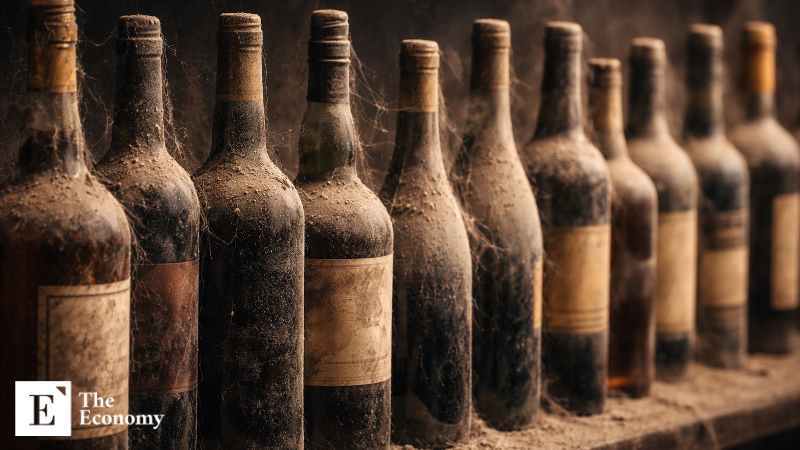
Global liquor companies are struggling to work through excess inventories, as producers that sharply ramped up output to meet surging demand during the COVID-19 pandemic are now facing a backlash from shifting consumer trends. In the market, there is a growing view that the global alcohol industry has entered a phase of structural change, pressured by economic slowdown and a rising preference for non-alcoholic beverages among younger consumers.
Global liquor industry faces inventory “emergency”
On the 18th (local time), the Financial Times reported that demand for Scotch whisky, whiskey, cognac, and tequila has fallen at a record pace, leaving liquor companies with massive stockpiles of aged spirits. The report said producers are being forced to temporarily shut distilleries and cut prices to clear bottles piling up in warehouses. According to company filings, the combined inventories of aged spirits held by five of the world’s largest listed liquor groups—Diageo, Pernod Ricard, Campari, Brown-Forman, and Rémy Cointreau—stand at about $22 billion, the highest level in the past decade.
Inventories are particularly heavy at Rémy Cointreau, a traditional French cognac house, where aged stock totals roughly $1.9 billion, nearly twice its annual revenue and close to its market capitalization. As of March last year, Rémy’s annual revenue stood at about $960 million. Diageo, maker of the Johnnie Walker range, has also seen the share of aged inventory relative to annual revenue jump from 34% in fiscal 2022 to 43% last year. Trevor Stirling, an analyst at Bernstein, said the scale of inventory accumulation is unprecedented, adding that current stock levels far exceed those built up after the global financial crisis.
The buildup of inventories is widely attributed to the pandemic-era drinking boom. Liquor producers expanded output aggressively to meet surging demand during COVID-19, only to face a sharp reversal as economic conditions cooled after the pandemic. With high inflation and slowing growth squeezing disposable incomes, demand for alcoholic beverages has weakened. Producers have since begun offloading existing whiskey stocks and halting production. Japan’s Suntory shut a key Jim Beam bourbon distillery in Kentucky for more than a year, while Diageo has suspended whiskey production at facilities in Texas and Tennessee until this summer.
Losing the hallmark “stability” of a defensive stock
The market is focusing on how the liquor industry—once seen as a classic defensive sector—has run into trouble alongside the economic downturn. Defensive stocks are industries believed to deliver relatively steady results regardless of the business cycle and are therefore considered less sensitive to economic conditions. Their share prices typically fall less when the economy weakens and rise less when conditions improve, meaning their overall volatility tends to be lower. Sectors commonly viewed as defensive include consumer staples and food, healthcare and pharmaceuticals, telecommunications, alcohol, tobacco, electricity, gas, retail, and energy.
These traits were clearly visible in the U.S. market in early 2025, before the artificial intelligence investment boom fully took hold. The S&P 500, which tracks the share-price performance of the 500 largest U.S.-listed companies, slipped into a correction in the first quarter of 2025, falling 4.6%. The drop reflected broader volatility as concerns over stretched valuations—especially in technology—combined with fears of slowing growth.
Over the same period, however, sectors typically classified as defensive—such as healthcare, consumer staples, and utilities—posted returns of 6.1%, 4.6%, and 4.1%, respectively, outperforming the broader index. As volatility rose, investor preference tilted toward defensive names whose earnings estimates tend not to swing sharply. An investment banking source said defensive sectors in early 2025 “limited downside even during an index decline, supported by demand for essentials and stable cash flows,” adding that “while their presence later faded as the market narrative shifted toward AI, their defensive strength during the correction was clearly evident.”
Shifts in alcohol consumption trends
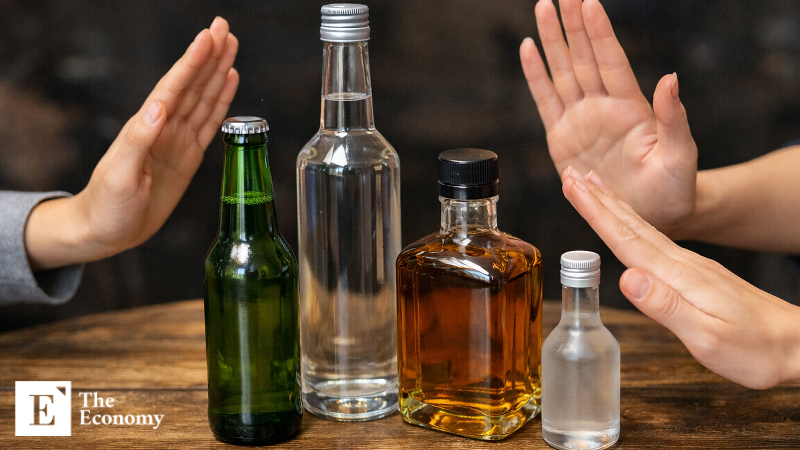
The global liquor industry, however, has failed to display its traditional defensive characteristics and instead slumped alongside the economic downturn. The decline reflects a drop in overall alcohol consumption, driven by trends such as the “healthy pleasure” movement spreading among younger generations worldwide. OECD data show that per-capita alcohol consumption in many member countries has been on a steady decline since 2011. Gallup has also reported that the share of Americans aged 18 to 34 who say they currently drink alcohol fell from 59% in 2023 to 50% as of August last year. Against this backdrop, global alcohol sales volume in 2024 totaled 47.72 billion bottles, down about 4% from 49.68 billion bottles in 2018, according to estimates by UK-based drinks market research firm IWSR, based on a standard 500ml bottle.
Demand from consumers leaving the traditional alcohol market has shifted toward non-alcoholic beverages, effectively reshaping the industry landscape. Changes in Germany—often dubbed the “land of beer”—clearly illustrate this shift. According to Germany’s Federal Statistical Office, beer sales in the country totaled about 6.8 billion liters in 2024, down roughly 2% from the previous year and 13.7% compared with 2014. By contrast, sales of non-alcoholic beer showed clear growth, as perceptions spread—especially among younger consumers—that alcohol-free beer is a healthy everyday drink. In response, German breweries have been rolling out new non-alcoholic beer products and stepping up related investment. Production of non-alcoholic beer in Germany rose from 300 million liters in 2014 to about 600 million liters in 2024.
The non-alcoholic trend is also evident in the strategies of major liquor companies. Global brewers have launched alcohol-free versions of flagship brands, including Heineken 0.0, Guinness 0.0, and Budweiser Zero, to capture younger consumers. Diageo entered the segment as early as 2019 with the acquisition of Seedlip, the world’s first non-alcoholic distilled spirit. According to IWSR, the global non-alcoholic beverage market is projected to grow at an annual rate of 7% through 2028, surpassing $4 billion in size.
Aoife Brennan is a contributing writer for The Economy, with a focus on education, youth, and societal change. Based in Limerick, she holds a degree in political communication from Queen’s University Belfast. Aoife’s work draws connections between cultural narratives and public discourse in Europe and Asia.
Similar Post
















