[U.S. defense industry] Korean shipbuilders expand in U.S. defense market on MASGA boost, pro-U.S. bloc push seen as next catalyst

Aoife Brennan is a contributing writer for The Economy, with a focus on education, youth, and societal change. Based in Limerick, she holds a degree in political communication from Queen’s University Belfast. Aoife’s work draws connections between cultural narratives and public discourse in Europe and Asia.
Authored On
Modified
Korean shipbuilders move to enter U.S. Navy warship programs head-on, beyond MASGA
Push accelerates despite steps to expand U.S. production capacity, including shipyard acquisitions
With Trump administration signaling a pro-U.S. economic bloc, shipbuilding alliance seen strengthening
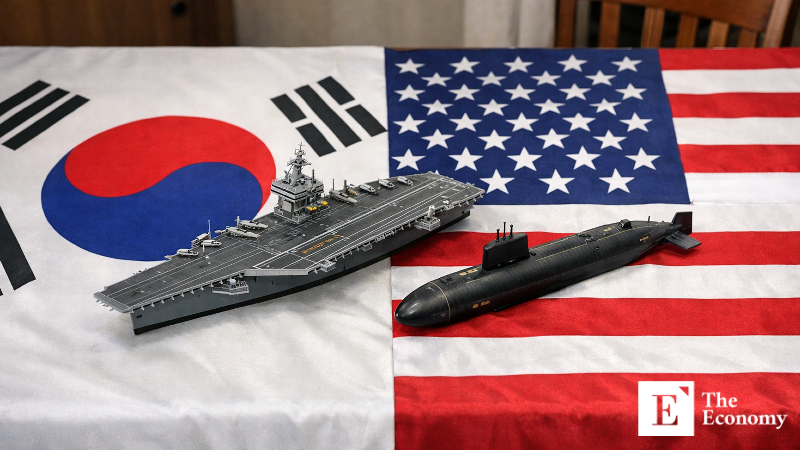
The MASGA project—short for “Make American Shipbuilding Great Again,” a symbol of U.S.-Korea shipbuilding cooperation—is gradually taking clearer shape. Major Korean shipbuilders including HD Hyundai, Hanwha Group, and Samsung Heavy Industries are moving into U.S. Navy warship programs in quick succession, expanding their presence in the local defense industry. With Washington recently signaling its intent to build a pro-U.S. economic bloc with allies, expectations are growing that the bilateral shipbuilding partnership will become even more entrenched going forward.
K-Shipbuilding takes on U.S. Navy warship programs one after another
According to the shipbuilding industry on the 21st, the companies currently at the forefront of a joint Korea-U.S. naval shipbuilding effort are HD Hyundai and Huntington Ingalls. The two firms have decided to jointly bid for the concept design tender for the U.S. Navy’s next-generation logistics support ship. The plan is for Huntington Ingalls’ yard to build the vessel based on HD Hyundai’s design drawings, key components exported to the United States, and shipbuilding know-how.
Hanwha Group is seeking to compete for the U.S. Navy’s next-generation frigate program through Hanwha Philly Shipyard in Philadelphia. The project is part of the “Golden Fleet” initiative and centers on building new frigates based on the Legend-class design with a budget of about $25 billion. U.S. President Donald Trump has previously said he would create a Golden Fleet to preserve America’s military edge and rebuild U.S. shipbuilding, and in connection with the initiative he explicitly stated that he would “work with Hanwha, a Korean company.”
Samsung Heavy Industries is also entering the U.S. next-generation logistics support ship program, worth up to $5 billion, together with NASSCO, a subsidiary of General Dynamics. The two companies also plan to gradually expand cooperation in government-ordered vessels and commercial ships. Commenting on the partnership, Brett Hershman, NASSCO’s director of business development, said, “We plan to incorporate Samsung’s latest design and shipbuilding technologies and methods,” adding that they are also “considering options for skilled Korean workers to work in the U.S. or provide training.”
Hanwha moves to expand its U.S. production base
Korean shipbuilders are also stepping up efforts to build out on-the-ground production capacity in the United States. HD Hyundai is reviewing options to acquire a U.S. shipyard or make joint infrastructure investments with Huntington Ingalls to establish a domestic production base. Michael Coulter, CEO of Hanwha Defense USA, said in an interview with The Wall Street Journal on the 8th (local time) that Hanwha’s two docks in Philadelphia alone would be insufficient to meet future manufacturing demand, adding that the company is considering ways to expand both production capacity and storage space. Hanwha Defense USA is a U.S. subsidiary that oversees Hanwha Group’s defense business in the country.
Hanwha previously invested $100 million on Dec. 1, 2024, to acquire Philly Shipyard in Philadelphia, Pennsylvania, but the yard’s current annual shipbuilding capacity stands at only around one to 1.5 vessels. Capacity is not yet a constraint given the limited order book, but constraints are expected to become more pronounced if Hanwha secures licenses to build U.S. military vessels and wins more Navy contracts. A report by the Federation of Korean Industries titled “Analysis of the U.S. Shipbuilding Industry and Implications for Korea-U.S. Cooperation” forecasts that, driven by the U.S. government’s MASGA push, orders for 403 to 448 vessels—including commercial ships, LNG carriers, and Navy warships—could be placed through 2037.
Against this backdrop, Hanwha plans to expand Philly Shipyard’s dry docks—from one to four—and enlarge the shipyard site. The goal is to develop the Philadelphia yard into a facility comparable to Hanwha Ocean’s Geoje complex, which produces more than eight vessels a year per dock. If the plan materializes, annual output at Hanwha Philly Shipyard would rise from 1.5 vessels to 20. Hanwha also said it is considering acquiring another U.S. shipyard within the next few years to handle overflow orders.
Trump’s push for a “pro-U.S. economic bloc”
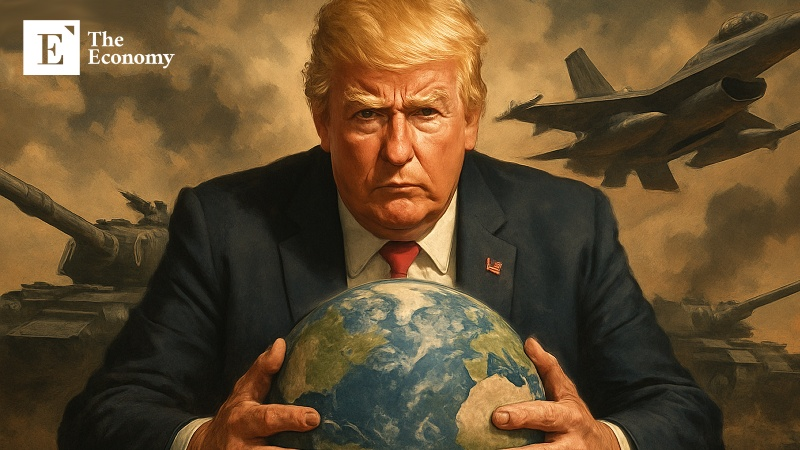
This Korea-U.S. shipbuilding cooperation framework is expected to solidify further going forward, as the U.S. government has recently signaled an intent to build a pro-U.S. economic bloc and hinted at deeper cooperation with allies. In its Agency Strategic Plan (ASP) for fiscal years 2026–2030, released on the 15th, the U.S. State Department said it would “drive commercial deals in every bilateral relationship and negotiation” to encourage allies and partners to prioritize U.S. companies and solutions, adding that it would “create a strong economic bloc of pro-U.S. countries” that leverages U.S. firms and exports.
According to the document, this pro-U.S. economic bloc would bear part of the cost of reviving U.S. manufacturing. The State Department said it aims to establish new economic security agreements across the bloc and create new industries and opportunities through critical infrastructure projects, arguing that the bloc would fund U.S. “reindustrialization” by purchasing an American technology stack and defense systems and ensure U.S. economic and technological leadership throughout the 21st century.
To achieve these goals, the U.S. plans to intensify “commercial diplomacy.” The State Department instructed overseas missions worldwide to support U.S. companies in winning key project contracts and bids from foreign governments, naming AI, energy, weapons systems, capital markets, and advanced manufacturing as priority areas. It also directed missions to actively intervene to block or replace Chinese companies’ participation in bids.
In addition, the U.S. government has repeatedly emphasized that it should share its defense industrial base (DIB) with allies. The document said it would deepen relationships with allies and encourage them to increase their own defense spending, and in return expand allies’ access to a revitalized defense industrial base. Referring to alliances in the Indo-Pacific and Europe, it added that an integrated defense industrial base with allies would provide the U.S. and its partners with strategic production depth in the event of conflict—effectively pressing allies to spend more on defense while offering access to advanced U.S. defense technologies as an incentive.
Aoife Brennan is a contributing writer for The Economy, with a focus on education, youth, and societal change. Based in Limerick, she holds a degree in political communication from Queen’s University Belfast. Aoife’s work draws connections between cultural narratives and public discourse in Europe and Asia.
Similar Post