Fraudulent Mechanics Hidden Behind the Banner of Decentralization: Trump Coin Crashes 93% as Meme Coin Frenzy Fades

Authored On
Modified
Trump meme coin once priced at nearly $75 now trades around $5
Melania Trump’s token down 99%
Narrative-driven pricing eclipses fundamentals, leaving pervasive fraud risk
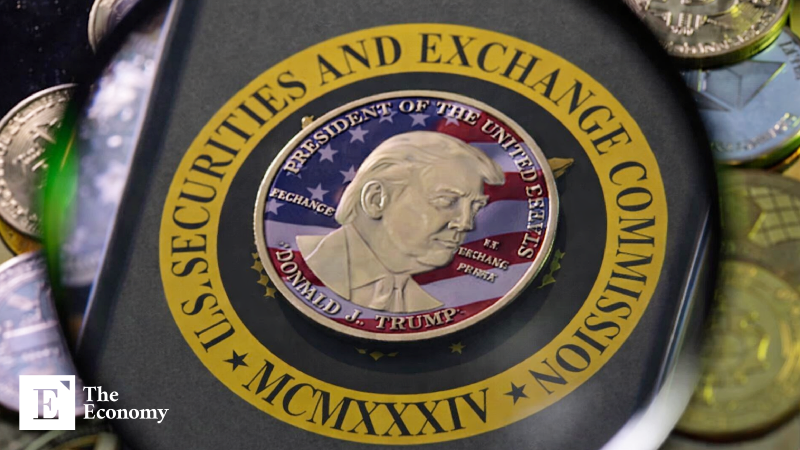
The meme coin bearing the name of U.S. President Donald Trump has plunged more than 90% from its peak a year ago, underscoring the rapid cooling of speculative fervor surrounding cryptocurrencies. Most meme coins that flooded the market during the boom have since lost trading liquidity and are sliding toward effective extinction, laying bare the structural fragility and speculative mechanics embedded across the crypto ecosystem.
Massive Losses for Trump Meme Coin Investors
According to CoinMarketCap on the 21st (local time), the $TRUMP token is currently trading at around $5. The coin was launched in January last year ahead of President Trump’s inauguration and surged to an intraday high of $75.35 on January 19, before collapsing by roughly 93%. A similar fate befell the $MELANIA token introduced by First Lady Melania Trump, which climbed to $13.73 on January 20 last year before plunging nearly 99% to about $0.15 within a year.
Since beginning his second term, President Trump has actively courted the crypto industry, appointing pro-crypto regulators and granting pardons to individuals convicted of crypto-related offenses. This shift coincided with the Trump family launching multiple crypto ventures. Critics, however, have denounced these moves as an exercise in easy profiteering and an abuse of presidential authority. Allegations of insider trading and abrupt price collapses have further eroded investor confidence, replacing early enthusiasm with deep skepticism. The Financial Times noted that the collapse of Trump-linked meme coins has saddled investors who bought near the peak with substantial losses.
By contrast, crypto-related businesses tied to the Trump family have reportedly generated more than $1 billion in pre-tax revenue. While the precise distribution of proceeds from the two tokens has not been disclosed, the Financial Times estimates that $TRUMP and $MELANIA together generated $427 million through sales and transaction fees. CoinMarketCap data also show that despite the sharp price decline, $TRUMP remains the fifth-largest meme coin by market capitalization.
A Meme Coin Market Built on Speculative Narratives
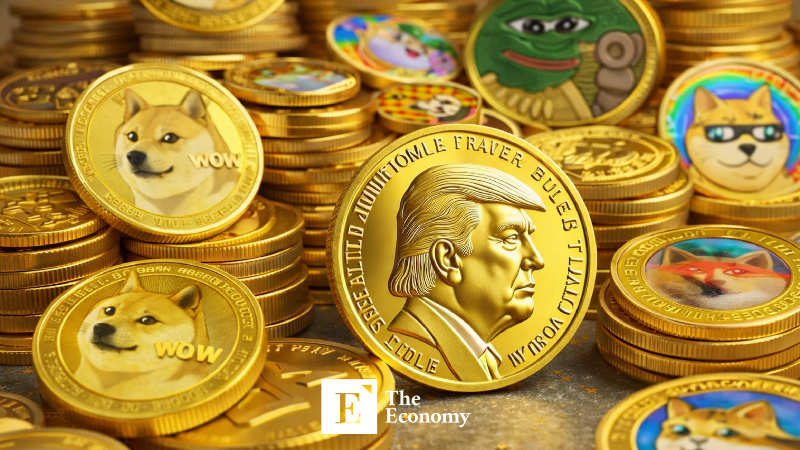
Meme coins are inherently high-risk assets, lacking clear business models or cash flows and relying instead on notoriety and viral appeal. Speculative demand for such tokens surged from late 2023 through early 2024, fueling the rapid proliferation of projects such as Dogecoin (DOGE), Shiba Inu (SHIB), and Pepe (PEPE). Unlike conventional blockchain initiatives that derive value from technical utility—such as smart contract enhancements or network performance—most meme coins offer no concrete use cases or development roadmaps. Their prices are driven almost entirely by community sentiment and speculative expectations.
A key factor bolstering meme coin appeal has been their perceived alignment with the blockchain ethos of decentralization. As the crypto market expanded, many projects backed by prominent venture capital firms allocated substantial portions of token supply to investors. Even with lock-up periods, the prospect of eventual sell-offs has raised concerns over price instability and de facto centralization.
Meme coins, by contrast, often emphasize ostensibly fair distribution. For example, Cat in a Dogs World (MEW) allocated 90% of its supply to a decentralized exchange liquidity pool and distributed the remaining 10% via airdrops to the Solana community. Bonk (BONK) reportedly airdropped 50% of its supply to Solana users. This model was amplified by Pump.fun, a Solana-based meme coin issuance platform that enables users to launch tokens with minimal barriers, resulting in tens of thousands of new meme coins being created daily. High-profile tokens such as Peanut (PNUT) and Goatseus Maximus (GOAT) also emerged from this platform.
Ninety-Seven Percent of Meme Coins Rendered Worthless, Increasing Use as Fraud Vehicles
Speculative enthusiasm has since evaporated. Binance data show that as of November last year, 97% of issued meme coins recorded zero trading volume. Overall meme coin trading volume has collapsed by 65% year-on-year, pushing total market capitalization down to $35 billion. This compares with roughly $100 billion at the end of 2024, meaning the sector’s value has shrunk to nearly one-third within a year.
The contraction reflects retail investors withdrawing from highly volatile speculative assets as risk aversion intensifies. The implosion of meme coin market capitalization—long viewed as a barometer of crypto risk appetite—signals a more cautious investment environment marked by tightening capital inflows. Although the market has recently staged a modest rebound to around $30 billion in capitalization, the recovery has been insufficient to reverse the broader downtrend.
The downturn has been exacerbated by a growing number of fraud cases involving meme coins. U.S. influencer Haliey Welch launched the Hawk Tuah (HAWK) token based on her online popularity, only for the price to collapse 91% within three hours, prompting investigations into alleged insider trading. Jamaican-American singer Sean Kingston released the King (KING) token, which briefly reached a $4 million market capitalization before plunging to $400,000 within minutes.
In other cases, developers of newly issued meme coins have retained large token allocations, sold them en masse after prices surged, and subsequently abandoned the projects. While tokens listed on major exchanges undergo baseline vetting, early-stage meme coins traded on decentralized exchanges offer virtually no investor protection. Some estimates suggest that one out of every six meme coins is an outright scam designed to siphon investor funds. Crypto analyst Andy Lian observed that President Trump’s meme coin launch blurred the boundaries between entertainment, politics, and finance, placing the U.S. Securities and Exchange Commission at a crossroads between tightening enforcement and establishing clearer regulatory frameworks to address market realities.
Similar Post